



Why Mercedes Radiator Material Choice Affects Cooling and Service Life
Why Mercedes Radiator Material Choice Affects Cooling and Service Life
The material used in a Mercedes radiator is not a cosmetic detail, and it is not only about weight or cost. It changes how quickly heat moves out of the coolant, how well the core survives thermal cycling, how the unit responds to vibration, and how easy it is to repair once the vehicle has already seen years of service. That is why two radiators with similar external dimensions can behave very differently in real use, especially in fleets, heavy-duty applications, and vehicles exposed to long idle periods, stop-and-go traffic, or high ambient temperatures.
A lot of buyers assume the question is simple: aluminum is modern, brass is old, and newer automatically means better. In practice, the answer is more specific than that. Mercedes cooling systems are engineered around airflow, coolant flow, pressure control, and packaging constraints. The radiator material has to work inside that system. A poor material match does not always fail immediately. More often, it shows up as marginal cooling, repeated small leaks, solder or braze fatigue, or a shorter service interval than expected.
For anyone evaluating a Mercedes radiator replacement, especially for commercial or long-service vehicles, the useful question is not “Which material is best in general?” It is “Which material and construction are appropriate for this vehicle’s duty cycle, repair expectations, and operating environment?”
Material choice changes how heat leaves the system
At the most basic level, a radiator core has one job: transfer heat from coolant to air. But material affects more than raw thermal conductivity. It also influences wall thickness, fin design, joining method, corrosion behavior, and how densely the core can be packaged. In other words, the radiator does not cool better just because one metal looks better on paper. The entire core design matters.
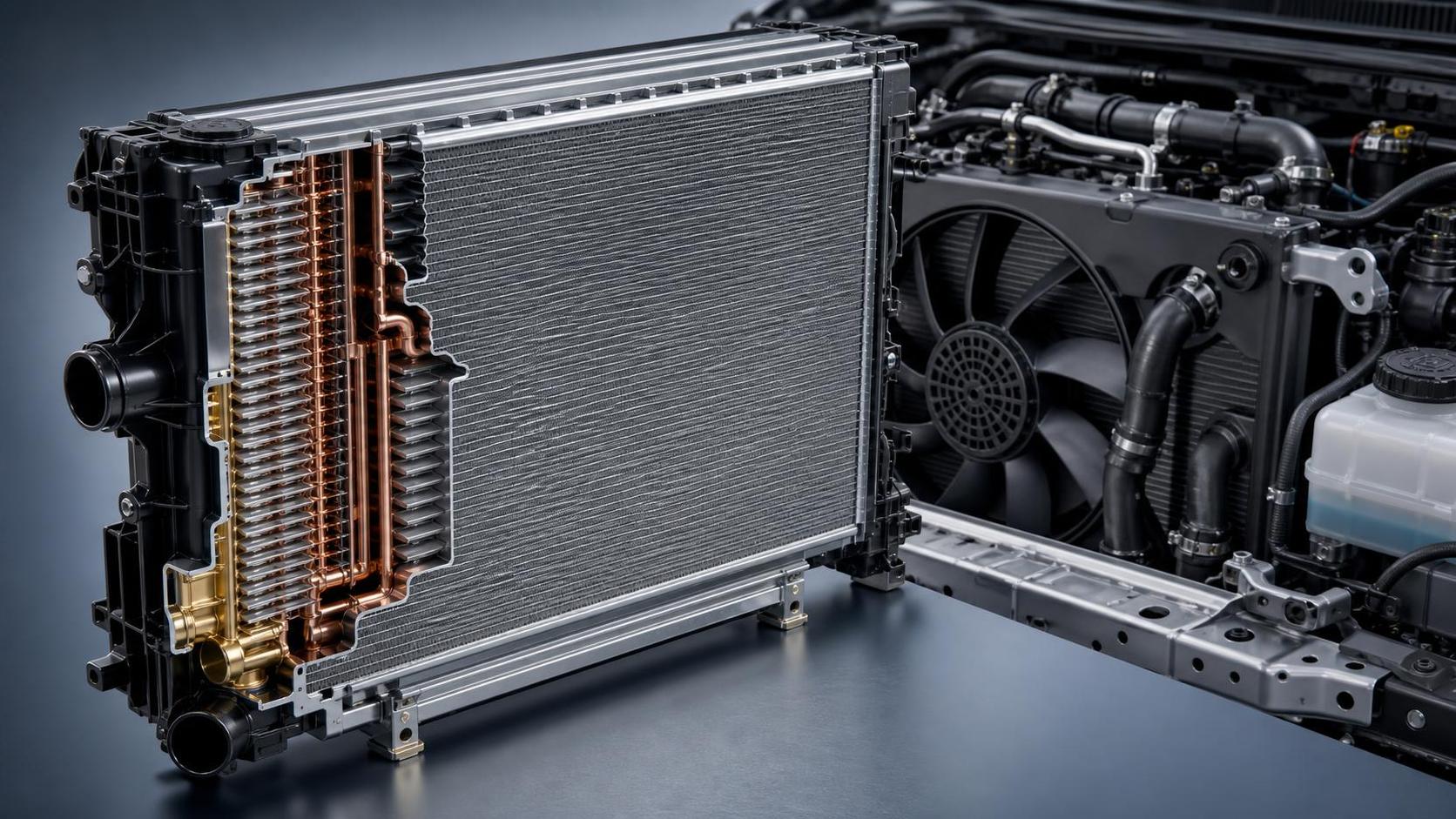
Aluminum radiators are now common across passenger vehicles and many commercial platforms because they support lightweight construction and efficient mass production. They also fit well with modern brazed core designs, where thin tubes and fins create a large heat-transfer area. When the design is done properly, an aluminum Mercedes radiator can deliver strong cooling performance while reducing overall system weight.
Brass and copper-brass constructions, which were more common in older systems, behave differently. Copper has strong heat transfer properties, and brass tanks or components can be easier to repair in some workshop environments. That is one reason these materials remained attractive for certain heavy-duty or repair-oriented applications. But they are generally heavier, and older designs may not match the packaging efficiency of modern aluminum assemblies.
So when people talk about a Mercedes radiator “cooling better,” they often compress several issues into one phrase. The real evaluation should include core architecture, fin density, tube geometry, air-side resistance, and whether the material supports a stable structure under repeated heating and cooling.
Why service life is often decided by corrosion and stress, not heat alone
Radiators rarely live in ideal conditions. They sit in a hostile environment: hot coolant inside, road salt and moisture outside, continuous vibration, and pressure pulses from the cooling circuit. In that setting, service life depends heavily on how the chosen material handles corrosion and mechanical fatigue.
Aluminum can perform very well, but it is sensitive to coolant quality and galvanic corrosion if the wider system is not properly maintained. Mixed metals elsewhere in the circuit, contaminated coolant, or extended service intervals can accelerate internal attack. This is where many buyers misread the problem. They blame the radiator material alone when the actual cause is chemical imbalance or neglected cooling system maintenance.
Brass and copper-brass units are not immune either. Soldered joints can age, vibration can weaken connection points, and added mass can place different loads on mounts and surrounding structure. In some operating conditions, particularly where vehicles see rough roads or long hours of engine vibration, joint durability matters just as much as the core metal itself.
For Mercedes applications, especially where thermal loads are consistent and packaging is tight, the durability question often comes down to manufacturing quality: braze integrity, material grade, tank-to-core sealing, and how well the radiator module was designed for the vehicle’s real thermal and mechanical profile.
Not every Mercedes radiator serves the same kind of vehicle
One reason material discussions become confusing is that “Mercedes radiator” covers very different use cases. A passenger vehicle radiator, a heavy truck cooling assembly, and a module integrated with intercooler or new energy thermal management components do not face the same demands. Even within one brand family, the thermal load profile can vary sharply.
In heavy trucks, extended engine load, cargo weight, and long operating hours make durability and stable heat rejection especially important. Construction machinery adds dust, vibration, and harsher working conditions. New energy radiator modules introduce another layer of complexity because battery and power electronics cooling may require different design priorities from conventional engine systems.
This is where specialized manufacturers tend to develop practical judgment. Liaocheng Xinde Auto Parts Co., Ltd., established in 2018, focuses on the research, production, and global sales of water tank radiators, intercoolers, construction machinery radiators, and heavy truck as well as new energy radiator modules. In sectors like these, material choice is rarely treated as an isolated spec. It is tied to system layout, vehicle class, and expected service conditions. That is the right way to read the issue.
A quick comparison that actually helps
This table should not be read as a ranking. It is a reminder that material only becomes meaningful when viewed together with design method and use case.
Common misunderstandings in replacement decisions
One common mistake is treating thickness as a direct sign of cooling quality. A thicker Mercedes radiator may hold more material or appear more robust, but if airflow drops or fin design is poor, the result is not automatically better cooling. Heat exchange depends on balance. More core is only helpful if air can move through it effectively and the coolant path is properly engineered.
Another misunderstanding is assuming all aluminum radiators are effectively the same. They are not. Alloy selection, brazing quality, tube design, header strength, and plastic or metal tank integration all affect reliability. Two products can look similar online and behave very differently after installation.
There is also a tendency to separate radiator life from maintenance habits. In real workshops, coolant type, change interval, contamination, and system flushing practice have a direct impact on the service life of the radiator. Material choice matters, but neglect can shorten the life of either aluminum or brass-based systems.
What professionals actually check before judging suitability
When experienced buyers or technical teams evaluate a replacement radiator, they usually go beyond the label. They look at whether the unit matches the original application in core size, mounting geometry, connection layout, and cooling circuit compatibility. They also ask what kind of duty the vehicle sees: urban stop-start traffic, highway distance, heavy haul, construction-site operation, or high-temperature regional use.
Material comes into that discussion through practical questions:
- Will the radiator resist the expected vibration and pressure cycling?
- Is the core design appropriate for the available airflow?
- Does the cooling system maintenance standard support this material choice?
- Is repairability important, or is full module replacement the normal service path?
- Does the supplier have experience with heavy truck, intercooler, or integrated radiator module production rather than generic aftermarket supply?
Those questions usually lead to better decisions than asking for the “best material” in isolation.
Where the industry is heading
The broader direction is clear even if details vary by platform. Cooling systems are becoming more integrated, lighter, and more packaging-sensitive. That naturally favors modern aluminum-based module designs in many applications, particularly where space, fuel efficiency, and assembly consistency matter. At the same time, the demands placed on radiators are increasing, not decreasing. Higher thermal density means there is less room for poor material quality or weak joining processes.
For manufacturers working in heavy trucks, construction machinery, and new energy radiator modules, this shift has pushed material selection closer to system engineering. It is no longer enough to choose a metal based on tradition or price alone. The supplier has to understand how that radiator will operate over time, under load, and under maintenance conditions that are often less than ideal.
A useful way to read the choice
If you are trying to understand why Mercedes radiator material choice affects cooling and service life, the short answer is this: the material determines part of the radiator’s thermal behavior, part of its structural durability, and part of its maintenance sensitivity. But the real-world result comes from how that material is engineered into the complete radiator.
That is why informed buyers do not reduce the discussion to aluminum versus brass. They examine the vehicle type, the cooling load, the service environment, and the manufacturing quality behind the radiator itself. In practice, that approach is far more reliable than chasing a single material as if it guarantees performance on its own.