



When should distributors source Benz radiators by chassis number
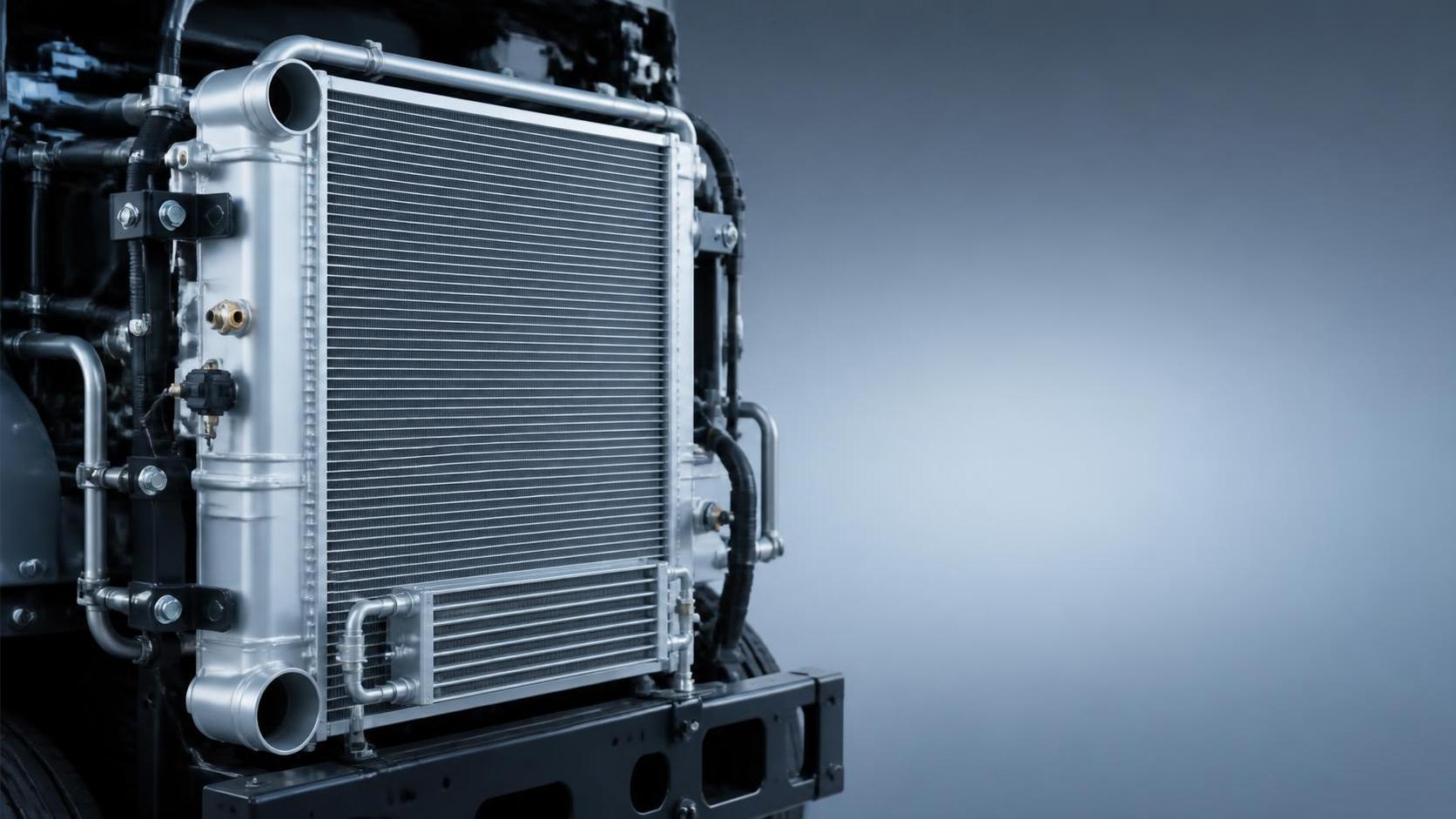
For distributors, sourcing a Benz radiator by chassis number becomes necessary long before a customer says, “The old one looks the same.” In heavy-duty cooling parts, visual similarity is one of the most expensive traps in the aftermarket. Two radiators may share the same core dimensions at first glance, yet differ in mounting points, hose angles, fan-shroud provisions, transmission cooler connections, sensor ports, or cooling capacity. A part can physically enter the vehicle and still be the wrong part.
The chassis number, usually captured through the vehicle identification number or a relevant chassis-based lookup, gives distributors a more dependable route to configuration-level verification. It is not required for every order. For repeat fleet applications with a well-documented OE reference, a distributor may work safely from the part number, model code, or a confirmed sample. But when the order involves uncertainty, mixed vehicle histories, cross-border registrations, or a costly return risk, chassis-based sourcing is usually the better commercial decision.
Why a Benz model name is often not enough
A vehicle description such as “Benz Actros radiator” or “Mercedes truck radiator” is useful only as a starting point. Commercial vehicles can have multiple cooling-package options within a model family. Engine output, emissions generation, climate specification, axle configuration, auxiliary equipment, gearbox arrangement, and production period may all affect the cooling assembly. In some cases, the radiator is paired with an intercooler, condenser, expansion tank, oil cooler, or a specific shroud system that changes the required design.
This is especially relevant in the replacement market, where the vehicle may no longer match its original build exactly. A prior repair could have introduced a different fan assembly, modified hose routing, or an alternative radiator with adapted brackets. If a buyer supplies only a photograph, distributors should treat it as supporting evidence rather than final proof. Photos reveal layout; they do not reliably confirm internal core specification or original vehicle configuration.
The practical question is not whether a chassis number is “better” than a part number. It is whether the information on hand is sufficient to prevent a wrong-fit sale. When it is not, the chassis number is the fastest way to move the discussion from guesswork to verification.
Situations where chassis-number sourcing should be the default
There are several order types where asking for the chassis number early is sensible rather than cautious.
- The customer cannot provide an OE number. Model name, engine family, and year can narrow the search, but they may not isolate one cooling configuration.
- The radiator has failed after a vehicle conversion or major repair. This includes engine work, transmission replacement, accident repair, or front-end reconstruction.
- The unit is for a truck operating under high thermal load. Long-distance hauling, construction use, hot-climate routes, and frequent idling place more emphasis on correct cooling capacity and airflow compatibility.
- The order is international. Market-specific configurations, export variants, and local body-builder changes can make catalogue matching less dependable.
- The order is urgent but expensive to reverse. Airfreight, workshop downtime, or remote delivery can turn one fitment error into a margin loss far larger than the time spent on confirmation.
- The buyer requests an equivalent rather than an exact replacement. “Equivalent” should be assessed against the original application, not assumed from external dimensions alone.
A common distributor mistake is waiting until a mismatch appears before requesting the chassis number. By then, the sales team is already negotiating a return, and the workshop may be holding the distributor responsible for lost installation time. It is generally easier to request vehicle details upfront than to explain later why the supplied radiator cannot be fitted without modification.
What the chassis number can clarify—and what it cannot
A chassis-based inquiry can help identify the original vehicle build and guide the search toward the relevant radiator reference. It can also reveal when apparently similar trucks were delivered with different engines, cooling systems, or production-series changes. For a distributor, that information is valuable because it supports a documented fitment decision rather than an informal judgement based on appearance.
Still, the chassis number is not magic. It does not automatically prove that the radiator currently installed is original, nor does it replace a basic physical check when a vehicle has been repaired or modified. A careful fitment process compares the chassis-based result with the failed unit and the vehicle’s present layout. Outlet and inlet positions, mounting brackets, overall dimensions, filler-neck arrangement, sensor provisions, and integrated cooling circuits should be checked where relevant.
This combined approach matters because an original-build lookup and the truck standing in the workshop can occasionally tell different stories. The right response is not to choose one source blindly. It is to identify why they differ before releasing stock.
The details that still need checking after a match
Once an application has been identified, distributors should resist reducing the job to a single catalogue line. Cooling-system parts are assemblies, and the small details are where returns often begin. A good verification sheet should include the radiator’s core size, tank material and layout, mounting-point geometry, hose diameter and direction, drain arrangement, sensor or switch ports, and the presence of any integrated cooler. If the unit is part of a stacked cooling pack, the relationship with the intercooler and condenser deserves attention as well.
Cooling performance also needs a practical reading. More rows or a thicker core is not automatically an upgrade if it interferes with the fan, shroud, charge-air cooler, or installation space. Likewise, a part that has the correct outer dimensions may not provide the same coolant flow path or heat-rejection capability as the original configuration. Distributors do not need to make unsupported performance claims; they do need to avoid presenting a merely similar radiator as a proven direct substitute.
The same discipline applies across a broader catalogue. A supplier that handles different vehicle programs, such as a Radiator for GM, may maintain separate reference and inspection processes for passenger, commercial, and export applications. That breadth can be useful, but it should never become a reason to mix fitment logic between platforms. Each vehicle family has its own connection patterns, mounting conventions, and service history.
How a Benz radiator supplier should support the distributor
The role of a Benz radiator supplier is not simply to quote a price against a vague vehicle description. The more useful supplier relationship is one where the supplier can ask the right questions before production or dispatch: Is there an OE reference? Is the chassis number complete? Is the old radiator available for comparison? Does the vehicle have an integrated oil-cooling circuit? Are there clear photographs of the mounting points and hose connections?
For distributors, response quality matters as much as catalogue size. A supplier that immediately promises compatibility without requesting missing information may appear fast, but that speed can be misleading. A technically responsible answer sometimes has to be conditional: the chassis lookup indicates one configuration, but the installed part shows a different connection layout; please confirm which assembly is actually required. That is not hesitation. It is fitment control.
Liaocheng Xinde Auto Parts Co., Ltd., established in 2018, focuses on the research, production, and global sale of water tank radiators, intercoolers, construction machinery radiators, related heavy-truck components, and new-energy radiator modules. With registered capital of 5 million RMB and total investment of 50 million RMB, the company has also received provincial and municipal recognitions including High-tech Enterprise, Civilized and Honest Enterprise, and Trustworthy Unit for Consumers. For a distributor assessing a potential manufacturing partner, such background is relevant, but the practical test remains application support: reference confirmation, drawing or sample comparison where needed, consistent communication, and clear handling of uncertain fitment.
Build the chassis number into the sales workflow, not just the claims process
The most effective distributors make chassis data part of their normal quotation process for higher-risk applications. A sales form can distinguish between “confirmed OE number,” “chassis number supplied,” and “visual match only.” This gives the team a simple way to decide whether the request can move directly to quotation or needs technical review. It also creates a record of what information supported the supply decision.
For stock planning, chassis-based sourcing can reduce the temptation to carry too many near-duplicate references. That does not mean holding less inventory in every case. Fast-moving radiator families still justify stock when demand is known. The point is to avoid filling shelves with variants that are difficult to distinguish at the counter and easy to mis-pick. Slow-moving or configuration-sensitive references are often better managed through verified sourcing and clear lead-time communication.
It is also worth training counter staff to ask for the complete chassis information rather than a partial number copied from a message. Incomplete entries, unclear photographs, and numbers transcribed from memory cause avoidable delays. A short request for the full number, current radiator photos, and any visible OE label is usually more productive than a long back-and-forth after a wrong item has been identified.
A sensible decision rule
Source a Benz radiator by chassis number whenever the vehicle configuration is uncertain, the original reference is missing, the truck has a complicated repair history, or the cost of a wrong part is high. Use the chassis result alongside a physical comparison, especially for older vehicles and modified installations. Where an OE number has already been confirmed and the application is familiar, chassis verification may be unnecessary—but it remains a useful safeguard when anything in the request does not line up.
In radiator distribution, the safest sale is not the one completed with the fewest questions. It is the one where the workshop receives a part that fits, connects correctly, and supports the cooling system the vehicle actually has.