



When does a higher-capacity vehicle radiator make sense
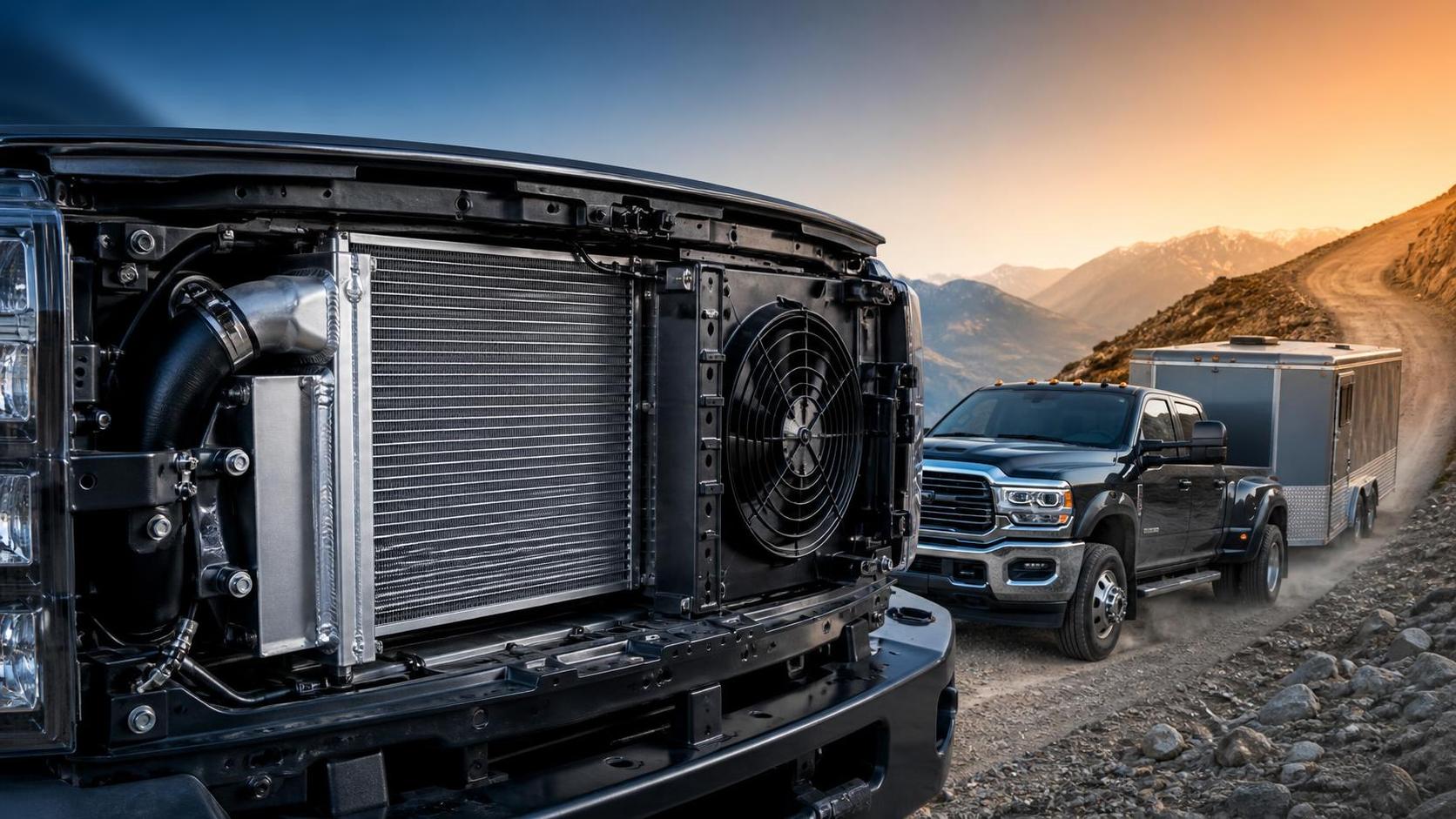
A higher-capacity vehicle radiator makes sense when the existing cooling system is repeatedly asked to reject more heat than it was designed to handle. That situation often appears during sustained towing, heavy cargo operation, steep grades, high ambient temperatures, extended idling, or dense stop-and-go traffic. In these conditions, a temperature gauge that rises slowly, frequent cooling-fan operation, coolant odor, or recurring loss of coolant can indicate that the system has limited thermal reserve.
The correct decision is not based on radiator size alone. A larger core can improve heat rejection, but only when coolant flow, airflow, fan performance, shrouding, pressure control, and engine condition are all compatible with the change. Replacing a sound, properly sized radiator with a much larger unit will not correct a blocked condenser, a slipping fan clutch, a sticking thermostat, combustion gases entering the cooling system, or an inaccurate temperature sensor.
Heat Load Must Be Higher Than Normal
An engine produces heat whenever it runs, and the cooling system transfers part of that heat from the coolant to outside air. Under light driving conditions, the original radiator may have ample capacity. The demand changes when the engine spends long periods under load without enough vehicle speed or cool intake air to support heat transfer.
Towing is a common example. Pulling a trailer increases engine load, transmission load, and often aerodynamic resistance. The radiator may also need to deal with heat from an integrated transmission cooler. Long uphill operation can be especially demanding because the engine remains under high load while airflow and road speed may be lower than expected. A higher-capacity radiator may be justified if the vehicle is mechanically sound but coolant temperature approaches the upper end of its normal operating range during these repeatable conditions.
Hot-climate operation creates a similar issue. The radiator can only transfer heat when its coolant temperature is higher than the air passing through the fins. When ambient air is already hot, that temperature difference becomes smaller. Air conditioning adds another layer: the A/C condenser sits in front of the radiator on many vehicles, warming the incoming air before it reaches the cooling fins. A cooling system that performs acceptably in mild weather may expose its limits during prolonged summer traffic with the A/C engaged.
Low-speed work matters as much as highway use. At highway speed, ram air moves through the grille and core. In traffic, at idle, or during slow site operation, airflow depends heavily on the fan, fan shroud, and the clearance between these parts and the radiator. A larger radiator without adequate fan coverage may add little benefit when heat problems occur mainly at low speed.
Capacity Is More Than a Larger Tank
Radiator capacity is often discussed as though it means coolant volume. Extra coolant volume can slow short temperature spikes, but it is not the main reason a larger radiator can handle more heat. The useful measure is the radiator's ability to transfer heat into the air stream over time.
Core dimensions affect that ability. A taller or wider core provides more frontal area for air to pass through. A thicker core can increase surface area and coolant tube length, although thickness has practical limits. If the core becomes too thick for the available fan and grille airflow, air resistance rises and the rear portion of the core may receive less effective flow. The best arrangement matches tube layout, fin density, thickness, and available airflow rather than simply maximizing one dimension.
Tube design also matters. Modern aluminum radiators commonly use wide, flat tubes that create a broad contact area between coolant and the tube wall. Fin geometry then transfers heat from the tube to air. Finer fin spacing can increase surface area, but it can also trap dirt more easily and restrict air when exposed to mud, insects, dust, leaves, or construction debris. A radiator selected for dusty service may need a core configuration that remains serviceable rather than an aggressively dense fin pattern.
Plastic side tanks with aluminum cores are common in many vehicles and can perform well when correctly designed. All-aluminum construction may be appropriate for certain repairable, heavy-duty, or modified applications, but material alone does not establish cooling performance. Tank shape, tube-to-header joints, mounting tabs, pressure rating, and vibration isolation must suit the vehicle. An improperly mounted radiator can crack at connections or fatigue around brackets even if its heat-transfer capacity is excellent.
Separate a Capacity Problem From a Fault
Before changing radiator size, establish whether the original system is under-capacity or simply underperforming. A radiator replacement should not begin with the assumption that overheating proves the core is too small. Cooling faults often appear first under heavy load because that is when a partially blocked or weak component can no longer compensate.
Start with the cooling system cold. Inspect coolant level, mixture condition, hose softness, hose collapse under suction, staining around seams, and deposits near the water pump weep hole. Coolant that is heavily contaminated, mixed with incompatible products, or carrying corrosion debris can reduce heat transfer and restrict narrow passages. The external face of the core deserves equal attention. Dirt between the condenser, charge-air cooler, oil cooler, and radiator can be difficult to see from the grille side.
A pressure test can reveal leaks that do not leave obvious puddles. The radiator cap or pressure cap should also be evaluated because system pressure raises the coolant boiling point. A weak cap may allow localized boiling and coolant loss even when the radiator itself is adequate. Thermostat opening behavior, water-pump condition, electric fan command, fan clutch engagement, relay operation, and fan blade condition should be confirmed using the vehicle's specified procedures.
Temperature readings should be interpreted carefully. A dashboard gauge may be damped and may not show rapid changes. Scan data, where available, can show coolant temperature trends, fan activation, and load-related behavior. An infrared thermometer can help compare inlet and outlet areas across the core, but readings depend on surface emissivity and access. A large cold section may suggest internal restriction, while a uniform but excessively hot core may point toward inadequate airflow or unusually high engine heat load.
Combustion-gas intrusion, head-gasket problems, incorrect ignition timing, lean operation, restricted exhaust flow, or a transmission generating abnormal heat can all overload the cooling system. These conditions need correction before a higher-capacity radiator is selected. Otherwise, the new unit may mask the symptom temporarily while the underlying fault continues.
When an Upgrade Usually Has a Strong Technical Basis
A higher-capacity radiator is often reasonable when the vehicle has a legitimate, recurring duty cycle beyond its original configuration and the rest of the system has been verified. The need is stronger when the temperature rise is repeatable under a known load, then returns to normal once the load or ambient temperature drops. That pattern is different from random overheating caused by a loose connector or intermittent fan relay.
- Regular trailer towing, payload hauling, or long grade climbing can create sustained heat rejection requirements that exceed a standard cooling package.
- An engine modification that materially increases power output may increase heat load, particularly when it is paired with heavier use rather than occasional acceleration.
- Vehicles used in high-temperature regions, slow-moving work areas, or urban congestion may need greater reserve capacity if airflow limitations have already been addressed.
- A replacement installation with limited room should prioritize an efficient core design and correct fan shroud geometry instead of forcing in a thicker unit that compromises clearances.
There are also situations where a larger radiator is unlikely to be the appropriate first response. Overheating only at idle usually directs attention to fan airflow, shroud sealing, condenser blockage, or electric fan controls. Overheating only at high road speed can indicate a restricted core, collapsed lower hose, incorrect coolant flow, or airflow being diverted around the radiator rather than through it. Rapid pressure buildup immediately after a cold start requires investigation beyond radiator capacity.
Fitment Details Can Decide the Outcome
A radiator must fit the vehicle's cooling package precisely. Core size is only one part of fitment. Confirm mounting points, locating pins, side brackets, upper support contact, lower isolators, hose diameter, hose angle, filler or expansion-tank arrangement, drain location, transmission-cooler connections, sensor ports, and fan clearance. Even a small difference in outlet position can place a hose under tension or cause interference after engine movement.
Part numbers should be used as a verification aid, not as the only match criterion. For example, when comparing an application such as radiator for mack xd93319, reference numbers including 25173861, 1003347, 1102085, and 1003458 may help narrow the comparison. They still need to be checked against the actual vehicle configuration, connection layout, and installed cooling package. A similar-looking unit can have different tank ports, core thickness, or support geometry.
Air sealing is frequently overlooked during installation. The radiator should receive air through the core rather than around its sides. Missing foam seals, damaged baffles, loose shrouds, or gaps between the condenser and radiator can allow air to take the easier route around the heat exchangers. Restoring these seals can be as important as adding cooling surface area.
Fan position deserves the same attention. A mechanical fan should sit in the shroud according to the vehicle design, while an electric fan assembly must cover an effective portion of the core and pull or push air in the correct direction. Reusing a damaged shroud because the new radiator appears larger can reduce low-speed cooling performance. Verify that the fan, belts, pulleys, and hoses retain clearance through the full range of engine movement.
Choosing a Suitable Core and Construction
When a higher-capacity replacement is appropriate, select a core designed for the actual duty rather than a generic oversized unit. A vehicle radiator supplier should be able to identify the core dimensions, thickness, tube configuration, fin arrangement, mounting details, and cooler provisions needed for a specific application. Clear technical information is more useful than broad claims about heavy-duty performance.
For towing or high-load road use, additional frontal area is often preferable when packaging permits because it can improve heat exchange without creating excessive air resistance. Where frontal area cannot increase, a thicker multi-row or optimized wide-tube core may be considered, but the fan system must be able to draw air through it. In debris-prone environments, a core that can be cleaned effectively may be a better long-term choice than one with very tight fins.
Integrated coolers should be considered as part of the thermal system. A radiator with an internal transmission cooler must have compatible fittings and suitable fluid separation. An external auxiliary cooler may reduce heat entering the radiator, but its placement must not block too much airflow to the condenser or radiator. Stacking multiple coolers in front of the radiator without evaluating airflow can create the very problem the additional cooler was intended to reduce.
Build quality affects service life. Look for straight, protected fins; secure header joints; properly formed tanks; undamaged threaded ports; and mounting features that match the original isolation system. Bent fins from shipping should be straightened carefully with an appropriate fin tool where possible, avoiding tube damage. A vehicle radiator supplier should package the unit so corners, fittings, and the core face are protected during transport, since hidden shipping damage can cause fitment trouble or early leakage.
Installation and First-Service Controls
Installation should begin with a clean cooling stack. Remove debris from the condenser, intercooler, oil cooler, and radiator without bending fins or driving contamination deeper between layers. Flush only when contamination, mixed coolant, or internal debris warrants it, and use procedures suitable for the vehicle's materials. Aggressive chemicals or tap water with unsuitable mineral content can create new corrosion concerns.
Use the specified coolant type and mixture. Different coolant chemistries are not automatically compatible, and mixing products without confirming compatibility can weaken corrosion protection or form deposits. Bleed air from the system using the prescribed fill points and warm-up procedure. Air pockets around the thermostat housing, cylinder head, heater circuit, or upper tank can cause unstable readings and localized overheating.
After the first heat cycle, inspect hose connections, drain fittings, transmission-cooler lines, mounting points, and coolant level after the system cools. Observe temperature behavior under the same conditions that previously created concern. The objective is stable operation within the vehicle's intended temperature range, not merely a lower gauge reading during a short idle period.
A higher-capacity radiator is a sensible upgrade when measured operating conditions show a genuine heat-rejection shortfall and the full cooling system supports the larger core. Correct diagnosis, accurate fitment, controlled airflow, and compatible components determine whether added capacity becomes durable thermal reserve or an expensive replacement that leaves the original problem untouched.