



What affects lead times from a vehicle radiator supplier
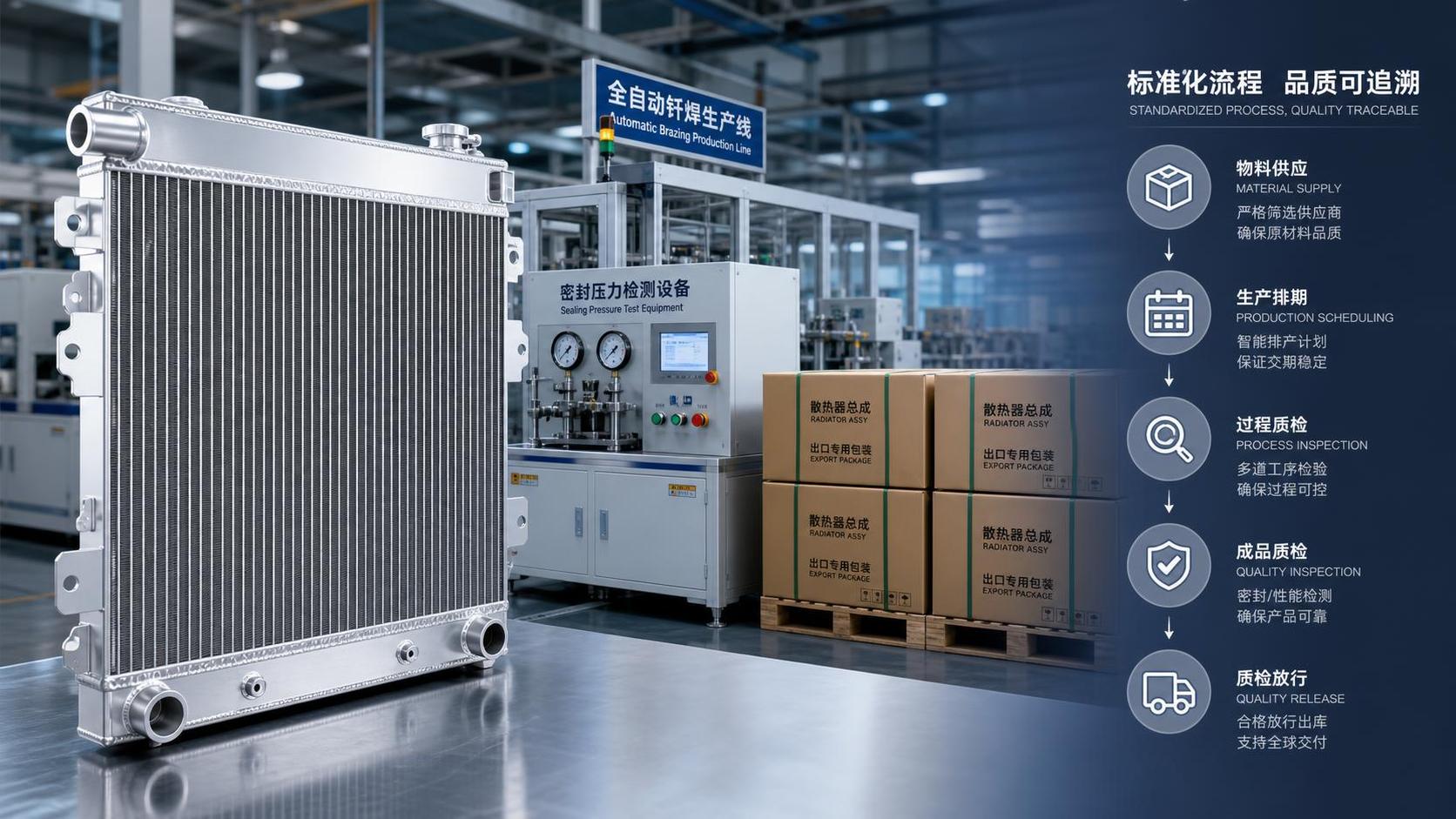
A late radiator delivery is rarely caused by one problem. A dependable vehicle radiator supplier has to align engineering data, raw-material supply, production slots, inspection requirements, packing, and freight before a shipment can leave. For a purchase tied to an equipment build, fleet repair program, or service-parts launch, the useful question is not simply “How many days?” It is “What assumptions make that delivery date realistic, and what could change it?”
That distinction affects cost. An optimistic quoted lead time can look attractive until a drawing revision, an unavailable core material, or an incomplete shipping document turns a small delay into idle equipment, premium freight, or a missed project milestone. The right supplier should be able to explain the route from order confirmation to dispatch in practical terms.
What a vehicle radiator supplier needs before lead time can be confirmed
Lead time starts with technical clarity. A radiator is not a generic metal box; it is a cooling assembly that must fit the vehicle, connect correctly, tolerate vibration, and provide the required heat rejection under actual operating conditions. If the buyer provides only a photograph, a partial part number, or approximate dimensions, the supplier may need time for identification and cross-checking before production can begin.
For an established aftermarket reference already in regular production, confirmation can be relatively quick. For a new release, a low-volume application, or a modified heavy-duty cooling module, the schedule should include engineering review. That review may cover core size, tube and fin construction, header arrangement, mounting brackets, inlet and outlet positions, transmission oil cooler interfaces, sensor ports, pressure requirements, and packaging protection.
A common purchasing mistake is treating a preliminary drawing as final. A change that appears minor, such as moving a mounting point or changing the hose connection angle, can affect tooling, fixtures, assembly instructions, inspection points, and packaging. If the change arrives after materials have been allocated, it may also create scrap or leave a supplier holding components that cannot be used elsewhere.
Before accepting a delivery promise, provide a controlled specification package: OEM or cross-reference number where available, approved drawing revision, application details, annual and initial quantities, target delivery destination, labeling requirements, and any required test or approval documents. The more complete this package is, the less time is lost in clarification.
Material availability often decides the real schedule
Most visible radiator parts are made from commonly used materials, but that does not mean every required specification is immediately available. Aluminum tubes, fins, headers, side plates, plastic tanks, seals, brazing consumables, and fittings may be sourced on different schedules. A supplier can have open production capacity and still be unable to complete an order because one material grade, thickness, profile, or purchased component is missing.
This risk increases with custom configurations. A standard core may use stock tooling and commonly held material, while a special fin pitch, unusual tube layout, proprietary plastic tank, or integrated oil cooler can require a separate procurement cycle. New-energy cooling modules can add further dependencies, including specific interfaces and tighter traceability expectations.
Ask whether the quoted lead time is based on material already in stock, material on confirmed purchase order, or an estimate of future supply. These are not equivalent. “Available” should mean physically available and released for your order, not merely listed in a supplier’s planning system.
There is also a cost decision here. Paying for a supplier to hold dedicated inventory may reduce schedule risk for a recurring program, but it ties up working capital and may create liability if demand changes. For a one-off purchase, it is usually more sensible to accept a longer, transparent lead time than to fund inventory that may never be consumed.
Capacity is more than the number of radiators a factory can make
When buyers hear that a factory has capacity, they often assume an order can be inserted immediately. In practice, production capacity is divided among core building, brazing, tank fitting, welding or mechanical assembly, pressure testing, final inspection, packing, and shipment preparation. A bottleneck in any one stage governs output.
Brazing capacity is particularly relevant for aluminum radiator production. Batch scheduling, fixture availability, oven loading, and downstream inspection can affect the release date even when raw material is ready. The same applies to specialized labor or equipment used for heavy-truck radiators, construction machinery radiators, and intercoolers. Product complexity matters more than the total number of units alone.
Order size changes the calculation. Very small quantities may wait for an efficient production batch; larger quantities may require multiple batches or a reserved production window. Neither approach is automatically poor. The concern is whether the supplier explains its batching policy and gives an achievable dispatch plan rather than a single vague date.
Liaocheng Xinde Auto Parts Co., Ltd., established in 2018, focuses on water tank radiators, intercoolers, construction machinery radiators, and related cooling components for heavy trucks and new-energy applications. For buyers assessing a manufacturer in this category, the relevant question is not only its stated product range or investment scale, but whether its current production plan can support the required configuration, volume, and inspection standard at the time of order.
Prototype, new-release, and repeat orders should not be quoted the same way
A repeat order for a validated part and a first order for a new application have different risk profiles. Treating them as identical creates avoidable disappointment.
For a repeat production part, the supplier may already have approved tooling, process parameters, packing methods, and inspection records. Lead time is then mainly a matter of material position, queue time, and logistics. A supplier may reasonably offer a shorter schedule, provided there is no design change and demand has not exceeded the planned forecast.
A new-release radiator deserves more caution. Consider the XD81112 RADIATOR FOR NEW RELEASE, specified with an 815*934*40mm core size. That dimension is useful for technical identification, but it is not enough on its own to establish readiness or interchangeability. The buyer still needs confirmation of the complete assembly details, application fitment, relevant connections, quality checks, and whether the item is in regular production or requires a first-run process.
Do not pressure a supplier to classify a first build as a standard stock item merely to shorten the purchase-order lead time. That can shift work out of the formal schedule, where it becomes harder to track. A better arrangement separates the phases: technical confirmation, sample or first-article approval where needed, production release, and shipment. It may look slower on paper, but it gives the project a date that can be managed.
Testing and quality release are scheduled work, not an optional final check
Radiators must be checked for leakage and assembly integrity before shipping. Depending on the product and customer agreement, additional controls may cover dimensions, mounting position, appearance, packing, traceability, or performance-related requirements. These checks take time, especially after a new setup or during a high-volume run.
The wrong response is to ask a supplier to “skip inspection to save time.” A leak found after installation can cost far more than a day or two in controlled release, particularly when access to the equipment is difficult. Construction machinery, heavy vehicles, and fleet assets often generate labor, downtime, transport, and reputational costs that exceed the price of the radiator itself.
The better question is whether testing is integrated into the production plan. Ask for the defined hold point: when does the order become ready to pack, and who has authority to release it? If a third-party inspection is required, identify it before production starts. Booking an inspector after goods are complete can add delay even when the factory has done its part.
Freight time is only one part of international delivery
Buyers sometimes compare a supplier’s factory lead time with the date the goods are needed at site. Those are separate clocks. After dispatch, the shipment may still require export documentation, pickup coordination, port or airport handling, customs clearance, import paperwork, domestic transfer, and receiving inspection.
Sea freight can be economical for planned container or consolidated orders, but it is not a recovery tool for a missed production schedule. Air freight can reduce transit time for urgent units, yet radiator dimensions and packaging volume can make it costly. The freight choice should be made from a total-cost perspective: unit value, shipment size, equipment downtime exposure, and the probability that the delivery date will hold.
Incoterms also matter. A quoted “delivery time” is incomplete unless both sides know whether it means ex-works readiness, goods loaded at the origin port, arrival at destination port, or delivery to a named location. Confirm the handover point, document responsibility, insurance arrangement, customs party, and destination charges. These details prevent the familiar situation where products are finished but cannot move.
How to evaluate a supplier’s lead-time promise
A useful quote breaks the timeline into visible stages. It does not need to reveal every internal detail, but it should distinguish engineering confirmation, material preparation, production, inspection, packing, and shipment readiness. A supplier that cannot identify the current constraint is not in a strong position to promise a reliable date.
When comparing quotations, use the following questions:
- Is the quoted date based on final drawings and confirmed application data?
- Which materials and bought-in components are already available?
- Is the item a repeat production part, a modified design, or a new development?
- What production stage is likely to become the bottleneck for this quantity?
- What testing, documentation, or third-party inspection must occur before release?
- What does the delivery date mean under the proposed shipping terms?
- What changes to volume, design, packaging, or destination would require re-quoting the schedule?
These questions are more useful than demanding a guaranteed number of days before the supplier has enough information to plan. A short lead-time claim without assumptions is a sales statement. A date linked to materials, capacity, and release conditions is a procurement commitment that can be monitored.
Cost control comes from planning the right buffer
Keeping excessive radiator inventory is expensive, yet ordering at the last possible moment is not a lean strategy when a cooling component can stop a vehicle or delay a build. The appropriate buffer depends on consumption variability, supplier location, part commonality, replacement difficulty, and the cost of downtime.
For high-use service parts, consider a rolling forecast and agreed reorder trigger. For project-specific equipment, lock technical data earlier than the planned installation date and build a contingency period for approval and freight. For critical low-volume parts, a small local safety stock can be cheaper than emergency international transport.
Do not apply the same rule to every item. A widely used replacement radiator with stable demand may justify scheduled replenishment. A specialized radiator for a limited equipment population may be better purchased against confirmed demand. The purpose is not to maximize stock; it is to prevent the most expensive form of shortage.
FAQ
Can a vehicle radiator supplier give a reliable lead time from a part number alone?
Sometimes, for a known repeat item. For a custom, new-release, or uncertain application, a part number should be supported by drawings, photos, fitment details, and required quantity before the date is treated as firm.
Why can a small order take longer than a larger one?
Small orders may wait for material minimums, tooling availability, or a compatible production batch. A larger confirmed order can justify a dedicated production slot, although it may also require multiple manufacturing batches.
Should urgent orders always move by air?
No. First confirm that production, quality release, and export documents are complete. Air freight only solves the transit portion of the schedule, and bulky radiator packaging can make it disproportionately expensive.
What is the clearest warning sign in a supplier quote?
A single delivery date with no stated basis. Ask what is assumed about drawings, materials, order quantity, test requirements, and shipping terms before using that date in a project schedule.
Choosing a vehicle radiator supplier is therefore a schedule-and-cost decision, not merely a unit-price comparison. Favor suppliers that identify dependencies early, distinguish standard production from development work, and communicate changes before they become urgent. That approach gives procurement a realistic delivery plan and gives the wider project fewer expensive surprises.