



How to compare vehicle radiator supplier quotes beyond unit price
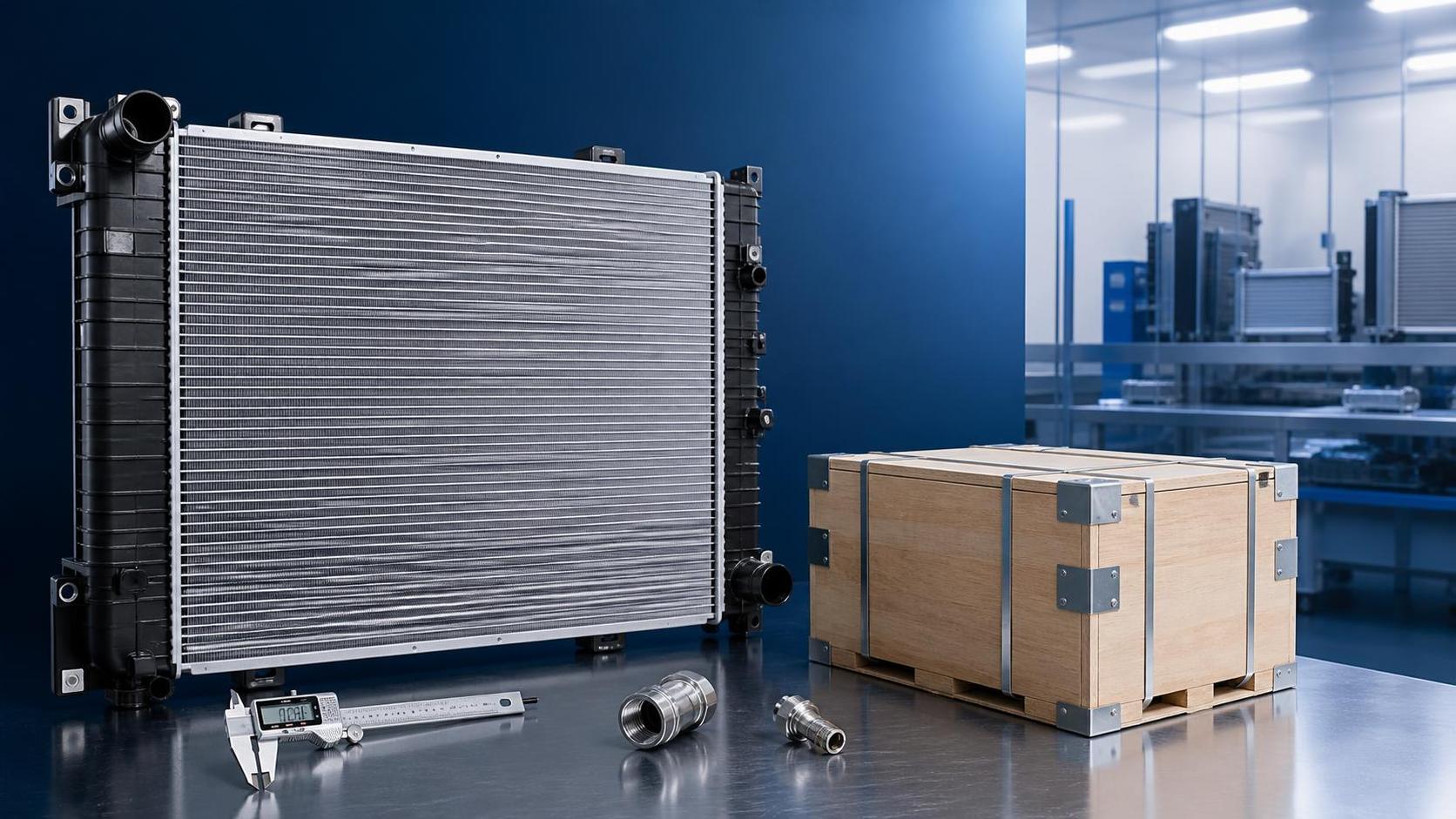
It often starts with a spreadsheet that appears easy to approve. Two or three radiator quotations are open side by side, and one number is clearly lower than the others. The part descriptions look similar, the requested quantity is the same, and the delivery date seems acceptable. Under time pressure, the lowest unit price can look like the responsible choice.
The difficulty usually appears later. A drawing revision may have been excluded, the core dimensions may not match the vehicle package, packing may be unsuitable for the shipping route, or a quoted lead time may only apply after technical approval. For a vehicle radiator supplier, the price per unit is only one part of the commercial picture. A quote comparison that does not expose the assumptions behind each number can create avoidable cost in receiving, rework, claims handling, emergency freight, and lost production time.
Start by making the quotations comparable
Before ranking suppliers, make sure every bidder is pricing the same requirement. This sounds obvious, but radiator requests are frequently sent with incomplete information: an OEM reference, a photo, an approximate core size, or a vehicle model without the exact installation conditions. Each supplier may fill in the gaps differently. One may quote a complete assembly, while another may quote a similar-looking radiator with different mounting points, tank configuration, transmission cooler provisions, or connection sizes.
Create a single quotation basis and send it back to every bidder. It should identify the applicable part number or drawing revision, vehicle or equipment application, annual forecast if available, required quantity, packaging expectation, delivery location, and requested trade term. Ask suppliers to state every exception in writing rather than allowing them to assume that a deviation is acceptable.
A useful quote comparison sheet separates “included,” “excluded,” and “not specified.” This distinction matters. An item marked as not specified is not automatically included. If a supplier cannot confirm a requirement, the resulting uncertainty should remain visible until it is resolved.
Read the technical line items, not only the product name
A radiator can share an application label with another part while differing in material selection, construction, cooling surface, or connection layout. For heavy-duty and commercial vehicle applications, small changes in core design can matter when the vehicle operates under high load, high ambient temperature, extended idle time, or dusty conditions. The quote should provide enough technical information to verify that the offered design is the requested design.
Ask for the core size, overall dimensions, inlet and outlet locations, tube and fin arrangement where relevant, tank material and construction, mounting configuration, and any integrated oil cooler or sensor provisions. Do not treat a general statement such as “OEM quality” as a specification. It is a commercial phrase, not a measurable acceptance criterion.
Where the request is tied to an original reference, check whether the supplier identifies cross-reference numbers clearly. For example, an offer for XD81202 RADIATOR FOR MERCEDES-BENZ can be reviewed against the listed references A9605002601 and 9605002601, its stated 2011-onward application, and the declared core size of 895*958. That does not replace engineering validation, but it gives the comparison a concrete starting point. Confirm that the year range and fitment details match the intended vehicle before treating the quote as equivalent to another offer.
If samples are needed, define what the sample is meant to prove. A sample can verify fitment, visual configuration, connection positions, and basic workmanship. It may not, by itself, prove long-term production consistency. The approval record should therefore identify the sample version and any changes permitted for serial production.
The lowest material description may carry the highest downstream risk
Material details deserve direct questions because radiator cost is strongly influenced by inputs and process choices. Rather than asking a supplier to disclose proprietary manufacturing information, request confirmation of the material grade or agreed material standard, tank construction, brazing approach where applicable, and corrosion-protection process where one is specified. The goal is to understand whether suppliers are quoting the same performance target.
Cooling performance should also be discussed in the language of the actual application. A unit installed in a passenger vehicle is not evaluated in exactly the same way as one installed in heavy trucks, construction machinery, or a packaged thermal-management module. Airflow conditions, coolant circuit requirements, fan arrangement, surrounding components, and operating duty all influence the right design.
If the buyer has test requirements, provide them at the enquiry stage. If no internal test method is available, ask the vehicle radiator supplier to explain the routine inspection and pressure-testing approach used for the quoted product, along with the records available for traceability. A supplier that gives a clear boundary around its verification process is easier to evaluate than one that makes broad claims without describing controls.
Turn “delivery” into a measurable commitment
Many quotation comparisons fail because delivery is recorded as a single number of days or weeks. That figure has little value unless its conditions are stated. Lead time may depend on technical confirmation, tooling availability, raw material status, order quantity, payment terms, or production scheduling. A low-priced offer with an uncertain production window may be more expensive if it forces expedited transport or interrupts a planned service program.
Ask each supplier to split the timeline into practical stages: technical confirmation, sample preparation if required, first-order production, repeat-order production, inspection, packing, and handover to the carrier. This does not need to become a complicated schedule. It simply reveals where the time is being counted.
Capacity should be considered in relation to your expected demand pattern, not only a supplier’s headline capability. A supplier may be able to produce the total annual volume but still struggle with a short-notice call-off, mixed SKU order, or seasonal increase. Discuss minimum order quantities, batch size, capacity reserved for repeat parts, and the process for handling forecast changes. These questions are particularly important when the radiator is a service item that may be needed unpredictably.
Calculate landed cost using the same assumptions
Unit price becomes meaningful only after the commercial terms are normalized. Put every quote onto the same basis before comparing it. If one supplier quotes ex-works and another quotes delivered terms, their unit prices cannot be ranked without adding the missing costs and responsibilities.
Include product price, domestic transport where applicable, export packing, freight, insurance if required, customs-related charges, brokerage or handling, inspection cost, and expected cost of any special labeling or documentation. The purpose is not to predict every minor expense perfectly. It is to prevent obvious omissions from making one quote appear artificially low.
Packaging deserves more attention than it usually receives. A radiator is vulnerable to bent fins, damaged tanks, and mounting-point deformation during handling. Ask for carton or crate details, pallet arrangement, protection for connection points, unit weight, outer dimensions, and quantity per package. Better packaging may increase the quoted price while lowering damage exposure and improving warehouse handling. Conversely, oversized packaging can increase freight costs. The comparison needs both sides of that trade-off.
Payment terms also affect the true cost and risk profile. Record deposits, balance timing, currency, validity period, and any price-adjustment language. If quoted pricing is based on a short validity period or uncertain material-cost conditions, note that separately instead of assuming the number will remain available at order release.
Evaluate the supplier’s ability to support the part after shipment
A quote should show what happens if there is a problem, not merely what happens when everything goes smoothly. Review warranty wording carefully: duration, start date, coverage scope, exclusions, claim evidence, response procedure, and remedy. A broad warranty statement without a defined process may be difficult to use when a field issue is time-sensitive.
Ask who will handle technical questions, how nonconforming goods are identified, and whether lot or batch information can be traced. For repeat purchasing, confirm how approved specifications, labels, and packing instructions will be controlled so that a later shipment does not drift from the accepted version.
It is also reasonable to assess communication quality during the quotation stage. Are questions answered against the requested part number? Are deviations identified clearly? Does the supplier distinguish confirmed information from assumptions? These are practical signals, not a substitute for formal qualification, but they matter. A supplier relationship often becomes difficult first through unclear documentation rather than through a visible product defect.
A practical way to make the final decision
Once the information is complete, avoid forcing all criteria into a single vague “supplier score.” Keep the decision readable. First remove offers that do not meet mandatory technical, fitment, compliance, or delivery requirements. Then compare the remaining options across landed cost, lead-time reliability, documentation quality, packaging, warranty process, and capacity fit.
For each factor, write a short evidence note instead of relying only on a rating. “Core dimensions confirmed against drawing” is more useful than “technical: 8/10.” “Lead time starts after sample approval” is more useful than “delivery: good.” Evidence notes make internal review easier and prevent a decision from being based on memory after several rounds of email.
The best choice may still be the lowest-priced quotation, but it should win because it remains competitive after the technical and commercial conditions are made equal. If a higher-priced option provides a more complete scope, clearer traceability, safer packaging, or a more dependable replenishment process, the difference should be visible as a deliberate trade-off rather than dismissed as an expensive unit price.
Before releasing the purchase order
Attach the approved technical reference, commercial terms, packaging requirements, inspection expectations, labeling details, and agreed delivery point to the order or its supporting documents. State the revision level where one exists. If a pre-production sample was accepted, identify it by date or internal reference. This final step is often where a careful comparison becomes an enforceable purchasing decision.
When reviewing a vehicle radiator supplier quote, the central question is not “Which number is lowest?” It is “Which offer delivers the required part, in the required condition, at the required time, with the least unmanaged cost?” Framing the decision that way helps protect both the budget and the continuity of supply.