



When a Radiator Core for Cooling Systems Limits Performance
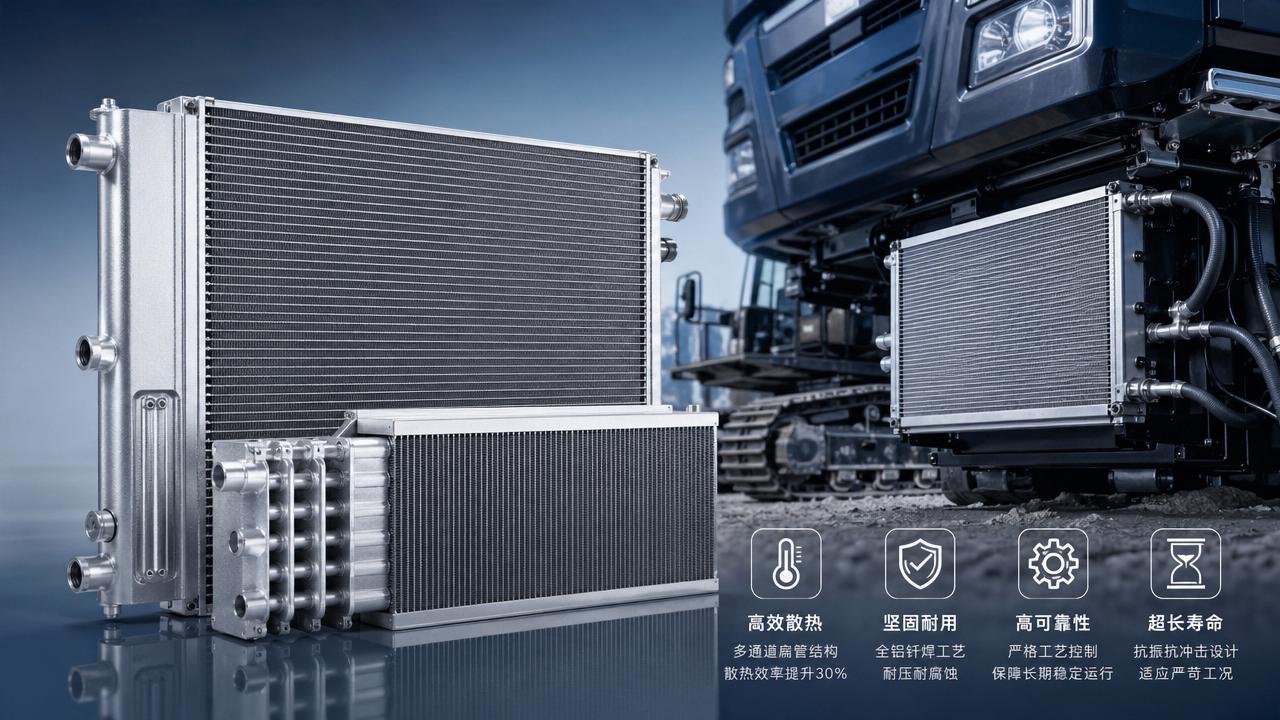
In demanding applications, a radiator core for cooling systems can become the hidden factor that restricts thermal efficiency, durability, and overall equipment performance. For technical evaluators, understanding how core design, material quality, and manufacturing precision influence heat dissipation is essential when selecting reliable components. This article examines the performance limits of radiator cores and what to look for in advanced solutions for heavy trucks, construction machinery, and new energy cooling systems.
Why does a radiator core for cooling systems become a performance bottleneck?
A radiator core for cooling systems is not just a passive heat exchanger. In heavy trucks, construction machinery, and new energy platforms, the core directly affects coolant temperature stability, pressure drop, fan load, and long-duration reliability. When heat rejection demand rises beyond the core’s effective transfer capacity, overall system performance starts to decline in ways that are often mistaken for pump, fan, or thermostat problems.
Technical evaluators usually face this issue during 3 typical conditions: sustained uphill load, high ambient operation, and low-speed work cycles with limited airflow. In these scenarios, even a small mismatch in tube geometry, fin density, or brazing consistency can narrow the thermal margin. A core that performs adequately at moderate duty can become a limiting factor after 2–4 hours of continuous operation.
The risk is higher when procurement decisions focus only on external dimensions or initial price. Two radiators may share the same installation envelope, yet their core efficiency can differ because of internal coolant path design, fin louver pattern, and material thickness tolerance. For technical review teams, the real question is not whether the component fits, but whether it maintains heat transfer efficiency within the intended operating window.
Common indicators that core limitations are already affecting the system
- Coolant temperature rises faster than expected during peak load, especially in ambient ranges above 35°C.
- The fan runs at a higher duty cycle, increasing energy consumption and acoustic load without solving temperature drift.
- Pressure drop across the radiator increases, reducing flow efficiency and placing extra demand on the pump.
- Localized hot spots appear after repeated duty cycles, often linked to uneven flow distribution or blocked fin passages.
For parts buyers and engineers, these indicators matter because they influence warranty exposure, maintenance frequency, and equipment uptime. In the parts industry, the radiator core must be evaluated as a performance-critical module rather than a generic replacement item.
Which core design factors matter most during technical evaluation?
When comparing a radiator core for cooling systems, technical teams should focus on 4 core dimensions of performance: heat transfer efficiency, airflow resistance, coolant-side pressure drop, and structural durability. These factors interact. A denser fin arrangement may improve heat exchange area, but if airflow resistance becomes too high, actual operating performance may worsen in dusty or low-speed applications.
Material choice is equally important. Premium thermal materials help maintain conduction efficiency, but material grade alone does not guarantee field performance. Tube-wall consistency, braze quality, header integration, and corrosion resistance all influence service life. In mixed-duty environments, especially with vibration and thermal cycling, poor joining accuracy can reduce performance well before visible leakage appears.
How to read key design variables
Tube geometry determines coolant contact behavior and flow distribution. Wider multi-channel tubes often support strong heat rejection, but they require careful matching with pump capacity and expected coolant quality. Fin geometry affects air-side transfer. Louver angle, fin pitch, and fin height can significantly influence the balance between heat dissipation and fouling tolerance over 6–12 months of real use.
Manufacturing precision is another evaluation point that cannot be ignored. In practical sourcing, tolerances such as flatness, braze uniformity, and assembly consistency often decide whether a radiator core for cooling systems performs steadily across batches. For technical evaluators handling medium-volume or large-volume procurement, repeatability is often as important as peak thermal capability.
The table below summarizes the main design dimensions that should be reviewed before sample approval or production release.
For procurement teams, the practical value of this framework is clear: it shortens comparison time, reduces trial-and-error cost, and improves alignment between the engineering department and sourcing department before a purchase order is issued.
How do application scenarios change the radiator core selection logic?
A radiator core for cooling systems should never be judged in isolation from its duty cycle. Heavy trucks, off-road construction machines, and new energy vehicles impose very different thermal profiles. Highway trucks may experience long steady-state heat loads at speed, while loaders and excavators face repeated low-speed, high-dust, high-vibration cycles. New energy systems add another layer because battery and power electronics cooling often require tighter thermal control.
In construction equipment, service conditions frequently include shock, debris exposure, and restricted cleaning intervals. Under these conditions, core fouling resistance and mechanical stability can matter more than headline heat transfer area. In contrast, for vehicle platforms with tighter packaging, the evaluator may prioritize compact geometry and optimized airflow behavior within limited frontal space.
Application-driven selection priorities
Technical evaluators should define 3 basic scenario variables before comparing samples: operating environment, load duration, and maintenance frequency. For example, a machine running 8–10 hours per day in dusty conditions will require different fin and tube priorities than a road vehicle with periodic maintenance and stable airflow conditions.
This logic also applies to passenger-related applications with fitment-specific requirements. In some replacement or repair cases, an option such as Radiator for AION may be evaluated not only for dimensional match but also for cooling efficiency, advanced fluid dynamics, and stability under demanding operating loads. For fitment programs, matching model details such as AIONV-1301010-0030 can simplify cross-checking during sourcing.
The following table helps map common application scenarios to core selection concerns and review priorities.
By linking the application profile to the core design, buyers avoid the common error of selecting the same radiator architecture for fundamentally different duty conditions. That approach reduces the risk of overengineering in one project and underperformance in another.
What should technical evaluators verify before supplier approval?
A sound supplier review process should combine product checks, manufacturing capability checks, and delivery support checks. In the parts sector, a radiator core for cooling systems is only as reliable as the factory process behind it. Sample quality without production consistency is a frequent sourcing problem, especially when projects move from pilot quantity to medium-volume procurement.
Liaocheng Xinde Auto Parts Co., Ltd., established in 2018 with a registered capital of 5 million RMB and a total investment of 50 million RMB, focuses on the research, production, and global sales of water tank radiators, intercoolers, construction machinery radiators, and related components for heavy trucks and new energy radiator modules. For technical evaluators, this specialization matters because it indicates process concentration rather than a broad but shallow product scope.
A practical 5-point review checklist
- Confirm whether the supplier can support drawing review, fitment verification, and technical feedback within a normal 3–7 day response cycle.
- Check production alignment between sample parts and mass-production parts, including brazing consistency and material control.
- Review application experience in heavy truck, construction machinery, or new energy cooling modules rather than relying on generic statements.
- Ask about typical lead-time ranges, such as sample preparation in 7–15 days or batch delivery in 2–4 weeks, depending on complexity.
- Verify communication quality on documentation, packing, traceability, and after-sales support for replacement or technical troubleshooting.
The company’s rapid development and provincial or municipal honors such as High-tech Enterprise, Civilized and Honest Enterprise, and Trustworthy Unit for Consumers may also be relevant as contextual indicators of organizational credibility. For B2B buyers, however, the decisive issue remains whether the supplier can translate manufacturing discipline into stable radiator core performance over repeated orders.
Why process capability can matter more than catalog breadth
A supplier with focused experience in radiators and intercoolers is often better positioned to discuss airflow restrictions, vibration concerns, and integration issues than a general parts trader. This becomes especially important when technical teams need custom recommendations, alternative configurations, or support for performance trade-off decisions under budget constraints.
How can buyers balance cost, reliability, and long-term replacement strategy?
Cost evaluation should go beyond purchase price. A lower-cost radiator core for cooling systems can appear attractive at the quotation stage but create hidden expense through higher maintenance frequency, shorter replacement cycles, or system derating under peak load. For fleet operators and equipment owners, these indirect costs often become visible only after 6–18 months of use.
Technical evaluators should compare at least 3 cost layers: initial component cost, installation or replacement handling cost, and operating risk cost. The third layer is frequently missed. If overheating raises downtime risk or affects engine and module efficiency, the component’s total cost profile changes quickly.
Comparison logic for sourcing decisions
For standard replacement projects, a fitment-ready solution can reduce installation uncertainty. In some programs, Radiator for AION may be considered where buyers need a high-performance replacement or repair option with premium thermal materials and uncompromising stability. The key is to assess whether the product meets the thermal and dimensional demands of the intended service environment rather than relying on part naming alone.
The table below provides a practical framework for comparing lower-cost and higher-spec options without reducing the decision to price alone.
This comparison does not mean the higher-cost option is always preferable. It means the radiator core decision should reflect operating context, maintenance capability, and failure cost. For technical evaluators, that is the difference between a cost-centered quote and a performance-centered procurement decision.
FAQ for technical evaluators reviewing radiator core performance
How do I know whether the radiator core is undersized for the application?
Start by reviewing thermal behavior under sustained peak load, not only under idle or moderate conditions. If the system shows repeated temperature rise during high ambient operation, or if the fan must operate near maximum for long periods, the radiator core for cooling systems may lack sufficient thermal margin. Field evaluation over 2–3 representative duty cycles is often more useful than a simple bench impression.
What are the biggest mistakes in radiator core procurement?
The most common errors are selecting by size only, ignoring pressure-drop impact, and treating all aluminum core designs as equivalent. Another frequent mistake is failing to account for contamination, vibration, and maintenance interval. A core that looks acceptable on paper can become a weak link if the real operating environment includes dust loading, shock, or long continuous runtime.
What delivery questions should I ask before placing an order?
Ask about sample lead time, batch lead time, drawing confirmation steps, and the number of technical revisions allowed before production release. In many projects, a normal planning range may include 7–15 days for samples and 2–4 weeks for regular batch supply, depending on tooling, quantity, and application complexity. Early clarification helps avoid project delays.
Is a higher fin density always better?
No. Higher fin density can improve heat transfer area, but it can also increase airflow resistance and make the core more sensitive to dust blockage. For low-speed or dirty applications, a balanced design may outperform a denser one over time. The best choice depends on airflow availability, cleaning access, and expected maintenance frequency.
Why choose us for radiator core evaluation and sourcing support?
For technical evaluators, the value of a supplier lies in how quickly and accurately the supplier can move from drawing review to workable recommendation. Liaocheng Xinde Auto Parts Co., Ltd. focuses on radiators, intercoolers, construction machinery radiators, and related components for heavy trucks and new energy radiator modules. That focus supports clearer communication on thermal demands, fitment constraints, and application-specific trade-offs.
If you are assessing a radiator core for cooling systems, you can consult on 6 practical items before purchase: dimensional confirmation, application matching, material and structure selection, sample scheduling, batch delivery cycle, and replacement or repair requirements. This is especially useful when your team must balance cost targets with durability expectations and delivery pressure.
What you can discuss with our team
- Parameter confirmation for tube-fin structure, fitment envelope, and cooling pathway requirements.
- Product selection for heavy truck radiators, construction machinery cooling components, and new energy radiator modules.
- Lead-time communication for sample support, pilot quantities, and regular production planning.
- Customization discussion based on drawings, operating scenarios, and service-life expectations.
- Quotation review with attention to technical scope, replacement needs, and practical delivery conditions.
When cooling performance becomes a limiting factor, the right decision is rarely the cheapest quick replacement. It is the component and supplier combination that fits the duty cycle, controls risk, and supports reliable long-term operation. If your project requires a focused technical review, a sourcing discussion based on drawings and use conditions is the most efficient next step.