



What to check before buying a radiator module
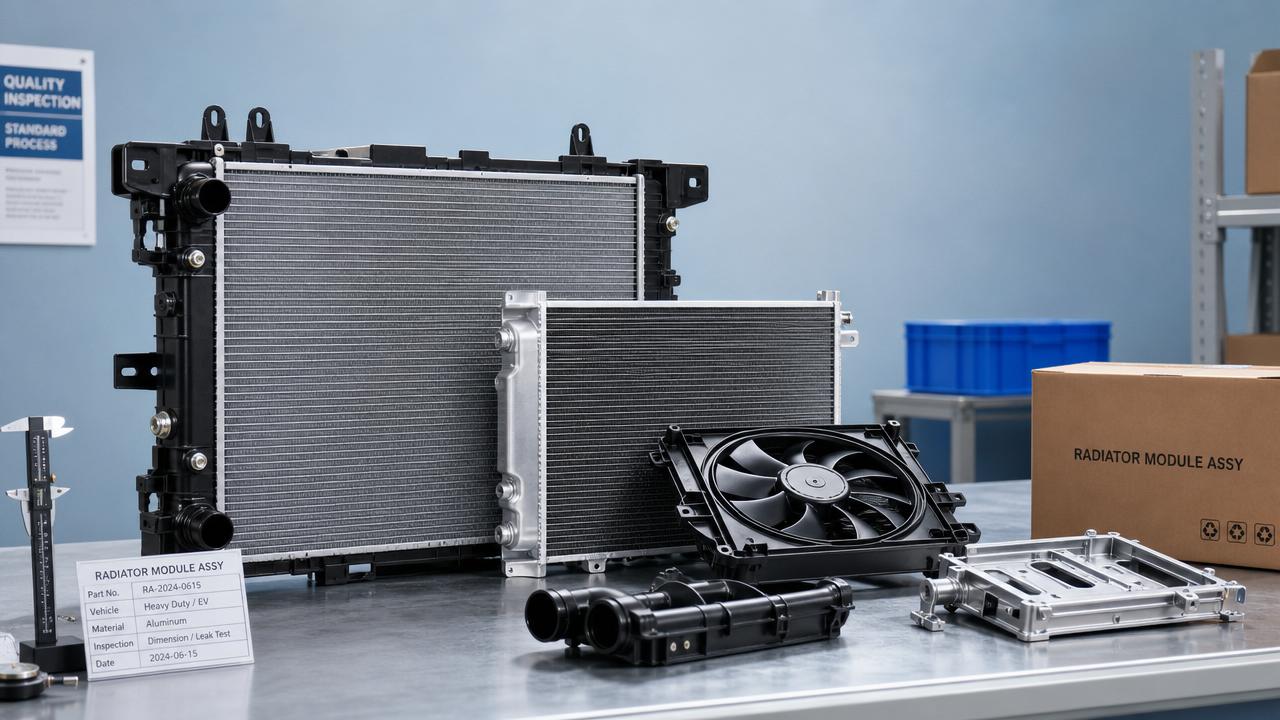
Before buying a radiator module, procurement teams should look beyond price and compare cooling performance, material quality, fitment accuracy, and supplier reliability. A well-chosen radiator module can reduce maintenance costs, improve vehicle efficiency, and support long-term operation. Understanding these key checkpoints helps buyers make smarter sourcing decisions and avoid costly quality or compatibility issues.
What should procurement teams verify first when evaluating a radiator module?
A radiator module is not just a heat exchanger. In the parts industry, it often works as an integrated cooling assembly that affects engine temperature control, system pressure stability, service intervals, and operating safety.
For buyers, the first task is to define the actual application. Heavy trucks, construction machinery, and new energy vehicles require different thermal loads, packaging dimensions, and durability levels.
If the operating environment includes dust, vibration, high ambient temperature, or long-duty cycles, the radiator module must be selected with stricter performance and structural standards.
- Confirm vehicle or equipment platform, part number, mounting points, inlet and outlet positions, and space constraints before requesting a quotation.
- Check whether the cooling system serves an engine, intercooler circuit, hydraulic system, or new energy thermal management loop.
- Review required service life, anti-corrosion expectations, and operating temperature range based on the target market.
- Ask the supplier to clarify whether the offer covers only the core radiator or a full radiator module with frame, fan interface, and related fittings.
Many sourcing problems start because buyers compare offers with different configurations. A low unit price may hide missing brackets, different core thickness, or lower material grade.
Why definition accuracy matters
When the technical definition is vague, the delivered radiator module may fit the drawing but fail in real operation. Procurement teams should therefore align technical, purchasing, and after-sales expectations at the start.
Which radiator module specifications have the biggest impact on performance?
Performance evaluation should focus on measurable factors rather than broad claims. A radiator module must dissipate heat efficiently while maintaining structural stability and acceptable pressure drop within the cooling circuit.
The table below helps procurement teams compare the most practical technical checkpoints before approving a supplier or sample.
Among these factors, fitment accuracy and cooling efficiency usually have the strongest influence on total ownership cost. A radiator module that requires rework can quickly erase any upfront price advantage.
Technical questions worth asking suppliers
- What test methods are used for leak detection and pressure verification?
- What is the recommended operating environment for this radiator module?
- Can the supplier support drawing review, sample confirmation, or reverse development from an original part?
- How is consistency controlled between pilot samples and mass production batches?
How do material quality and manufacturing process affect radiator module reliability?
In the spare parts business, durability problems often come from hidden process weaknesses rather than visible defects. A radiator module may look acceptable on arrival but fail early because of unstable brazing, thin material, or poor sealing.
Buyers should therefore assess not only the component itself but also the manufacturer's production discipline. Liaocheng Xinde Auto Parts Co., Ltd., established in 2018, focuses on research, production, and global sales of water tank radiators, intercoolers, construction machinery radiators, heavy truck components, and new energy radiator modules.
Its business scope matters to procurement teams because suppliers with broad cooling-product experience usually understand cross-application design differences better. That improves communication speed when special dimensions, replacement references, or thermal requirements must be checked.
Key process signals of a reliable manufacturer
- Stable raw material sourcing, especially for aluminum components exposed to pressure, vibration, and coolant chemistry.
- Consistent brazing and assembly control to reduce internal leakage and weak joint points.
- Dimensional inspection procedures that keep bracket positions and connection points within target tolerance.
- Packaging methods that prevent fin deformation and transport damage during export handling.
The company's rapid development and honors such as High-tech Enterprise, Civilized and Honest Enterprise, and Trustworthy Unit for Consumers indicate recognized local credibility, but buyers should still pair these signals with product-level checks and sample validation.
What fitment and application details are often missed in radiator module sourcing?
Compatibility mistakes are common when purchasing teams rely only on appearance photos or a partial reference number. In practice, even small dimensional shifts can create assembly issues or reduce cooling airflow.
The table below outlines application checkpoints that should be confirmed before placing a production order for a radiator module.
A complete sourcing file should include drawings, photos, old sample measurements, expected market, and target annual quantity. This improves quotation accuracy and shortens development time.
Example from new energy cooling demand
In new energy vehicles, a radiator module may support battery packs, drive motors, and power electronics rather than a traditional engine alone. This changes cooling priorities and often raises fitment sensitivity.
For buyers handling this segment, a relevant reference is Radiator for BYD, model BYD476ZQB-1301010-025, designed for new energy vehicles with efficient cooling for battery packs, drive motors, and power electronics.
Products developed for such applications should be reviewed for exact fit, heat exchange capability, and operating safety across different climates. Procurement teams should request precise interface and dimensional confirmation before volume orders.
How should buyers compare price, cost, and long-term value?
A cheap radiator module can become expensive if it causes returns, delayed installation, or repeated maintenance. Procurement teams should compare total cost, not only purchase price.
The comparison below shows why the lowest quotation is not always the most economical sourcing choice.
This is especially important for distributors and fleet-support buyers. A radiator module that performs consistently protects service reputation and reduces downstream claims from installers or end users.
A practical cost-control approach
- Use sample approval before bulk orders for new references.
- Set clear acceptance criteria for dimensions, leak testing, and packaging.
- Ask for separate pricing when alternative material or structure options are available.
- Consider annual purchase planning if stable demand can improve lead time and supply continuity.
What standards, documentation, and supplier capabilities should be reviewed?
Procurement professionals often need more than a compliant product. They need traceable communication, usable documents, and a supplier that can support quotation, development, and delivery under time pressure.
In radiator module sourcing, common review items include dimensional drawings, pressure or leak inspection records, packing details, material descriptions, and export coordination capability.
Basic supplier review checklist
- Can the supplier respond quickly to drawing confirmation, replacement references, and technical clarification?
- Is there a clear process for sample development, correction, and final approval?
- Can export packaging be adapted to reduce damage risk for delicate fins and connections?
- Is the supplier experienced in heavy truck and new energy radiator modules, where application complexity is higher?
Liaocheng Xinde Auto Parts Co., Ltd. has built its business around these cooling-related categories, which can be useful for buyers who need responsive communication across multiple radiator and intercooler references.
When your project includes new energy applications, products engineered for precise fit and maximum heat exchange, such as the BYD-focused solution mentioned earlier, show why application-based review is more valuable than generic catalog matching.
FAQ: common radiator module sourcing questions from buyers
How can I verify whether a radiator module is truly compatible?
Ask for dimensional confirmation against an original sample, drawing, or OEM-style reference. Check mounting points, core size, hose neck positions, and any frame or shroud interfaces. Photos alone are not enough.
What matters more, material thickness or cooling design?
Both matter. Thicker or stronger materials can improve durability, but the radiator module must also have suitable tube and fin structure for the target thermal load. Overemphasis on one factor can create imbalance.
Is a custom radiator module always necessary for special applications?
Not always. If a standard reference matches dimensions and thermal demand, it may be enough. Customization is more relevant when fitment, interface layout, or duty conditions differ from common catalog models.
What are the most common procurement mistakes?
The most common mistakes are comparing unlike specifications, skipping sample validation, ignoring packaging requirements, and focusing only on unit price. These issues often lead to claims, delays, and hidden operational cost.
Why choose us for radiator module sourcing support?
For procurement teams, a useful supplier is one that helps reduce uncertainty. Liaocheng Xinde Auto Parts Co., Ltd. combines manufacturing focus in radiators, intercoolers, construction machinery radiators, heavy truck parts, and new energy cooling modules with an export-oriented approach.
If you are evaluating a radiator module for aftermarket distribution, equipment support, or new energy vehicle applications, you can consult on practical issues before placing an order.
- Parameter confirmation, including core size, interfaces, mounting points, and application environment.
- Product selection guidance for heavy trucks, construction machinery, and new energy thermal management needs.
- Sample support for fitment review and early-stage sourcing risk reduction.
- Lead time discussion based on order quantity, development status, and delivery urgency.
- Quotation communication for standard references or customized solutions with clear technical alignment.
A radiator module purchase should protect both performance and supply stability. When technical details are checked early and supplier capability is reviewed carefully, buyers can control cost more effectively and avoid preventable failures after delivery.