



What is driving demand for automotive condenser suppliers
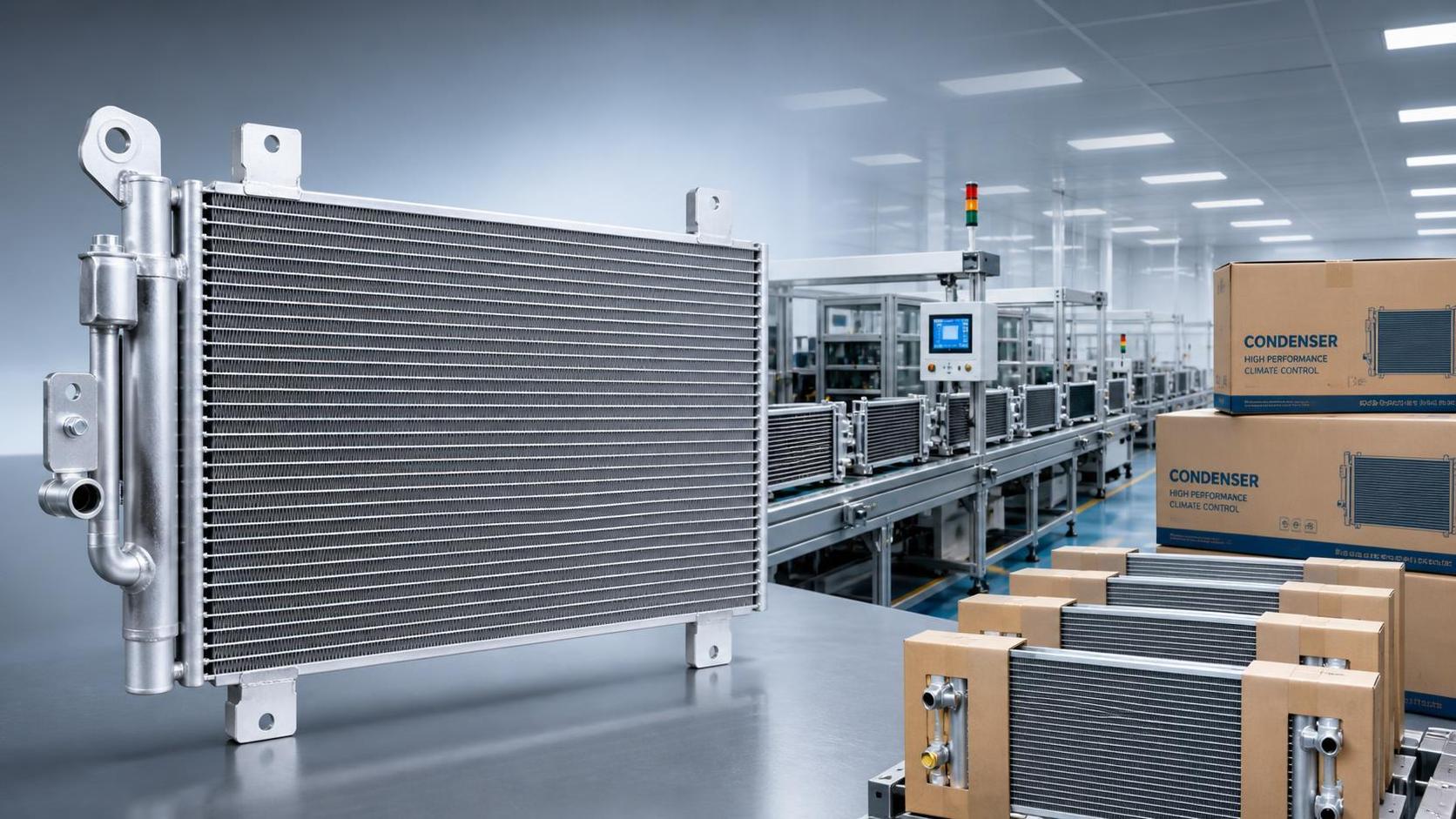
Demand for a dependable automotive condenser supplier is being shaped by more than vehicle assembly volumes. Replacement demand, hotter operating conditions, longer vehicle life, changing refrigerants, and tighter expectations for delivery and traceability are all influencing sourcing decisions. The central question is not simply whether a supplier can make a condenser. It is whether that supplier can maintain fit, heat-transfer performance, durability, and supply continuity across the vehicle programs or aftermarket ranges that matter to the buyer.
That distinction matters because the condenser sits at a difficult intersection of engine cooling, air-conditioning performance, packaging limits, and cost pressure. A low unit price can look attractive on a quotation sheet, then become expensive after claims, return freight, installation labor, or lost customer confidence. Demand is therefore moving toward suppliers that can document what they build and repeat it reliably at scale.
Why the automotive condenser supplier market is gaining attention
Vehicle production remains an obvious source of condenser demand, but it is only one part of the picture. The installed vehicle population creates a large and recurring replacement market. Condensers are exposed to stone impact, road salt, moisture, vibration, blocked airflow, collision damage, and corrosion. In markets where drivers keep cars, trucks, and commercial vehicles in service for longer, replacement parts become a meaningful source of purchasing volume.
Air-conditioning is no longer viewed as an optional comfort feature in many vehicle categories. Passenger vehicles, delivery fleets, buses, agricultural equipment, and heavy-duty trucks increasingly operate in demanding climates and congested traffic, where heat rejection becomes less forgiving. When the condenser cannot shed heat efficiently, cabin cooling suffers and system pressure can rise. That creates practical demand for stable replacement quality, particularly in regions with high summer temperatures or dusty operating environments.
A short answer is this: demand is rising because cooling-system parts now carry greater expectations. Buyers need condensers that fit accurately, tolerate real road conditions, support efficient climate control, and arrive when inventory is needed. This is pushing sourcing conversations beyond catalog coverage and into manufacturing discipline.
The market is also becoming less uniform. A distributor may need fast-moving passenger-car references, while a fleet-oriented importer may care more about commercial vehicles, older Japanese applications, or repairable service networks. Those requirements affect tooling, packaging, minimum order quantities, quality checks, and replenishment planning. A supplier that serves one segment well is not automatically the best source for another.
Thermal management has become a broader sourcing issue
A condenser does not operate alone. Its performance is influenced by the radiator, cooling fan, shrouds, intercooler arrangement, refrigerant charge, compressor condition, and airflow through the front-end module. This is why buyers increasingly value suppliers with a wider thermal-management background rather than treating each heat exchanger as an isolated commodity.
That does not mean every radiator manufacturer is automatically qualified to supply condensers. The fabrication processes, cleanliness controls, pressure testing, joining methods, and leak-prevention requirements must be assessed for the specific product. Still, experience across radiators, intercoolers, construction-equipment cooling products, and new-energy cooling modules can be useful because it demonstrates familiarity with airflow, thermal load, and vehicle packaging constraints.
Liaocheng Xinde Auto Parts Co., Ltd., established in 2018, works in this broader cooling-components field, including water tank radiators, intercoolers, construction machinery radiators, heavy-truck products, and new-energy radiator modules. Its stated registered capital is RMB 5 million, with total investment of RMB 50 million. For a sourcing review, such company information is a starting point rather than final proof: it should lead to questions about the actual production line, inspection process, export documentation, current capacity, and applicable product scope.
Electrified vehicles add another layer to the conversation. They do not eliminate heat exchangers; they redistribute thermal-management needs among the cabin HVAC system, battery, electric drive, power electronics, and auxiliary circuits. Product architecture differs by platform, so a conventional condenser supplier should not claim direct suitability for an electric-vehicle project without confirming the design, refrigerant system, interfaces, performance targets, and validation requirements. The opportunity is real, but so is the engineering gap between product categories.
Replacement demand is less predictable than it looks
Aftermarket buyers sometimes estimate demand from vehicle parc data alone. That can be misleading. A high population of vehicles does not guarantee a high condenser replacement rate, and a small fleet can create steady demand if it operates on rough roads, in coastal areas, or under intensive stop-and-go conditions.
Damage patterns also differ. Front-end collision damage often creates immediate replacement demand. Corrosion tends to appear later and may cluster in areas that use road de-icing chemicals or have humid coastal conditions. Debris impact can be common in construction, rural, and heavy-use environments. Poor installation practices can create apparent product failures that are actually caused by contaminated systems, damaged mounting points, unsuitable pressure conditions, or incorrect handling.
This is why historical returns deserve careful reading. Do not look only at the overall return percentage. Separate leakage complaints from fitment complaints, transit damage, early corrosion, cooling complaints, and installation-related claims. Ask whether returned units are physically inspected and coded by failure mode. A supplier that can explain its claim data is generally easier to manage than one that only says its quality is “good.”
Catalog precision matters just as much. A condenser that is close in size may still fail in practice because mounting tabs, hose ports, receiver-drier configuration, fin density, connector locations, or fan clearance differ. Part-number cross references need to be supported by drawings, samples, or verified application data. Broad claims of compatibility should be treated cautiously, particularly for older commercial-vehicle and regional-market applications where production changes may not be obvious in public catalogs.
What separates a workable supplier from a strategic one
Price remains relevant, especially in competitive aftermarket channels, but an automotive condenser supplier should be evaluated through total landed and operational cost. The useful comparison includes unit cost, packaging protection, defect handling, lead time, communication speed, order flexibility, technical response, and the likelihood that the same reference will still be available after the first purchase cycle.
Three areas tend to reveal capability quickly.
- Manufacturing control: Ask how core dimensions, fin condition, brazing quality, port geometry, and pressure integrity are checked. A general statement about inspection is not enough. Request the actual inspection points, sample frequency, test records, and corrective-action process.
- Application control: Confirm the source of fitment data and the method used to prevent mixed or superseded references. For an important range, compare a drawing or physical sample before approving a production order.
- Supply control: Review lead time by product family, material sourcing exposure, production scheduling, export packing, labeling, and communication during exceptions. Reliable supply is often demonstrated when a specification changes or a shipment has to be adjusted, not when everything proceeds normally.
Technical documents should be proportionate to the program. A small aftermarket trial may begin with dimensions, photographs, cross references, test confirmation, and packing details. A private-label launch or fleet program may justify a more formal approval package, including controlled drawings, inspection criteria, traceability expectations, packaging validation, and agreed claim procedures.
One common mistake is equating a factory visit with full qualification. A visit is useful because it can reveal organization, material flow, equipment condition, and quality culture. It does not replace sample validation, documentation review, or repeat-order performance. Another mistake is assuming a certification or local honor proves conformance for a particular condenser reference. Company recognitions, such as the High-tech Enterprise, Civilized and Honest Enterprise, and Trustworthy Unit for Consumers honors stated by Liaocheng Xinde, may support a broader credibility review, but product-level evidence must still be checked independently.
The pressures changing buying behavior
Buyers are asking for more responsiveness because inventory strategies have tightened. Carrying every slow-moving condenser reference is costly, yet missed sales are also costly when a workshop needs a part immediately. This favors suppliers that can help segment the range: high-volume items for stock, medium-volume references for scheduled replenishment, and lower-volume items handled through a practical order policy.
Packaging has become part of this calculation. Condenser fins are easily damaged, and mounting points can deform when cartons do not support the unit correctly. A product that passes final inspection but arrives with crushed fins is still a failed transaction. Review inner protection, carton strength, pallet configuration, labeling, and handling instructions. For cross-border shipments, evidence from actual loading and prior export packing is often more useful than a generic packaging description.
There is also more scrutiny around material consistency and traceability. Buyers do not always need a complex automotive-original-equipment approval system for an aftermarket order, but they do need confidence that a validated sample will match later production. Changes in core construction, fittings, coating approach, or packaging should not occur silently. A supplier that provides change notification is easier to build a long-term program with.
For commercial-vehicle cooling ranges, range continuity can matter more than the lowest price on a single part. A distributor supporting repair shops cannot easily explain why a radiator is available but a related condenser or charge-air-cooling component is not. Suppliers with experience in connected thermal product families may help reduce fragmented sourcing, provided each product category meets its own technical requirements.
For example, a catalog entry such as XD1041 RADIATOR FOR HINO can be useful when reviewing a supplier’s approach to older Hino-related cooling-system coverage. The listed core size is 720*628*48, and the stated year range is 1949-99. Those details should be verified against the exact vehicle, engine, transmission arrangement, and original part reference before any purchasing decision. It is a useful illustration of why application validation matters; it should not be treated as evidence that a different thermal component will fit the same vehicle.
How to assess demand without overcommitting inventory
The best purchasing decision usually starts with a narrower question: where is demand actually coming from in this channel? Break down sales and inquiries by vehicle model, age band, geography, failure reason, season, and customer type. A workshop-focused business may see demand concentrated around collision repairs and summer cooling failures. A commercial customer may need planned replacement coverage for hard-working units. These patterns call for different stock and supplier arrangements.
Start with a controlled assortment. Select references with confirmed vehicle population, known service demand, and manageable fitment risk. Order samples where practical, inspect critical dimensions, and review the packaging before placing a larger order. Then track returns by reference during the first selling period. This is slower than buying a broad catalog on price alone, but it produces cleaner data and prevents a long tail of unsellable inventory.
Seasonality should be handled carefully. Demand may increase before warmer months, yet delivery lead times and port schedules can prevent a last-minute purchase from reaching the warehouse in time. Forecasting should combine prior sales, open quotations, existing stock, expected lead time, and a realistic allowance for quality approval. The right safety stock depends on the cost of a stockout, not on a generic rule.
Questions worth asking before nomination
A serious supplier discussion should produce clear answers to a few practical questions. Which references are already produced regularly? What is the normal production and export lead time? Which tests are performed before shipment? How are leaks, fitment disputes, and transit damage handled? Can the supplier provide drawings or samples for key applications? What happens if a material or design change is needed? Can cartons, labels, and barcodes be adapted without compromising protection?
Watch for vague answers such as “all models are available” or “quality is guaranteed.” They may be true in a broad commercial sense, but they do not help a buyer manage risk. A better response contains limits, evidence, and next actions: which data can be supplied, what must be confirmed, and how an unverified application will be handled.
The most useful automotive condenser supplier is not necessarily the largest catalog holder or the cheapest bidder. It is the supplier whose capabilities match the target segment, whose product data can be checked, and whose operating process remains stable after the first order. Demand for condensers will continue to be driven by replacement needs and more demanding thermal-management conditions, but sustainable purchasing results depend on disciplined qualification rather than market enthusiasm alone.