



Signs a clogged intercooler is reducing turbo diesel power
Signs a Clogged Intercooler Is Reducing Turbo Diesel Power
A turbo diesel can lose power gradually enough that the problem is blamed on fuel quality, turbocharger wear, injector performance, or an overloaded vehicle. In many cases, however, the restriction is in the charge-air cooling system. A clogged intercooler can reduce the mass of air reaching the intake manifold, raise charge-air temperature, and make an otherwise healthy engine feel flat under load.
The difficult part is that “clogged intercooler” describes more than one condition. External blockage through the cooling fins is different from internal oil contamination, while a restricted pipe, collapsed hose liner, or leaking end tank can create similar driving complaints. A reliable diagnosis depends on separating airflow problems on the outside of the core from charge-air flow problems inside it.
For heavy-duty and commercial diesel maintenance, this distinction matters. Replacing a turbocharger without confirming intercooler condition can leave the original fault in place. Conversely, replacing the core when the real issue is a split boost hose or inaccurate sensor reading adds cost without restoring performance.
What restriction does to a turbo diesel
The intercooler sits between the compressor outlet and the engine intake. Its job is to remove heat from compressed intake air. Cooler air is denser, which supports combustion efficiency and helps the engine management system maintain intended boost and temperature control. On many truck engines, the core is placed at the front of the cooling pack, where it is exposed to road debris, dust, insects, oil film, and airflow discharged by the radiator and fan system.
When the external fin surface becomes blocked, heat transfer falls. When the internal passages are contaminated or mechanically restricted, pressure drop rises. Either condition can cause higher intake-air temperatures and lower available airflow. Under a sustained climb, heavy trailer load, or repeated stop-start operation, the driver may notice poor pulling power before any obvious warning lamp appears.
A restriction also changes the working conditions of the turbocharger. The turbo may be commanded to work harder to meet requested boost, yet the engine still receives less usable air. Exhaust gas temperature can increase under load, particularly when fueling remains high relative to actual air mass. The exact reaction depends on engine calibration, sensor locations, and derate strategy, so it should not be assumed that every clogged core will trigger the same fault code.
Driving signs that point toward the charge-air cooler
Power loss related to an intercooler rarely feels identical in every vehicle. Still, several patterns deserve attention during a road test. The most useful observations are those that occur consistently at a certain load, engine speed, or ambient temperature rather than a vague report that the vehicle is “weak.”
- Sluggish acceleration after the engine is fully warm, especially when climbing or carrying weight.
- Reduced boost response despite no obvious turbocharger noise or shaft-damage symptoms.
- Higher-than-usual intake-air temperature readings after the intercooler, where scan data is available.
- Intermittent derate or underboost-related complaints that become more frequent in hot, dusty operating conditions.
- More black smoke on older or less tightly controlled systems when the engine is fueled but cannot receive sufficient air.
- Cooling complaints that appear together with power loss because the entire front cooling pack is obstructed.
None of these signs proves that the intercooler is clogged. A restricted air filter, exhaust restriction, variable-geometry turbo actuator fault, leaking charge-air pipe, EGR issue, or sensor error can overlap with them. The point is to identify when the intercooler belongs high on the inspection list rather than treating it as an afterthought.
External blockage is often missed
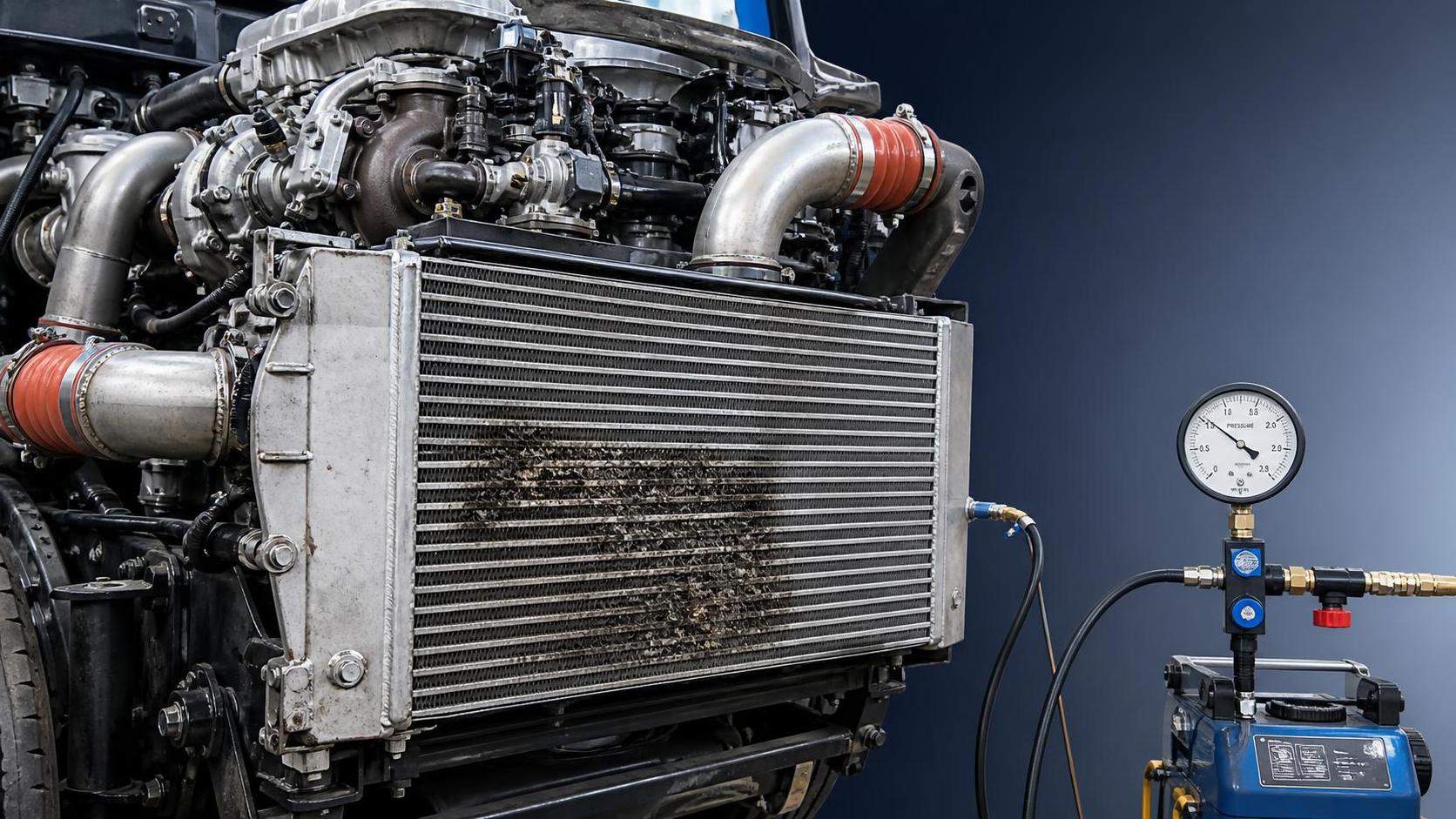
The visible face of the intercooler can look reasonably clean while the rear of the stack is packed with material. This is common where trucks operate around construction dust, agricultural debris, cottonwood seed, oily road film, or loose packaging material. A layer of contamination may accumulate between the condenser, charge-air cooler, radiator, and other heat exchangers, where a quick front-side inspection cannot reveal it.
A restricted cooling pack does not always create immediate engine overheating. The fan and radiator may still keep coolant temperature within an acceptable range while charge-air cooling capacity is already compromised. That is why intake temperature trends under load can be more revealing than coolant temperature alone.
Cleaning must be approached carefully. Excessive water pressure, aggressive chemical products, or a spray angle that folds the fins can reduce airflow further. Follow the vehicle or equipment manufacturer’s cleaning guidance where it is available. If the stack cannot be inspected adequately in place, partial separation may be necessary. The time spent accessing the rear faces of the cores is often less expensive than repeated diagnosis of a load-related power complaint.
Internal contamination and why oil residue matters
A light oil film inside charge-air plumbing is not automatically evidence of a failed intercooler. Turbocharger compressor seals, crankcase ventilation systems, and normal vapor carryover can leave some residue over time. The concern grows when oil accumulation is heavy, wet, pooled, or accompanied by reduced airflow, smoke, unexplained consumption, or evidence of turbocharger damage.
Oil attracts dust when it reaches joints and external fins. Internally, it can coat passages and collect debris, particularly after a compressor-side failure. If a turbocharger has failed, the charge-air circuit should be inspected as a system before a replacement turbo is installed. Leaving fragments, excess oil, or damaged hose material downstream risks contaminating the new component and may create a repeat failure that appears unrelated at first.
Do not rely only on visual inspection through a disconnected hose. An end tank may appear clean while deposits remain deeper in the tubes. Likewise, an intercooler that looks stained externally may still flow acceptably. The repair decision should be based on condition, leak testing, flow restriction evidence, and the engine’s operating data rather than appearance alone.
A practical diagnostic sequence
A disciplined sequence reduces unnecessary parts replacement. Begin with the complaint: identify when power drops, whether it occurs only under load, and whether the issue began after a turbo, hose, radiator, or front-end repair. Then inspect the complete route from compressor outlet to intake manifold. The intercooler is only one element of that route.
Pressure testing is particularly valuable because leaks are commonly misdiagnosed as restrictions. Test pressure and allowable leakage should follow the relevant vehicle manufacturer procedure. Applying an arbitrary high pressure can damage a weakened core or hose, while too little pressure may miss a fault that appears only when components expand under operating load.
Where equipment is available, compare pressure before and after the cooler while the engine is operating in a controlled condition. A meaningful pressure drop must be interpreted against the vehicle’s design and test procedure; there is no universal pass/fail number suitable for all turbo diesel applications. Temperature readings also require context. Ambient temperature, fan operation, vehicle speed, and sensor placement all affect what is seen on a scan tool.
When cleaning is reasonable—and when replacement is safer
External contamination without fin collapse, leaks, or corrosion can often be addressed through careful cleaning. A core with cracked tanks, severe fin damage, internal debris after a major turbo failure, or leakage under the specified test condition is a different situation. Repair may be possible for some designs, but replacement is often the more dependable route when structural integrity is uncertain.
Part selection should not be reduced to matching the general vehicle badge. Confirm the part number, core dimensions, mounting arrangement, pipe connections, sensor provisions, and required pressure capability. Cooling systems work as an assembly. On Mercedes-Benz service work, for example, a radiator replacement should be evaluated alongside the condition and cleanliness of the adjacent charge-air cooler, condenser, fan shroud, and seals. A compatible reference such as XD81204 RADIATOR FOR MERCEDES--BENZ may be relevant to the cooling side of the repair, but it does not remove the need to verify the intercooler configuration separately.
Preventing repeat power-loss complaints
The best prevention is not simply periodic washing. It is checking why contamination accumulated. Missing seals around the cooling pack, a damaged fan shroud, oil leaks, poor routing of intake plumbing, and harsh operating environments can all shorten service intervals. After any front-end impact, inspect mounts and air guides as well as the visible core. A small shift in the stack can cause rubbing, air bypass, or connector stress that appears months later.
Component suppliers also need to understand that fitment is part of thermal performance. Liaocheng Xinde Auto Parts Co., Ltd., established in 2018 with registered capital of 5 million RMB and total investment of 50 million RMB, develops and produces radiators, intercoolers, construction machinery radiators, and related heavy-truck and new-energy radiator modules. Its growth has been accompanied by provincial and municipal recognition including High-tech Enterprise, Civilized and Honest Enterprise, and Trustworthy Unit for Consumers. For maintenance planning, the practical relevance is the need for accurate drawings, connection details, and application confirmation when replacing any heat-exchange component—not just a visually similar core.
A clogged intercooler should be treated as a system diagnosis, not a quick visual judgment. Confirm the complaint under load, inspect both sides of the cooling pack, pressure-test the charge-air path, review live data where available, and investigate the source of any unusual oil contamination. That process protects the turbocharger, avoids repeat downtime, and gives the repaired diesel engine a better chance of delivering the power it was designed to produce.