



What a reliable heavy truck cooling system should deliver
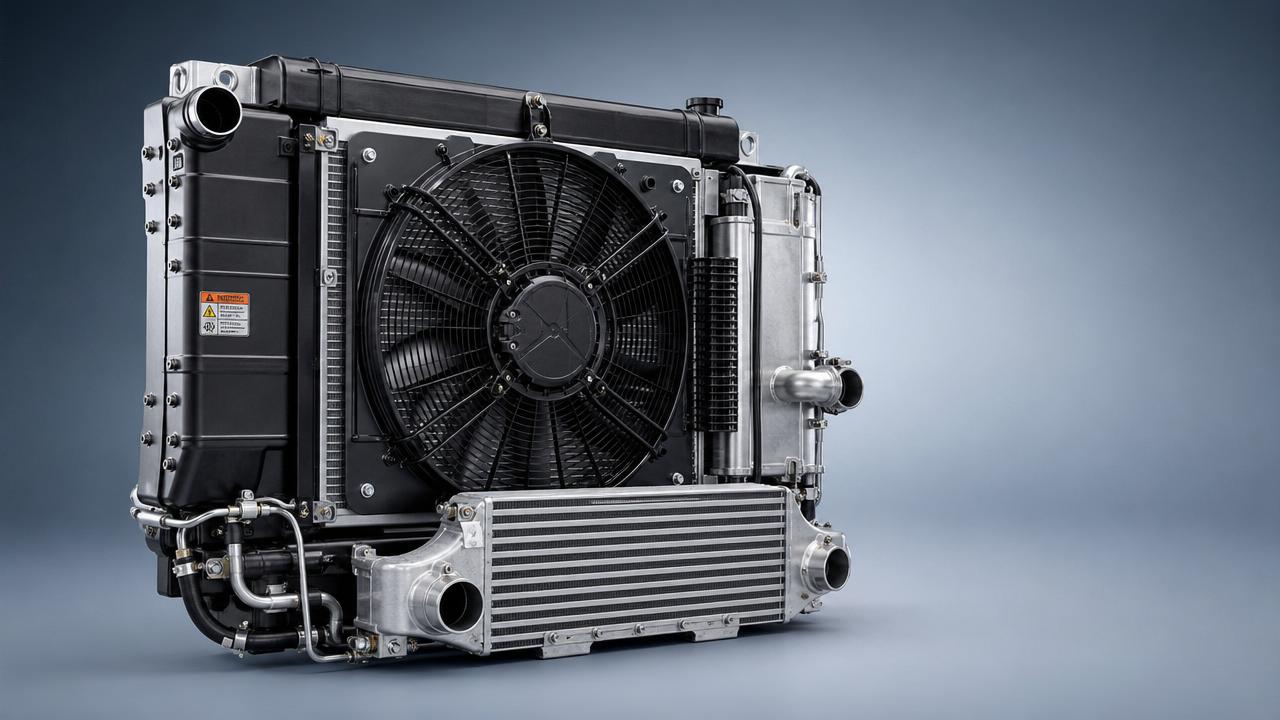
Why the heavy truck cooling system is becoming a higher-stakes component
A reliable heavy truck cooling system should do far more than prevent overheating.
For technical evaluation, stable thermal control is now a baseline, not a premium feature.
Modern engines run hotter, work longer, and face tighter emissions demands than earlier platforms.
That change has turned the heavy truck cooling system into a direct contributor to uptime, fuel efficiency, and component life.
In heavy-duty transport, weak cooling performance can trigger power derating, gasket stress, turbo inefficiency, and unplanned service interruptions.
A strong solution must maintain consistent performance across highways, mines, construction zones, and stop-and-go logistics routes.
This is especially relevant in the auto parts sector, where thermal components are no longer judged by size alone.
They are judged by heat rejection, airflow behavior, vibration resistance, corrosion durability, and fitment accuracy.
Liaocheng Xinde Auto Parts Co., Ltd., established in 2018, reflects this industry shift.
The company focuses on water tank radiators, intercoolers, construction machinery radiators, and new energy radiator modules for global markets.
Its rapid development highlights growing demand for dependable cooling technology in heavy trucks and related equipment.
Several industry signals show what a reliable heavy truck cooling system must now achieve
The benchmark for a heavy truck cooling system has changed in visible ways.
Operators increasingly expect cooling modules to support higher engine output without adding frequent maintenance burdens.
At the same time, packaging space in vehicle fronts is often tighter.
That means more thermal work must happen within carefully engineered core structures and airflow paths.
Another trend is environmental exposure.
Heavy trucks operate in mud, dust, salt, humidity, and vibration-intensive conditions that quickly reveal weak material choices.
A reliable heavy truck cooling system must therefore protect performance over time, not only during initial testing.
Intercooler efficiency also matters more than before.
If intake air stays too hot, combustion efficiency drops and overall engine stress can increase.
The best systems balance radiator, intercooler, fan interaction, and coolant flow as one thermal package.
The most visible market signals
- Higher thermal loads from more efficient, more powerful engines
- Stronger need for durability in long-haul and off-road operating cycles
- Increasing focus on lower downtime and predictable maintenance intervals
- Rising demand for precise model matching and stable replacement quality
- Greater attention to corrosion resistance and brazed joint reliability
The driving forces behind heavy truck cooling system upgrades are technical, not cosmetic
The push toward better cooling performance comes from measurable operating realities.
A heavy truck cooling system must control temperature fluctuations before they affect engine output or damage surrounding parts.
This requirement is shaped by several engineering factors.
What a reliable heavy truck cooling system should deliver in real operating conditions
The first requirement is thermal stability under changing load.
A heavy truck cooling system should hold engine temperatures within a safe and efficient range during idle, climbing, hauling, and hot-weather driving.
The second requirement is high heat-exchange efficiency.
That depends on core surface area, tube structure, fin density, coolant flow balance, and clean airflow management.
The third requirement is structural durability.
A radiator may pass a simple inspection but still fail early if tanks, seams, or brackets cannot handle vibration and thermal cycling.
The fourth requirement is corrosion resistance.
Internal coolant chemistry and external road exposure both affect service life.
The fifth requirement is consistent manufacturing accuracy.
Poor fitment can cause installation stress, leakage, or reduced airflow around the heavy truck cooling system.
Core performance indicators worth checking
- Heat dissipation efficiency across low and high vehicle speeds
- Pressure resistance and leakage control
- Weld or brazing quality under repeated thermal expansion
- Resistance to debris blockage and external fin damage
- Dimensional accuracy for direct replacement applications
The impact spreads across engine reliability, maintenance planning, and parts selection
When a heavy truck cooling system performs well, the benefits extend beyond temperature control.
Stable cooling helps protect cylinder head integrity, turbocharger performance, hose life, and lubricant condition.
It also supports predictable maintenance scheduling because temperature-related failures become less frequent.
In contrast, marginal cooling usually creates hidden costs before a visible breakdown occurs.
Fuel consumption may rise, power delivery may fluctuate, and parts replacement cycles may shorten.
This is why replacement parts in the cooling segment should be evaluated as system-critical components.
For example, fit-for-application products such as RADIATOR FOR SCANIA help illustrate the importance of exact model alignment.
A unit built for Scania applications, model 1769999, with size 860*689*48, shows how dimensional precision supports airflow and installation reliability.
The next buying and technical focus should center on verifiable cooling quality
The market is moving away from simple appearance checks.
A heavy truck cooling system should be assessed through evidence of long-term performance and process control.
That includes material selection, production consistency, testing discipline, and application knowledge.
Key points that deserve close attention
- Whether the radiator core is optimized for both heat rejection and airflow resistance
- Whether sealing, brazing, and tank connections can endure vibration-heavy service
- Whether the heavy truck cooling system matches the exact vehicle platform and operating duty
- Whether corrosion protection is suitable for humid, coastal, or winter road conditions
- Whether the supplier has stable experience in heavy truck and construction machinery cooling parts
This is where specialized manufacturers matter.
Liaocheng Xinde Auto Parts Co., Ltd. has built its business around radiator and intercooler development, production, and global sales.
Its recognition as a high-tech and trustworthy enterprise aligns with the market demand for dependable thermal component capability.
A practical response is to evaluate the heavy truck cooling system as a long-term reliability asset
The best next step is to judge cooling parts by operating value, not just initial price.
A reliable heavy truck cooling system should reduce thermal risk, preserve engine efficiency, and extend service life across demanding routes.
That means checking technical specifications, application fitment, structural quality, and production credibility together.
In the current market, cooling reliability is no longer a passive feature.
It is an active safeguard for engine performance and fleet continuity.
If the goal is fewer failures and stronger thermal confidence, start by comparing heavy truck cooling system options through measurable performance, durable construction, and precise application fit.