



What Makes a New Energy Vehicle Radiator Harder to Source?
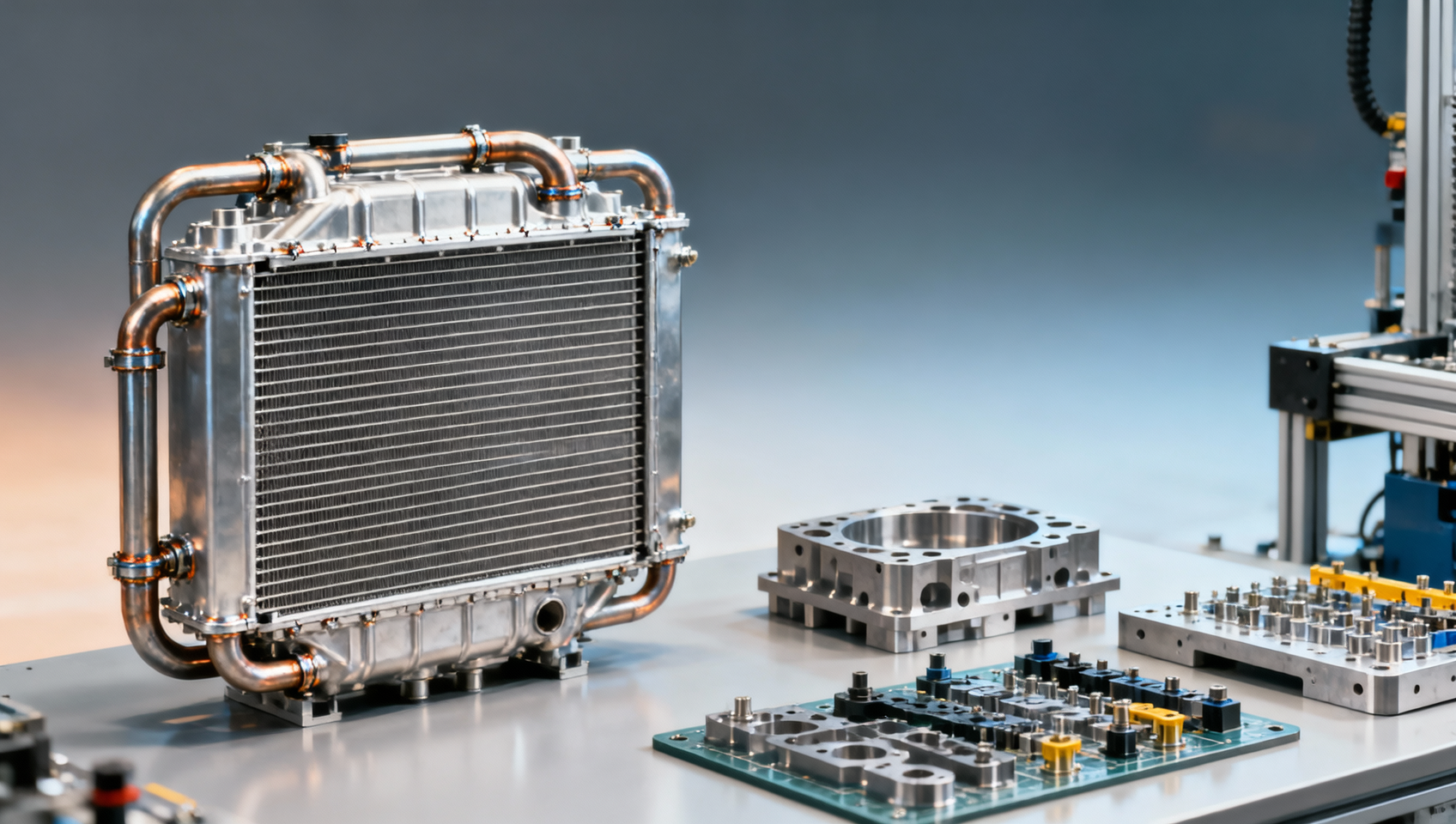
Sourcing a New Energy Vehicle radiator is harder because the part is no longer just a heat exchanger. It is a system-critical component tied to battery temperature control, motor efficiency, packaging limits, lightweight targets, noise expectations, and long-term safety. For technical evaluators, procurement teams, business reviewers, and decision-makers, the real challenge is not finding a factory that can make a radiator. It is finding a supplier that can consistently meet thermal performance, material requirements, validation standards, and delivery reliability at scale.
Compared with a Heavy duty truck radiator, Condenser, Agriculturaal radiator, or Excavator radiator, a new energy cooling module usually involves tighter tolerances, faster project changes, and more coordination between design, manufacturing, and quality control. That is why many buyers discover that supplier screening for new energy applications takes longer, costs more, and carries higher risk if the wrong partner is chosen.
Why NEV radiators are more difficult to source than conventional vehicle radiators
The core reason is that new energy vehicle thermal management is more demanding and less forgiving. In a conventional system, the radiator mainly supports engine cooling. In a new energy vehicle, the cooling system may serve the battery pack, motor, electronic control systems, and integrated thermal loops. That increases complexity in four practical ways.
First, performance requirements are more precise. Small deviations in thermal efficiency can affect battery life, charging stability, range consistency, and system durability. Buyers are not simply purchasing a standard catalog part; they are often evaluating whether a supplier can meet project-specific heat rejection targets.
Second, lightweight design matters more. NEV platforms are highly sensitive to weight. A radiator that performs well but adds unnecessary mass may hurt the overall vehicle efficiency target. This forces manufacturers to balance fin design, tube structure, brazing quality, and material thickness more carefully than in many traditional applications.
Third, packaging is tighter. Modern vehicle architecture leaves limited installation space. Cooling modules must often fit into compact layouts while still maintaining airflow efficiency, structural strength, and compatibility with surrounding systems.
Fourth, development cycles are faster. NEV platforms evolve quickly. A supplier may need to respond to frequent design changes, prototype requests, and validation rounds. Companies without strong engineering support or process discipline struggle in this environment.
What technical reviewers usually check before approving a supplier
For technical assessment teams, the biggest question is simple: can this supplier turn a drawing or thermal target into a stable, manufacturable product? Price alone is not enough. A low-cost source that fails validation or creates field issues becomes expensive very quickly.
The most useful evaluation points include:
- Thermal performance capability: Can the supplier provide test data, simulation support, or development experience for new energy cooling modules?
- Material compatibility: Are the aluminum alloys, joining methods, coatings, and sealing materials suitable for the coolant type and operating environment?
- Brazing and welding consistency: Weak process control can create leaks, uneven strength, or unstable heat transfer.
- Pressure and durability validation: Can the supplier support vibration, pulse, thermal cycle, burst, corrosion, and leak testing?
- Dimensional accuracy: Tight packaging means poor tolerance control can delay assembly or create fitment issues.
- Engineering responsiveness: Can they quickly revise tooling, samples, and process parameters during project development?
Technical reviewers should also verify whether the supplier understands the difference between a standard replacement radiator and an application-specific NEV thermal component. Experience in heavy trucks or construction machinery is valuable, but it does not automatically mean the supplier can handle new energy platform requirements without adaptation.
Why procurement teams often face hidden sourcing risks
Procurement professionals usually encounter the practical side of sourcing difficulty: many suppliers appear qualified at first glance, but fewer can deliver stable quality, communication, and lead time under real project pressure.
The hidden risks usually come from the following gaps:
- Prototype-to-mass-production inconsistency: Sample parts may pass, while later batches show leak rate, brazing, or dimensional issues.
- Unclear raw material control: Material substitutions can reduce thermal performance or long-term reliability.
- Weak supply chain resilience: Delays in aluminum materials, tooling, or outsourced processes can disrupt delivery commitments.
- Insufficient quality traceability: If defects occur, root-cause analysis becomes slow and costly.
- Overpromised customization capacity: Some suppliers accept complex projects without adequate engineering or production readiness.
For buyers, this means supplier qualification should go beyond quotations and sample approval. A better sourcing process includes plant audits, process reviews, validation planning, and realistic capacity checks. In new energy programs, supplier reliability often matters as much as unit cost.
What business evaluators and decision-makers want to know
At the management level, the question is not only “Can we source this radiator?” but also “What is the business risk if we source it from the wrong partner?”
New energy vehicle radiator sourcing affects several strategic outcomes:
- Launch timing: Thermal component delays can hold up vehicle development and customer delivery.
- Warranty exposure: Cooling failures can trigger expensive field claims and brand damage.
- Total cost: A cheaper part with unstable quality often creates higher testing, rework, logistics, and after-sales costs.
- Platform scalability: If the supplier cannot scale with future programs, the sourcing decision becomes a bottleneck.
- Reputation and compliance: Stable manufacturing systems and documented quality practices reduce long-term operational risk.
This is why experienced decision-makers usually prioritize three things: proven process control, engineering cooperation, and supply continuity. In many cases, these factors generate better return on investment than chasing the lowest purchase price.
For example, when evaluating platform compatibility across premium and specialized vehicle programs, buyers may review reference products such as Radiator for Hongqi. A project like this, with OE reference 1301010HA01 and applications covering luxury engines, new energy systems, H series sedans, and HS luxury SUVs, reflects the kind of precision and durability expectations that are increasingly common in advanced cooling programs.
How to judge whether a radiator manufacturer is truly ready for NEV projects
A capable supplier should demonstrate more than production equipment. They should show that their organization can support the full project lifecycle, from development to volume supply.
Here is a practical checklist for evaluation:
- R&D support: Can they participate in early-stage design discussion, not just quote from drawings?
- Prototype speed: Do they have the internal coordination to deliver samples quickly and revise them efficiently?
- Manufacturing discipline: Are brazing, assembly, leak testing, and inspection processes standardized and repeatable?
- Quality system maturity: Can they provide documentation, traceability, and corrective action workflows?
- Global sales and communication ability: Can they support export projects with clear technical communication and reliable follow-up?
- Relevant product range: Experience across water tank radiators, intercoolers, construction machinery radiators, heavy truck cooling products, and new energy radiator modules can indicate broader manufacturing depth.
Liaocheng Xinde Auto Parts Co., Ltd., established in 2018 with a registered capital of 5 million RMB and a total investment of 50 million RMB, operates as a specialized manufacturer focused on research, production, and global sales of water tank radiators, intercoolers, construction machinery radiators, heavy truck cooling products, and new energy radiator modules. For buyers, this kind of specialization matters because it suggests process concentration rather than fragmented capability. Rapid growth and recognition such as High-tech Enterprise and Trustworthy Unit for Consumers can also be useful indicators when assessing business stability, though they should still be validated through direct supplier review.
Where sourcing usually fails, and how to avoid costly mistakes
Most sourcing failures do not come from one dramatic problem. They come from small assumptions made too early in the project.
Common mistakes include:
- Choosing a supplier based mainly on price without validating engineering depth
- Assuming conventional radiator experience fully transfers to new energy applications
- Skipping process audits because the prototype looked acceptable
- Underestimating the impact of material quality and joining consistency
- Failing to align technical, purchasing, and management teams on qualification criteria
The better approach is cross-functional evaluation. Technical teams should verify performance and manufacturability. Procurement should review capacity, lead times, and supply stability. Business stakeholders should assess total cost, risk, and long-term fit. When these perspectives are aligned early, sourcing becomes faster and safer.
Even when reviewing a specific product line such as a Hongqi-compatible radiator designed for quiet efficiency, peak performance, and long-term reliability, buyers should still test whether those claims are supported by process capability, not just marketing language. Warranty terms, such as a 6-month warranty in some programs, should also be interpreted within the broader context of validation standards and actual application conditions.
Conclusion: the real sourcing challenge is not availability, but capability
What makes a New Energy Vehicle radiator harder to source is not simple market scarcity. It is the combination of higher thermal requirements, lighter structures, tighter packaging, faster development cycles, and greater quality risk. For technical reviewers, procurement teams, business evaluators, and company decision-makers, the right supplier is the one that can consistently balance engineering performance, manufacturing control, and delivery reliability.
If you are evaluating suppliers in the auto parts industry, the smartest decision is to look beyond unit price and ask a more important question: can this partner support the full technical and commercial demands of a new energy program? In most NEV radiator projects, that is the factor that determines whether sourcing becomes a competitive advantage or a costly problem.