



Aftermarket Heavy Duty Truck Radiator Problems That Appear Late
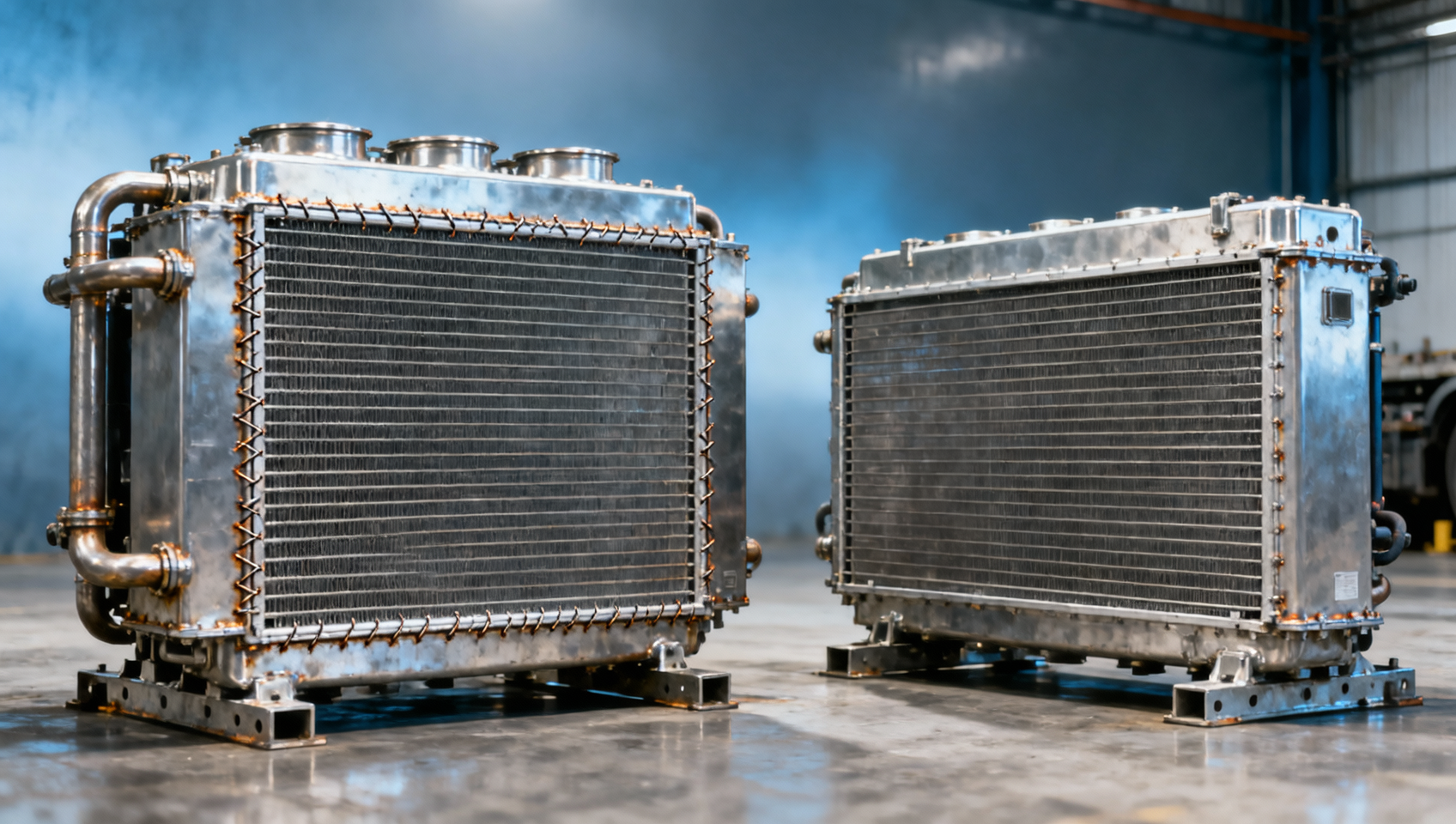
Many aftermarket cooling parts look fine at installation but reveal hidden issues only after months of operation. For buyers and evaluators of Heavy duty truck radiator systems, Vehicle radiator assemblies, Condenser units, Agriculturaal radiator products, Excavator radiator solutions, and New Energy Vehicle Radiator modules, understanding these late-appearing problems is critical to reducing failure risk, warranty costs, and procurement mistakes.
Why do some aftermarket heavy duty truck radiator problems appear only after long-term use?
Late-stage radiator failure is rarely caused by one visible defect at delivery. In the parts industry, the bigger risk is hidden mismatch between material grade, brazing consistency, tube geometry, fin density, pressure tolerance, and real operating load. A heavy duty truck radiator may pass a basic visual check on day 1, but after 3-6 months of thermal cycling, vibration, road contamination, and coolant fluctuation, weak points begin to show.
Technical evaluators often focus on dimensions, mounting points, and initial leak testing. Procurement teams may focus on unit price, lead time, and supplier responsiveness. Commercial reviewers look at total cost and claim exposure. Decision-makers need all three views at once, because late-appearing radiator problems usually turn a low purchase price into higher downtime, repeat labor, and brand risk within 1-2 service cycles.
Typical delayed issues include seam fatigue, gradual coolant seepage, reduced heat rejection under high ambient load, corrosion starting at joints, and deformation caused by vibration or unstable brackets. These are especially relevant in fleets operating 8-12 hours per day, in construction routes, mining transport, agricultural haulage, or regional logistics with frequent stop-and-go duty.
For buyers of radiators, intercoolers, condenser-related cooling assemblies, and new energy radiator modules, the practical question is not only whether a part fits. The real question is whether it can maintain stable cooling performance over repeated temperature swings, pressure pulses, and contamination exposure across seasonal use.
- Initial fit does not guarantee long-term sealing reliability.
- A low-cost core can become expensive after one warranty season.
- Evaluation should cover at least 5 key checks: material, joint quality, core structure, pressure stability, and supplier process control.
The delayed-failure pattern procurement teams often underestimate
A radiator that survives installation and early road testing may still fail later because service stress accumulates slowly. In many aftermarket applications, a part shows stable operation for the first 30-90 days, then begins to lose margin during peak summer load, uphill transport, or dust-heavy working conditions. This pattern misleads buyers into thinking the original sourcing decision was correct.
Liaocheng Xinde Auto Parts Co., Ltd., established in 2018 with a registered capital of 5 million RMB and total investment of 50 million RMB, focuses on the research, production, and global sales of water tank radiators, intercoolers, construction machinery radiators, and new energy radiator modules. That specialization matters because long-term reliability depends on controlled manufacturing discipline rather than simple appearance conformity.
For enterprise buyers, supplier background should be linked to product category depth. A manufacturer serving heavy trucks and construction machinery usually understands vibration load, heat rejection demand, and field durability better than a general trading source that only matches shape and catalog number.
Which hidden radiator defects usually emerge after 3-12 months?
The most costly defects are those that do not trigger immediate rejection. Instead, they create gradual instability. In heavy duty truck radiator procurement, delayed problems often fall into 4 categories: structural fatigue, thermal inefficiency, corrosion progression, and assembly mismatch under vibration. Each category can begin small and then accelerate once the cooling system operates under full seasonal stress.
The table below summarizes common late-appearing aftermarket radiator problems, what causes them, and how buyers can identify the risk earlier during evaluation. This is useful for technical assessment, supplier audits, and RFQ comparison before a purchasing decision is finalized.
For procurement teams, the practical lesson is clear: delayed radiator failure usually has visible upstream signals if the evaluation process is detailed enough. A supplier that can explain structure, materials, fitment logic, and production control will usually reduce risk better than one competing only on quotation speed.
Why heat rejection problems often show up later than leak problems
Leak issues can be seen once a seam weakens enough. Heat rejection loss is harder to identify because the truck may still operate normally under moderate conditions. The problem becomes visible only when ambient temperature rises, payload increases, route gradient changes, or airflow becomes partially obstructed. That is why some fleets report acceptable performance for 2-4 months and then rising engine temperature during summer dispatch.
In this stage, the radiator is not fully failed, but it has lost operating margin. That creates a hidden business cost: more service checks, more driver complaints, more emergency replacement decisions, and less confidence in repeat purchasing.
Common technical warning signs
- Coolant temperature rises faster during long climbs or heavy payload runs.
- The fan engages more frequently after 4-8 weeks of real operation.
- Surface appearance remains acceptable, but internal thermal transfer efficiency drops.
- Returned parts show no dramatic rupture, only gradual performance decline.
How should technical evaluators and buyers assess aftermarket radiator quality before ordering?
A reliable purchasing process should combine technical review, sourcing review, and business risk review. For heavy duty truck radiator systems, at least 3 layers of assessment are recommended before volume approval: drawing and fitment confirmation, material and structure review, and durability-oriented supplier communication. This approach is more effective than approving samples based only on installation compatibility.
The next table can be used as a practical evaluation framework in RFQ comparison, pilot order review, or supplier qualification. It helps separate visible compliance from long-term operating suitability and gives procurement teams a clearer basis for negotiation.
This framework is especially relevant when your purchasing team compares multiple aftermarket radiator quotations with similar dimensions but different risk profiles. In many cases, a small difference in component quality can lead to a large difference in service life and after-sales workload.
A 6-point pre-order checklist for procurement teams
Before placing a batch order, technical and commercial teams should align on a shared checklist. This reduces the common gap where engineering approves fitment, but procurement later faces complaints related to durability or unstable performance.
- Confirm whether the radiator is designed for the actual duty cycle, not only the vehicle model reference.
- Ask for material and structure explanation rather than relying only on photos.
- Review pressure and leak inspection practice across production batches.
- Check whether the supplier supports pilot quantity before large-volume release.
- Clarify lead time, replacement handling, and issue response workflow in advance.
- Estimate total cost over 6-12 months, not just initial unit cost.
In related cooling categories, buyers also look at passenger and new energy applications where stable thermal control remains critical. For example, Radiator for AION is relevant when evaluating replace or repair demand in car fitment scenarios that require cooling efficiency, advanced fluid dynamics, premium thermal materials, and stable performance under demanding workloads. The application differs from heavy trucks, but the sourcing logic is similar: hidden weaknesses often emerge only after real operating stress accumulates.
What are the cost consequences of choosing the wrong aftermarket radiator?
The cost of a poor radiator choice is rarely limited to the part itself. In B2B procurement, the larger burden usually appears in service labor, vehicle downtime, emergency resupply, complaint handling, and internal coordination. A low-cost unit that fails after 90-180 days can create a much higher total cost than a properly validated radiator purchased at a moderate premium.
This is especially true for heavy duty truck operators, construction equipment service providers, and distributors managing mixed fleets. If a radiator underperforms during high-demand periods, the commercial impact includes delayed transport schedules, interrupted jobsite utilization, and reduced buyer confidence in future orders. That is why business evaluators should consider at least 4 cost layers: acquisition, installation, downtime, and claims.
When comparing offers, buyers should separate “apparent savings” from “operational savings.” A cheaper aftermarket cooling part may save money only if it remains stable through the expected service window. If replacement occurs too early, even one extra intervention can erase the original price advantage.
Suppliers with category focus can usually support better risk control. Liaocheng Xinde Auto Parts Co., Ltd. has developed rapidly in the radiator and related cooling component field and has received honors such as High-tech Enterprise, Civilized and Honest Enterprise, and Trustworthy Unit for Consumers. For buyers, this kind of manufacturing background matters because long-term purchasing success depends on process discipline, product specialization, and responsive communication.
Cost comparison: cheap unit price versus controlled lifecycle risk
The table below helps procurement managers compare a low-price sourcing approach with a controlled-risk sourcing approach. The purpose is not to promote the highest price, but to show where hidden cost migration usually occurs in aftermarket radiator projects.
In most B2B cooling parts projects, the best sourcing decision is not the cheapest line on the quotation sheet. It is the option that performs consistently through service conditions, allows manageable lead times, and reduces claim volatility across the first operating year.
What standards, process controls, and supplier capabilities should decision-makers review?
Decision-makers do not always need to inspect every production detail, but they do need confidence that the supplier understands category-specific requirements. In the radiator and cooling module business, this means reviewing whether the manufacturer can discuss application fit, process control, testing routines, and issue resolution in a structured way. A supplier that cannot explain these points is difficult to rely on in repeated purchasing.
For heavy duty truck radiator sourcing, useful review topics include production consistency, leak-testing process, dimensional verification, packaging protection, traceability by batch, and communication speed when non-conformance occurs. These are not abstract management points. They directly affect whether the purchased radiator arrives correctly, installs efficiently, and survives real operation beyond the first quarter.
Because Liaocheng Xinde Auto Parts Co., Ltd. specializes in water tank radiators, intercoolers, construction machinery radiators, and new energy radiator modules, it is positioned to support more focused discussions on cooling-system applications rather than generic parts trading. For technical teams, that means more useful dialogue on fitment, workload, and expected service conditions. For procurement teams, it means clearer coordination on sample support, delivery timing, and product selection logic.
When projects involve multiple cooling categories, from truck radiator assemblies to compact passenger vehicle applications such as Radiator for AION, buyers benefit from suppliers that understand both component replacement needs and thermal-performance priorities. Cross-category knowledge helps identify where design demands differ and where evaluation methods can still be shared.
A practical supplier review sequence in 4 steps
Step 1: Confirm application and operating conditions
Share not only the OE reference or vehicle model, but also route type, load range, ambient climate, and service expectations. A radiator used in regional logistics has different stress patterns from one used in construction or agricultural machinery support.
Step 2: Review structure and manufacturing logic
Ask about materials, tube-fin design logic, joint processing, and quality checkpoints. If the supplier can explain why the design supports cooling efficiency and stability, the evaluation becomes more meaningful than a simple catalog match.
Step 3: Start with sample or pilot quantity
For new suppliers or unfamiliar part numbers, pilot validation over one procurement cycle is often safer than immediate volume release. This is especially useful for applications with high vibration, extended daily runtime, or seasonal thermal peaks.
Step 4: Define after-sales and replenishment expectations
Clarify response time, replacement logic, documentation, and replenishment planning before signing off. A sourcing project becomes far more controllable when technical and commercial responsibilities are agreed in advance.
FAQ: what do buyers most often ask about delayed aftermarket radiator failure?
How can we tell whether a radiator problem is caused by product quality or vehicle system conditions?
Start with 3 checks: installation alignment, coolant system condition, and part structure. If mounting stress, coolant contamination, or fan-system malfunction is present, the radiator may not be the only cause. But if the pattern repeats across the same part batch or appears at joints and mounting areas after 3-6 months, product-related consistency should be reviewed closely.
What delivery timeline is common for radiator sourcing projects?
Actual timing varies by part complexity, order volume, and whether tooling or special packaging is involved. In many B2B parts projects, sample review and confirmation may take 7-15 days, while regular batch lead time can extend to 2-4 weeks depending on schedule and specification clarity. Clear drawings and application data usually shorten the process.
Is the lowest quotation ever a good choice for heavy duty truck radiator procurement?
Not by itself. A low quotation can be suitable only when fitment accuracy, structure quality, and production consistency are also clear. If the quote excludes meaningful technical validation, hidden cost risk rises sharply during the first operating season.
Which buyers should pay the most attention to delayed radiator problems?
Technical evaluators, sourcing managers, commercial reviewers, and enterprise decision-makers all need to pay attention, but for different reasons. Technical teams care about reliability, procurement cares about repeatability and claims, commercial teams care about total cost, and decision-makers care about supplier stability and long-term business impact.
Why choose a specialized cooling parts manufacturer for your next project?
When aftermarket heavy duty truck radiator problems appear late, the root cause is often not simple bad luck. It is usually a sourcing decision made without enough technical depth. Working with a manufacturer focused on radiators, intercoolers, construction machinery radiators, and new energy cooling modules improves the chance of getting clearer technical communication, more practical fitment review, and better long-term procurement control.
Liaocheng Xinde Auto Parts Co., Ltd. combines manufacturing focus with rapid development in the cooling parts field. For B2B buyers, that means support that is more aligned with real purchasing needs: parameter confirmation, application matching, sample discussion, delivery planning, and solution-oriented communication for heavy trucks and related thermal management products.
If your team is evaluating aftermarket radiator sourcing, you can consult on 6 practical areas: drawing and fitment confirmation, structure and material review, pilot order planning, delivery cycle discussion, replacement or repair scenarios, and quotation comparison based on operational risk rather than unit price alone. This is the best way to reduce late-stage failure exposure before it becomes a warranty problem.
Contact us to discuss your heavy duty truck radiator, vehicle cooling assembly, intercooler, construction machinery radiator, or new energy module requirements. Share your model reference, application scenario, expected order quantity, delivery target, and any certification or technical review points. A more precise conversation at the start usually saves weeks of correction later.