



What Is a Condenser in a Vehicle AC System and How Does It Work?
Why does the condenser matter so much in a vehicle AC system?
Many people know the AC blows cold air, but fewer understand how that cooling actually happens. The condenser is a key part of that process.
In simple terms, the condenser releases heat taken from inside the vehicle. Without it, the refrigerant cannot cool down and change state properly.
That is why a weak or damaged condenser often leads to poor cabin cooling, unstable AC performance, or higher system pressure.
For anyone comparing parts, diagnosing faults, or learning how automotive thermal systems work, the condenser is one of the first components worth understanding.
This also matters in the wider auto parts industry. Companies such as Liaocheng Xinde Auto Parts Co., Ltd. focus on radiators, intercoolers, and heavy-duty cooling modules, showing how heat exchange parts remain central across vehicle systems.
So, what exactly is a condenser?
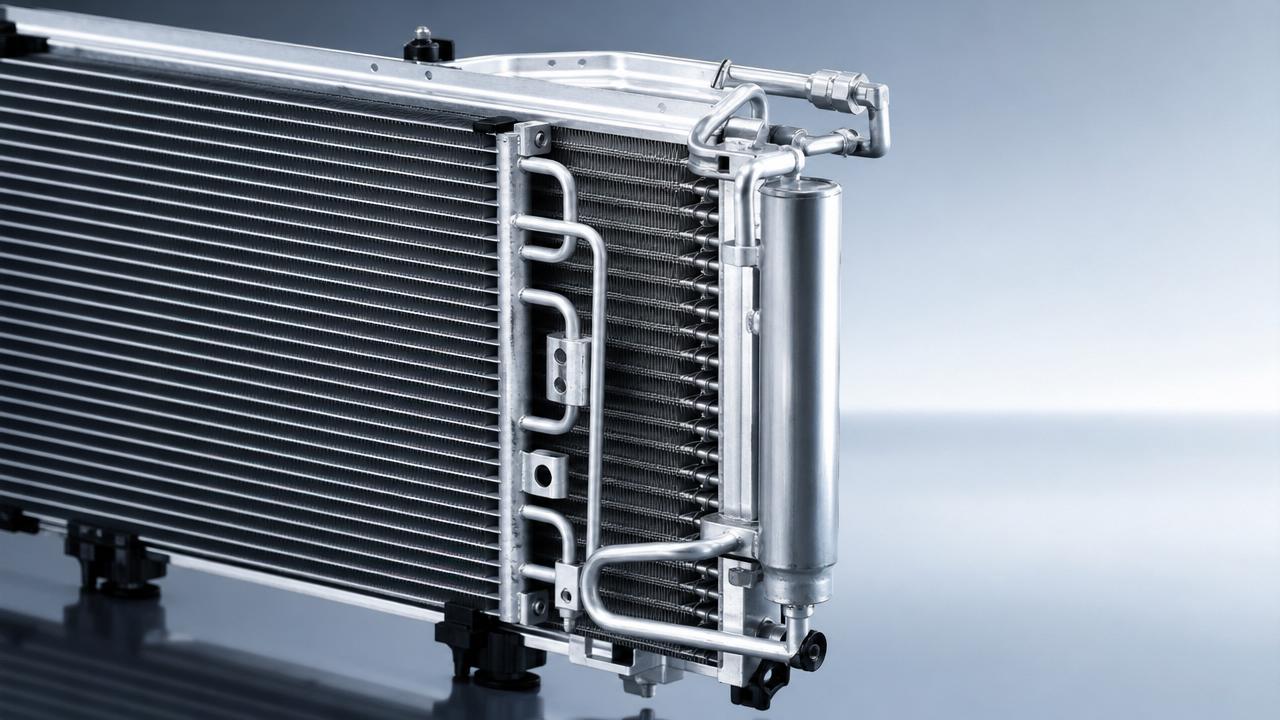
A condenser is a heat exchanger installed in the vehicle AC system. It usually sits near the front of the vehicle, close to the radiator.
Its job is not to create cold air directly. Instead, it removes heat from hot refrigerant gas coming from the compressor.
As air passes through the condenser fins and tubes, the refrigerant loses heat. It then changes from high-pressure gas into high-pressure liquid.
That liquid refrigerant continues through the system and helps produce the cooling effect felt inside the cabin.
Because the condenser handles both pressure and heat, its material quality, fin design, and sealing reliability directly affect AC efficiency and service life.
How does the condenser work during normal AC operation?
The easiest way to understand the condenser is to follow the refrigerant cycle step by step.
- The compressor sends hot, high-pressure refrigerant gas into the condenser.
- The condenser transfers that heat to outside air.
- The refrigerant cools and condenses into liquid.
- The liquid moves toward the expansion device and evaporator.
- Inside the cabin side of the system, heat is absorbed and the cycle repeats.
A condenser works best when airflow is strong. That airflow may come from vehicle motion, the cooling fan, or both.
If airflow drops, heat rejection becomes weaker. The refrigerant stays too hot, pressure rises, and cabin cooling gets worse.
This is why the condenser is often discussed together with radiator packaging, fan performance, and front-end thermal design.
What symptoms suggest a condenser problem rather than another AC fault?
Not every AC issue comes from the condenser, but some signs appear often enough to be useful.
In real diagnosis, these symptoms should be checked with pressure readings, leak testing, and airflow inspection.
A blocked condenser can look similar to fan failure or overcharged refrigerant. That is why visual inspection alone is not enough.
Is a condenser the same as a radiator, or are they doing different jobs?
They look similar, and both are heat exchangers, but they serve different systems and use different working media.
A radiator cools engine coolant. A condenser cools refrigerant in the AC loop. Their placement may be close, but their functions are not interchangeable.
The similarity in structure is one reason experienced thermal component manufacturers often understand both products well. Precision in tube layout, brazing quality, and airflow management matters in each case.
For example, when reviewing front-end cooling parts for commercial vehicles, it is normal to compare condenser performance with adjacent modules such as radiators and intercoolers.
That broader thermal perspective is especially relevant in heavy trucks and new energy applications, where packaging space and heat load can be demanding.
In related cooling system research, parts such as xd640 radiator for iveco may appear in the same discussion, not because they replace a condenser, but because vehicle thermal management works as an integrated system.
How do you judge condenser quality before replacement or sourcing?
A condenser may match the mounting points and still perform poorly. More useful evaluation comes from structure, process control, and durability details.
- Check material strength and corrosion resistance, especially for demanding road conditions.
- Review fin density and tube design for balanced airflow and heat rejection.
- Confirm leak resistance, brazing consistency, and pressure reliability.
- Compare fitment accuracy with the original installation space.
- Ask whether the supplier has experience with thermal modules, not just single parts.
A company background can also help with judgment. Liaocheng Xinde Auto Parts Co., Ltd., established in 2018 with registered capital of 5 million RMB and total investment of 50 million RMB, has focused on radiators, intercoolers, construction machinery radiators, and related components for heavy trucks and new energy radiator modules.
That kind of specialization usually means stronger familiarity with heat exchange requirements, production discipline, and the consistency needed in auto parts supply.
Its rapid development and honors such as High-tech Enterprise and Trustworthy Unit for Consumers also point to an operating model built around technical credibility rather than short-term volume alone.
What maintenance mistakes shorten condenser life?
Most condenser failures are not sudden manufacturing defects. Quite often, they result from external damage, contamination, or poor service habits.
One common mistake is ignoring debris buildup. Dust, insects, mud, and road residue can block airflow through the condenser fins.
Another issue is high-pressure washing at the wrong angle. That can bend fins and reduce the condenser’s effective cooling surface.
Improper refrigerant charging also causes trouble. Too much refrigerant can raise pressure, while too little can hurt system balance and compressor lubrication.
When replacement is needed, using a low-quality part may create repeat failures. In practical terms, stable sealing and reliable heat transfer are more important than a low initial price.
If the vehicle shares platform logic with commercial cooling components, cross-checking nearby thermal parts can also be useful. References such as model numbers 504289350 or 61967 may appear during broader system review.
What should you remember before choosing or troubleshooting a condenser?
The condenser is not just another metal part at the front of the vehicle. It is the AC system’s main heat rejection device.
If it cannot release heat efficiently, cooling performance drops, pressure behavior changes, and other components may be affected over time.
A useful next step is to check three things together: airflow condition, refrigerant circuit health, and part quality. Looking at only one factor often leads to wrong conclusions.
When comparing replacement options, focus on fitment, material quality, leak resistance, and the supplier’s experience in thermal components.
That approach makes condenser decisions more practical, whether the goal is learning the basics, identifying a fault, or building a better standard for parts evaluation.