



Vehicle Radiator Specifications Explained: Rows, Tubes, Fins, and Cooling Efficiency
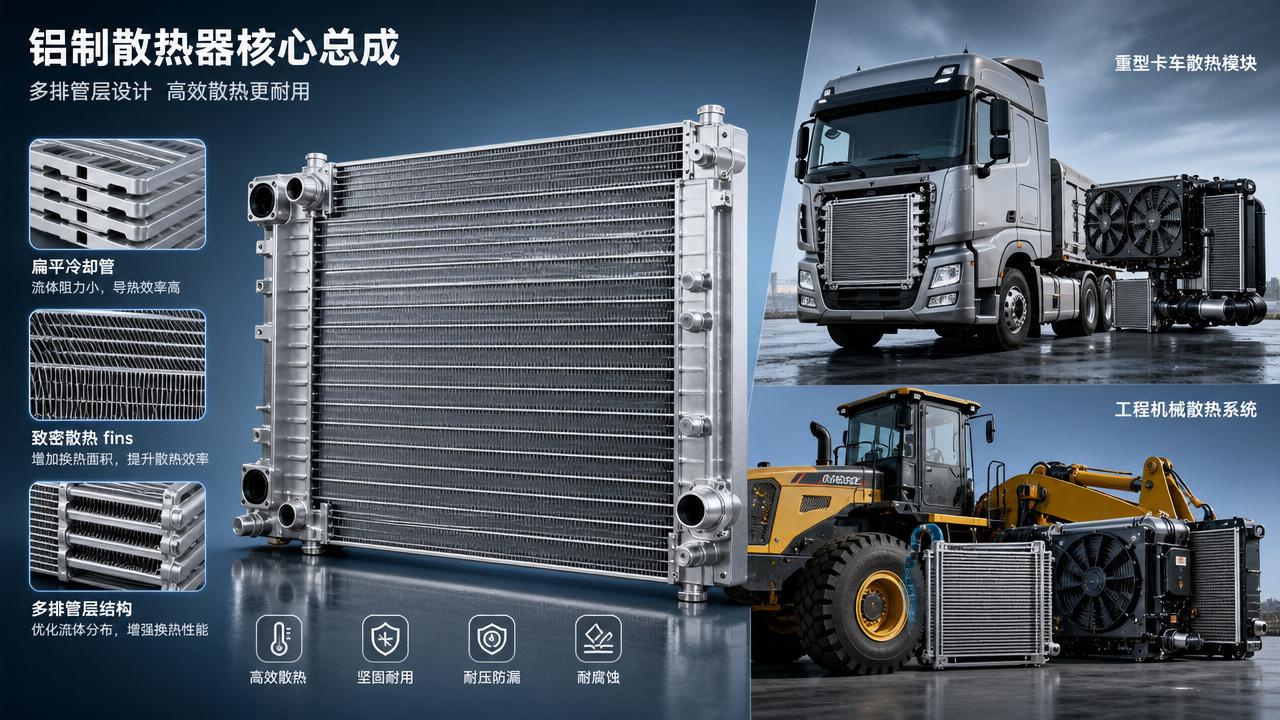
Vehicle Radiator Specifications Explained: Rows, Tubes, Fins, and Cooling Efficiency
Selecting the right vehicle radiator requires more than checking dimensions. Real performance depends on how core structure manages heat, airflow, pressure drop, and durability under load.
That is why vehicle radiator specifications matter during technical comparison. A radiator with similar size can still deliver very different cooling results in the field.
Rows, tubes, and fins are the core variables. Together, they shape heat transfer capacity, coolant flow behavior, vibration resistance, and service life.
In heavy trucks, construction machinery, and new energy systems, those details become even more important. Operating cycles are tougher, ambient temperatures vary more, and cooling margins are often tighter.
Liaocheng Xinde Auto Parts Co., Ltd., established in 2018, focuses on radiator and thermal system development for global markets. Its portfolio covers water tank radiators, intercoolers, construction machinery radiators, and heavy-duty as well as new energy radiator modules.
From an evaluation standpoint, the goal is simple. You need to read vehicle radiator specifications in a way that predicts real cooling efficiency, not just catalog appearance.
Why Core Specifications Matter More Than Overall Size
Overall length, width, and thickness are only starting points. They tell you whether the radiator fits the package space, not whether it performs well there.
A vehicle radiator works by transferring heat from coolant to metal surfaces, then from metal to moving air. Every design choice affects one of those transfer steps.
More rows may increase heat exchange area. However, they can also restrict airflow if fin and tube geometry are not balanced properly.
More tubes can improve coolant distribution. Yet if tube shape, wall thickness, and header design are poorly matched, pressure losses may rise unnecessarily.
Higher fin density may raise surface area. At the same time, it can trap dust, reduce airflow, and hurt performance in muddy or debris-heavy environments.
This is why the best vehicle radiator is not always the thickest unit. The best one is the design that stays thermally efficient inside the actual duty cycle.
Understanding Radiator Rows
Rows refer to the number of tube layers arranged from front to back across the radiator core. This is one of the most discussed vehicle radiator specifications.
What More Rows Actually Do
Adding rows usually increases total contact area between coolant, tubes, fins, and air. In theory, that creates more opportunity for heat rejection.
But airflow loses energy as it passes through each layer. By the rear rows, air is already warmer and slower, so the added benefit often decreases.
When More Rows Help
- High-load diesel engines with long uphill operation
- Construction machinery facing low-speed, high-heat conditions
- Applications with sufficient fan power and airflow reserve
- Systems needing higher thermal capacity during peak cycles
When More Rows Can Hurt
- Engine bays with restricted air entry
- Dusty sites where fin blockage builds quickly
- Vehicles where fan energy consumption must stay low
- Compact systems where extra thickness affects surrounding components
So, a row count should never be read alone. It must be evaluated together with airflow path, fan curve, shroud design, and heat load profile.
Tube Design: The Hidden Driver of Cooling Efficiency
Tube design often has a bigger impact than buyers expect. In many cases, tube geometry explains why two similar-looking radiators perform differently.
Tube Count and Tube Width
More tubes usually mean more coolant passages. That can improve heat transfer area and support better distribution across the core.
Wider tubes increase exposed surface area per passage. They can also reduce flow resistance compared with many narrow passages, depending on the internal design.
Flat Tubes Versus Traditional Round Concepts
Modern aluminum vehicle radiator designs often use flat tubes. Flat profiles present more surface area to airflow and generally package more efficiently within a given core thickness.
This also supports better fin contact. Better contact means more reliable heat conduction from coolant to the external air side.
Internal Tube Structure
Some tubes include internal turbulators or multi-channel layouts. These features disturb boundary layers and improve heat transfer, especially under demanding thermal conditions.
Still, added complexity should be checked against clogging risk, coolant cleanliness requirements, and long-term manufacturability standards.
If you compare replacement or platform-specific products such as Radiator for FIAT, tube layout should be reviewed alongside the intended engine heat rejection demand, not as a stand-alone selling point.
Fin Density and Air-Side Performance
Fins are the bridge between tube heat and passing air. Their spacing, shape, and density strongly influence real vehicle radiator efficiency.
Why Fins Matter
Coolant does not release most of its heat directly to open air. It first passes that heat into tubes and fins, which multiply the available exchange surface.
Higher fin density usually increases surface area. That may improve cooling in clean, high-airflow conditions, especially at highway speed or with a strong fan system.
The Trade-Off Behind Tight Fins
Tighter fin spacing creates more resistance to airflow. In real operation, that can reduce air volume through the core and narrow the expected performance gain.
Another issue is contamination. Dust, insects, oil film, and jobsite debris fill narrow fin passages faster than wider ones.
For off-road and construction use, moderate fin density often gives a better balance between thermal efficiency and field maintainability.
What to Check During Evaluation
- Fins per inch or equivalent spacing metric
- Fin bonding quality to tube surfaces
- Resistance to vibration and fin deformation
- Cleaning access for service environments
- Airflow performance after partial fouling
How to Judge Cooling Efficiency in Practical Terms
Cooling efficiency is not one single number. It is the result of thermal transfer, pressure behavior, packaging constraints, and operating stability over time.
Key Performance Indicators
- Heat rejection capacity under defined flow conditions
- Coolant-side pressure drop across the core
- Air-side pressure drop through the fin field
- Approach temperature between coolant outlet and ambient air
- Thermal stability under transient or peak loading
Real-World Factors That Change Results
A vehicle radiator may test well in the lab and still underperform in service. Installation environment often explains the difference.
Fan shroud sealing, grille opening ratio, upstream intercooler placement, and engine bay recirculation all affect available cooling air.
This also means specification review should include the whole thermal module, not just the radiator core. That approach reduces comparison errors.
Material, Durability, and Manufacturing Quality
Vehicle radiator performance is only valuable if it lasts. Durability should be assessed with the same attention as pure cooling data.
Aluminum designs remain widely used because they combine good thermal conductivity, weight advantages, and scalable manufacturing efficiency.
However, material alone does not guarantee quality. Brazing consistency, header strength, tank sealing, and vibration resistance directly affect service reliability.
For heavy-duty or new energy applications, repeated thermal cycling is a major concern. Weak joints may survive initial testing but fail after long-term expansion and contraction.
This is one reason growing manufacturers with dedicated research and production capabilities attract attention. Fast expansion only matters when it is supported by process control and stable product consistency.
A Simple Evaluation Checklist for Specification Review
When comparing any vehicle radiator, a short structured checklist helps keep decisions practical and repeatable.
- Confirm actual heat rejection target, not just vehicle model matching.
- Review row count together with airflow capability and contamination risk.
- Check tube number, tube shape, and internal passage design.
- Assess fin density based on the operating environment and cleaning frequency.
- Compare coolant and air-side pressure drop, not heat transfer alone.
- Verify material quality, brazing consistency, and fatigue resistance data.
- Look at module integration effects from intercoolers, fans, and shrouds.
- Use platform-specific fitment parts, such as Radiator for FIAT, only after performance fit is confirmed.
Final Takeaway
The best vehicle radiator is rarely defined by one headline specification. Rows, tubes, and fins must work together as a balanced thermal system.
A good technical review looks beyond thickness and catalog claims. It checks how airflow, coolant flow, fin density, and durability interact in the real application.
In practical sourcing, that balanced view helps avoid overspecifying, underspecifying, or choosing a vehicle radiator that performs well only under ideal conditions.
If the goal is reliable cooling efficiency, the smartest next step is clear. Compare specifications as an integrated performance package, then validate them against the actual duty cycle.