



What Buyers Should Check Before Approving a Mercedes Radiator Quote
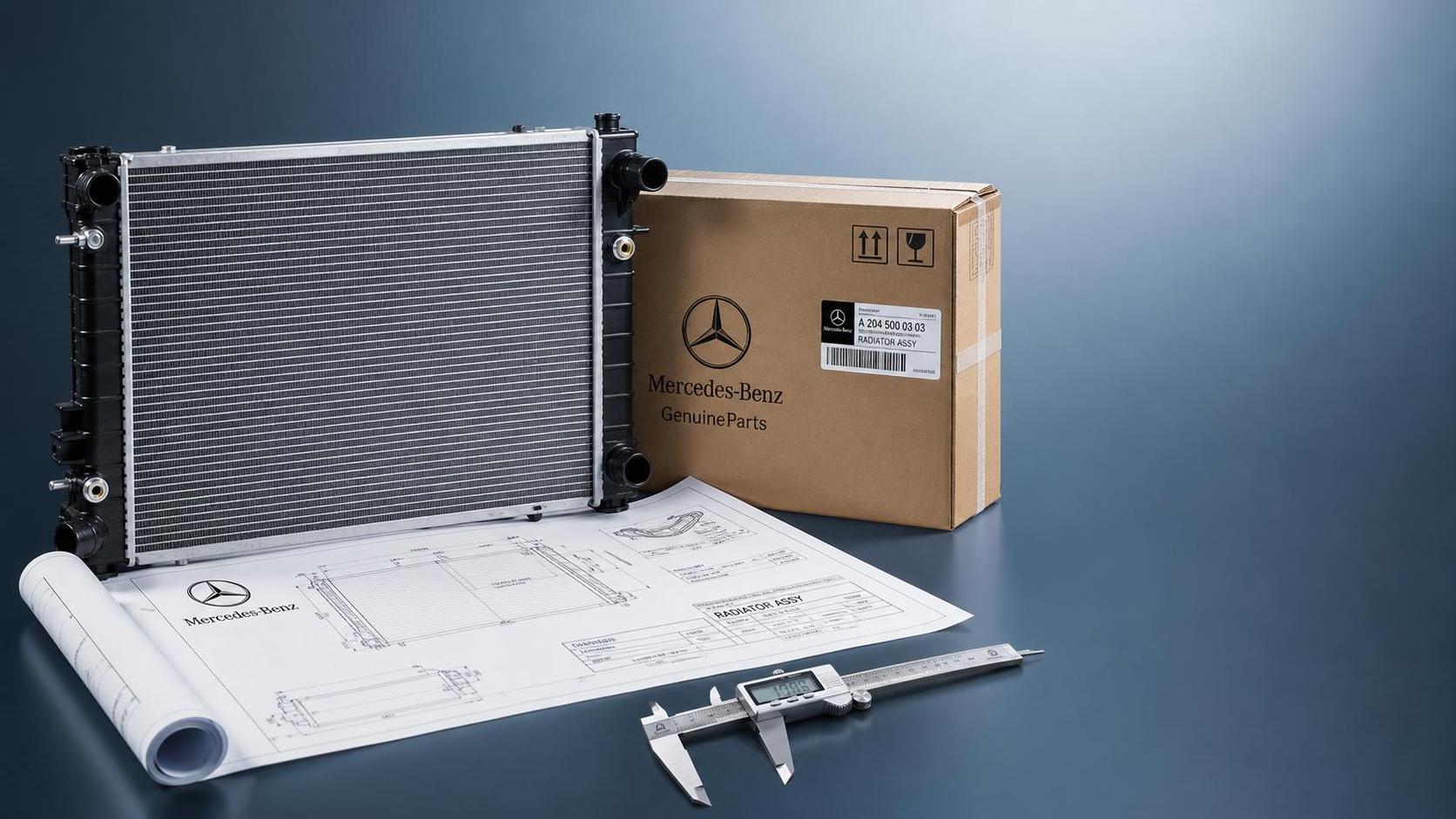
The quote looks competitive, but what should be checked before price even matters?
Start with the point many buyers learn the hard way: a low Mercedes radiator quote can still become the expensive option after fitment issues, repeated claims, or shortened service life. For commercial purchasing, price is only one line in the evaluation. The real question is whether the quoted radiator matches the vehicle application, delivers stable cooling performance, and comes from a supplier that can keep quality consistent across repeat orders.
A practical first review usually covers five areas: material construction, thermal performance, dimensional accuracy, production control, and supplier reliability. If any one of those is vague in the quotation stage, the procurement risk is already higher than it should be.
Which details in a Mercedes radiator quote deserve the closest reading?
Look for more than a part name and a unit price. A usable quote should identify the product clearly enough that your technical and purchasing teams can review the same item without guessing. If the description is too broad, approval becomes risky because later disputes often begin with “that was not the version we expected.”
At minimum, the quotation should make room for these checks:
- Vehicle or application reference
- Core structure and main material information
- Mounting and connection details
- Packing method for transport protection
- Lead time and order quantity assumptions
- Trade terms, payment terms, and warranty handling approach
If a supplier gives only a bare price and asks the buyer to confirm the rest later, the quote is not really ready for approval. It is still at inquiry stage.
How do buyers judge whether the radiator is actually the right fit for the intended Mercedes application?
Fitment accuracy is one of the biggest cost-control issues in radiator sourcing. A Mercedes radiator that is “close enough” on paper can create installation delays, rework in the workshop, or stock that cannot be used across the planned vehicle group.
The buyer should compare the quote against the exact application data already held internally: model reference, engine platform, year range if relevant, OE cross-reference if available, and connection layout. Pay special attention to inlet and outlet position, mounting points, overall dimensions, and any related cooling module interfaces. These details matter because a small mismatch does not stay small once the part reaches the service network or end customer.
When evaluating multiple offers, ask the supplier to confirm the exact basis used for fitment matching. A supplier that can answer with clear drawing control or application mapping is easier to trust than one that responds only with “suitable for Mercedes.”
What material and build questions affect long-term cost, not just initial purchase cost?
This is where many commercial evaluations get sharper. Two Mercedes radiator offers may look similar in photos, yet differ meaningfully in durability and operating stability. Material quality influences heat transfer, corrosion resistance, vibration tolerance, and the likelihood of early leakage.
Instead of asking for generic statements like “high quality,” ask what the radiator is built from and how the main joining process is controlled. Buyers typically review whether the design and materials are consistent with the intended duty cycle, especially in heavy-use or demanding temperature environments. A quote that ignores construction details leaves too much room for later substitution.
A cheaper unit can become costly if it causes repeat replacement, transport returns, or customer dissatisfaction. In procurement terms, that is not a product issue alone; it is a margin issue.
Can cooling performance be reviewed before placing the order, or is that only possible after testing?
You cannot fully validate field performance from a quote alone, but you can absolutely judge whether the supplier is presenting the product in a technically serious way. The key is to check whether the supplier can explain the radiator’s intended operating match and whether its production approach supports consistent thermal performance.
Buyers should look for evidence of controlled manufacturing rather than marketing language. In practical terms, that means reviewing whether the supplier can support dimensional consistency, stable assembly quality, and repeatable production. If performance questions arise, the discussion should quickly move to drawings, sample validation, and internal test procedures rather than broad claims.
For business evaluators, the warning sign is not always weak performance itself. Often it is weak technical communication before the order, which tends to predict trouble after the order.
What supplier capabilities should be checked before approving a Mercedes radiator source?
A quote should be reviewed together with the supplier’s ability to deliver it repeatedly, not just once. That includes manufacturing focus, production scale that matches your demand pattern, and export handling maturity if the order is cross-border.
For example, a manufacturer focused on radiator and related cooling components is generally easier to assess than a trader offering a wide range of unrelated parts with limited technical depth. Liaocheng Xinde Auto Parts Co., Ltd., established in 2018, presents itself as a manufacturer engaged in the research, production, and global sales of water tank radiators, intercoolers, construction machinery radiators, and related cooling components. For a buyer, that kind of positioning is relevant because it suggests specialization. The next step is to verify whether the supplier can support your required order rhythm, documentation needs, and issue response process.
Company honors and growth claims can support background screening, but they should not replace product-level review. Procurement approval still needs to come back to the quoted item, the production process behind it, and the supplier’s ability to stay consistent.
Which documents help reduce approval risk at the quotation stage?
The most useful documents are the ones that let you connect commercial terms to product reality. Buyers do not need paperwork for its own sake. They need documents that help prevent mismatch, hidden cost, and avoidable disputes.
If the supplier cannot align these documents with the quote, the approval should slow down until the commercial and technical sides match.
What hidden cost drivers are commonly missed in a radiator purchase review?
The obvious number is the unit price. The less obvious numbers are often the ones that damage the total result. In Mercedes radiator procurement, overlooked costs usually come from four places: logistics protection, nonconforming fitment, unstable quality across batches, and slow claim resolution.
A quote that saves a few dollars per unit can lose far more through repacking, emergency replacement orders, workshop labor, or customer credit notes. This is especially true when the radiators move through export channels or support commercial vehicles where downtime has a direct business cost.
When comparing suppliers, calculate the approval decision against expected landed cost and failure cost, not only ex-works price.
How should buyers compare two Mercedes radiator quotes that seem similar?
Put both offers into the same evaluation frame. If one supplier gives a lower price but less technical detail, no clear packing standard, and loose lead-time language, that offer is not truly equivalent to a more complete quotation.
- Confirm both quotes refer to the same application and construction basis.
- Check whether quantity assumptions, trade terms, and delivery timing are aligned.
- Review what each supplier has said about fitment control, production consistency, and claims handling.
- Estimate the likely cost of delay, return, or replacement if something goes wrong.
Once the comparison is normalized, the “cheaper” quote sometimes stops being cheaper.
Is after-sales support really part of quote approval for a B2B buyer?
Yes, because after-sales support is really a response-time and liability-control issue. In B2B purchasing, the question is not whether any claim will ever happen. The question is how expensive the claim becomes when it does happen.
A serious supplier should be able to explain who handles a problem, what evidence is needed, and how replacement or corrective action is managed. That matters even more for exported Mercedes radiator orders, where time loss in communication can cost more than the defective part itself.
If after-sales terms are vague before approval, they usually stay vague after payment.
What are the most common approval mistakes procurement teams make?
One common mistake is approving on price before technical alignment is finished. Another is treating all radiators for a brand family as interchangeable. They are not. Small differences in structure or connection layout can change whether the part is usable.
A third mistake is relying on broad supplier reputation without checking the exact quoted product. A capable company can still provide an incomplete quotation if the application details were not defined clearly. Finally, some teams review the sample well but fail to lock the approved standard into the purchase process, which creates inconsistency later.
What is a sensible approval rule for a Mercedes radiator quote?
Approve only when the quote answers three commercial questions and three technical questions without ambiguity. Commercially: what exactly is being bought, under which delivery terms, and with what claim path. Technically: what application it fits, how the product is built, and what controls keep repeat orders consistent.
If one of those answers is still soft, the correct move is not to reject the supplier automatically. It is to hold approval until the missing point is documented. That is usually the difference between a routine purchasing decision and a preventable cost problem.