



Nissan Radiator Replacement: Which Specs Matter More Than Part Number
Why a Nissan Radiator Can Be Wrong Even When the Part Number Looks Right
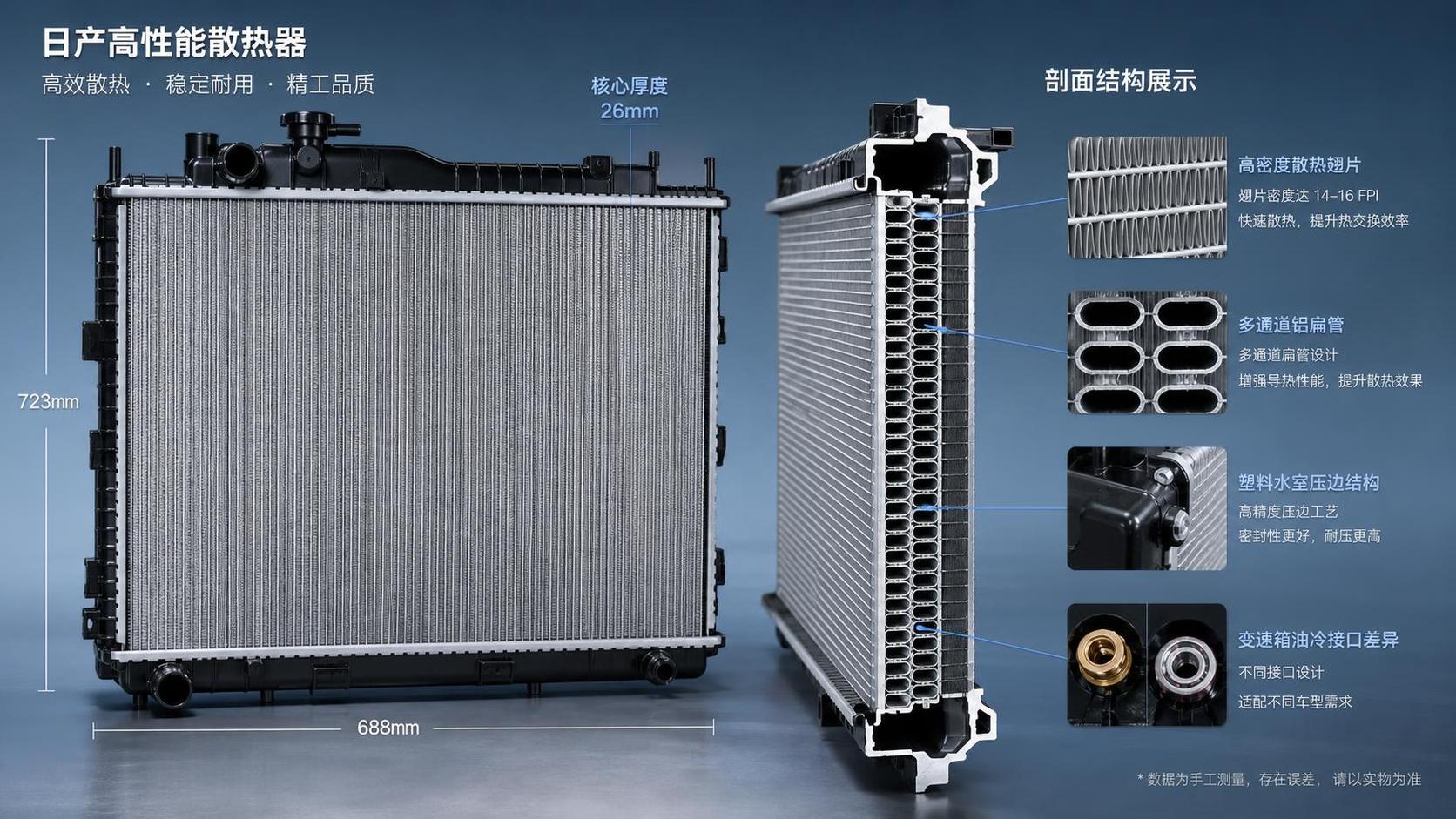
In radiator replacement work, the part number is often treated as the final answer. It is not. For a Nissan radiator, especially in commercial use, export supply, or mixed aftermarket channels, the part number is only a starting reference. What actually determines whether the replacement will perform correctly is the specification set behind that number: core dimensions, tube and fin structure, material grade, tank design, mounting geometry, transmission oil cooler configuration if equipped, and pressure capability that matches the vehicle’s cooling system.
This matters because two radiators can be sold under cross-referenced numbers and still behave differently in service. One may physically bolt in but run hotter under load. Another may match the outline size yet have lower heat rejection because the core is thinner, the tube section is reduced, or the fin density is changed for cost reasons. In technical evaluation, that is the real risk: not obvious installation failure, but a replacement that passes the first impression and fails later in traffic, under towing, in high ambient temperature, or in stop-and-go duty where airflow is already limited.
That is why experienced buyers do not ask only, “What is the Nissan radiator part number?” They ask, “What is the exact cooling package specification behind it?”
The specifications that usually matter more
The first item to verify is OE-equivalent overall size, but “size” needs to be read carefully. External length and height are not enough. Core thickness has a direct effect on heat transfer capacity, coolant volume, and airflow resistance. A thicker core is not automatically better, because fan capacity and shroud design also matter, but a thinner core than the original specification is one of the most common reasons a replacement underperforms.
Tube design comes next. In aluminum radiators, the number of rows is less useful than the tube width, tube height, wall consistency, and total effective tube area. A radiator with fewer but wider multi-channel tubes can outperform an older narrow-tube layout. On the other hand, some low-cost replacements reduce material usage by narrowing the tube section or changing the internal channel design. The unit may still fit and pass a simple leak test, but cooling reserve is lower.
Fin geometry also deserves attention. Fin pitch influences heat rejection, but higher fin density is not a universal advantage. In dusty service, construction support vehicles, or routes with insects and road debris, overly tight fins can clog more easily and lose effectiveness over time. A technical evaluator should look for balance: enough fin area for the required duty cycle, without creating a core that becomes maintenance-sensitive in the actual operating environment.
Material grade is another point that is often hidden behind generic wording such as “aluminum radiator.” That description says very little. What matters is whether the tube, header, and tank materials are appropriate for brazing quality, vibration resistance, corrosion exposure, and coolant chemistry. In real-world use, poor material consistency often shows up first at the joints, the tube-to-header connection, or the plastic tank crimp area if the design uses plastic end tanks.
Fitment is more than bolt pattern
A Nissan radiator can be dimensionally close and still create installation or service issues. Mounting brackets, isolator positions, hose neck angle, inlet and outlet diameter, fan shroud attachment points, sensor ports, drain location, and filler neck configuration all affect whether the radiator integrates correctly with the vehicle. If the lower hose outlet is off by even a small angle, the hose can sit under twist load. That may not fail immediately, but it shortens hose life and increases the chance of seepage at the clamp area.
For automatic transmission applications, the internal or integrated transmission oil cooler specification must also be checked. Some replacement radiators are sold as broad-fit solutions, but cooler connection type, thread form, and internal flow arrangement may differ. That turns a simple radiator replacement into a cooling system and transmission risk. Part-number matching alone rarely captures that level of detail.
Pressure rating is another overlooked factor. The radiator has to work with the cap rating and the system’s designed operating pressure. If the core or tank assembly has weak burst margin or poor crimp retention, field failure often appears during temperature spikes, not during workshop inspection. Technical evaluation therefore needs to consider not just leak status at delivery, but structural reliability through thermal cycling and pressure fluctuation.
Where technical evaluators usually get misled
One common misunderstanding is assuming that a catalog cross-reference proves functional equivalence. In practice, cross-reference systems are useful for narrowing options, but they do not replace dimensional confirmation and performance review. Catalog data can lag behind design changes, regional variants, or supplier substitutions.
Another mistake is treating visual similarity as engineering similarity. A radiator may look nearly identical from the front, while the internal tube arrangement, braze quality, fin thickness, or tank reinforcement differs significantly. These are not cosmetic differences. They affect durability under vibration and cooling efficiency over long service intervals.
Price-driven substitutions also create distortion in evaluation. When a buyer compares quotations only by nominal fitment and part number, suppliers are pushed toward visible equivalence and hidden reduction. The reductions are predictable: less core thickness, lighter headers, lower-grade plastic tanks, simplified mounting reinforcements, or weaker packaging that damages the core before installation. None of these issues are obvious if the review process is too narrow.
A more practical way to assess a replacement radiator
For selection work, a short specification checklist is usually more valuable than a long product brochure. At minimum, the evaluator should confirm the following points before approving a Nissan radiator for purchase or sourcing:
If the supplier cannot provide this information clearly, the evaluation is incomplete, even if the commercial offer looks attractive.
How manufacturing background changes the reliability discussion
In radiator sourcing, the drawing matters, but the factory matters too. Two suppliers can quote the same specification sheet and still deliver different consistency in braze quality, leak integrity, and dimensional control. For buyers evaluating long-term supply, manufacturing scope is relevant. A producer focused on radiator and heat-exchanger categories generally understands the interaction between cooling performance, vibration load, and vehicle-specific packaging better than a trader working from catalog aggregation alone.
Liaocheng Xinde Auto Parts Co., Ltd., established in 2018, operates as a specialized manufacturer in water tank radiators, intercoolers, construction machinery radiators, and related thermal management components for heavy trucks and new energy radiator modules. That background does not eliminate the need for technical validation, but it does speak to process familiarity in a category where consistency is often more important than brochure claims. For technical evaluators, this kind of production focus is useful because radiator replacement quality depends as much on execution discipline as on nominal design.
That is particularly true when replacement parts are intended for demanding operating conditions. Heavy-load service, frequent thermal cycling, rough-road vibration, or mixed climate exposure will reveal weaknesses faster than light-duty passenger use. A radiator that survives ordinary commuting may still be the wrong choice for vehicles that spend long periods under sustained cooling demand.
What “OE-equivalent” should mean in evaluation
The phrase “OE-equivalent” is often used loosely. In a serious evaluation context, it should mean more than visual resemblance or nominal fit. It should imply that the replacement aligns with the original equipment intent in dimensions, interface points, thermal capacity, and service reliability within the expected duty cycle. It does not always require identical construction, because modern designs may use different tube architecture or manufacturing methods, but the replacement should not reduce the operating margin that the original cooling system depended on.
That is why technical teams often request drawings, sample inspection, pressure test information, and material details before approving a supplier. Even limited documentation can tell a great deal. A supplier who can explain the radiator by structure and application is usually more credible than one who can only repeat cross-reference numbers.
The better decision rule
When selecting a Nissan radiator, use the part number to identify the search range, not to close the decision. The actual decision should be based on whether the replacement preserves cooling capacity, system compatibility, and durability in the vehicle’s real operating conditions. If there is a conflict between the label and the specification, trust the specification.
That approach takes more effort at the evaluation stage, but it avoids the expensive pattern that many buyers already know: the radiator fits, the vehicle leaves, and the problem returns when the cooling system is finally asked to do its full job.