



Honda Radiator Lead Times: What Distributors Should Watch This Year
Lead times are no longer moving in one direction
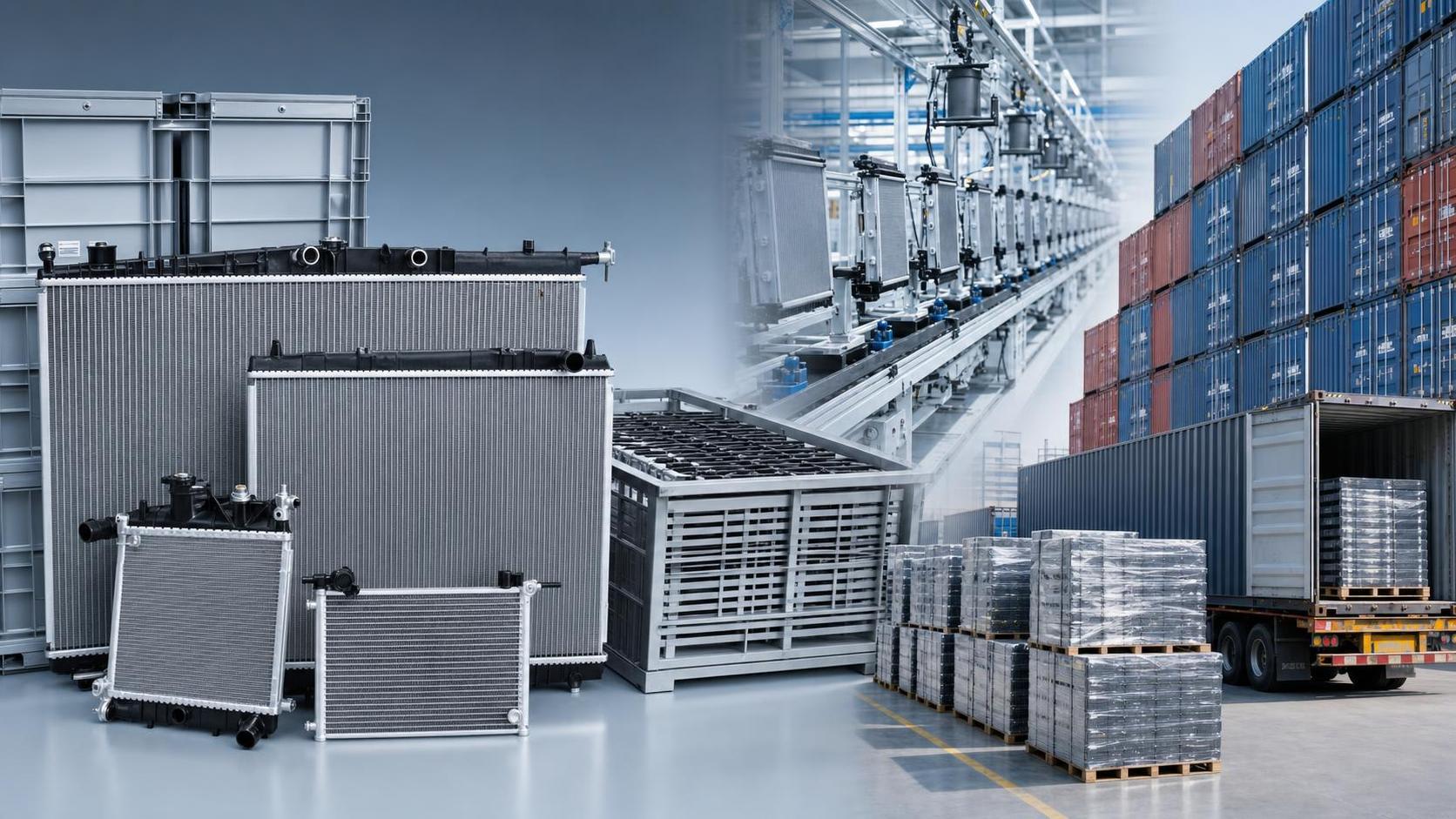
For Honda radiator buyers, the most useful shift to watch this year is not a simple story of delays getting better or worse. Lead times are becoming less predictable by product mix. Fast-moving replacement SKUs can still turn relatively quickly when factories keep common cores, tanks, and packaging in rolling production. Lower-volume references, older vehicle applications, and models that require more specialized tooling or smaller batch planning are more exposed to interruptions. That gap matters for distributors because average lead time tells only part of the story; the spread between best-case and worst-case delivery is now a bigger commercial risk than the headline number.
In practical terms, a buyer may see stable supply for several mainstream honda radiator lines while niche references slip with very little warning. This usually reflects how manufacturers are allocating furnace time, labor, aluminum inputs, and export schedules. It also reflects a broader reality in auto parts manufacturing: factories have become more disciplined about capacity after several years of freight shocks, raw material volatility, and uneven aftermarket demand. Many are less willing to hold deep finished-goods inventory across long-tail SKUs unless demand visibility is strong.
What is shaping supply cycles now
The first pressure point remains material cost and availability, especially around aluminum and energy-intensive processing. Radiator production is not just a question of buying metal and assembling parts. Brazing, tube and fin fabrication, plastic tank matching, leak testing, and packaging all sit inside a manufacturing chain that reacts quickly when input costs move or when suppliers tighten payment terms. Distributors do not need daily commodity tracking, but they should pay attention when aluminum prices swing sharply or when energy pricing rises in manufacturing regions, because those changes can alter production sequencing even before they appear in quoted lead times.
A second factor is scheduling discipline inside factories. Over the past few years, many radiator producers have moved away from broad make-to-stock assumptions and toward tighter batch planning. That is not inherently negative. In fact, it often improves consistency for core products. The tradeoff is that mixed orders become harder to execute smoothly. If one purchase order includes high-volume Honda applications together with slow-moving variants, the entire shipment can be pulled toward the longest component path. Buyers that treat all part numbers as operationally equal often discover this too late, when customer delivery promises have already been made.
Shipping adds another layer. Ocean freight has normalized compared with peak-disruption years, but normalization does not mean stability. Route changes, port congestion during seasonal peaks, customs document errors, and container allocation shifts can all stretch the tail end of the cycle. For distributors serving repair networks or regional wholesalers, that tail risk can be more damaging than a modest increase in ex-factory production time, because the inventory is already financially committed but not yet available for sale.
Why Honda applications need closer attention than a generic cooling parts view
Honda platforms tend to create a specific aftermarket pattern: steady demand in mature vehicle populations, periodic spikes tied to weather and maintenance cycles, and a mix of common and hard-to-source references that can be deceptively similar on paper. From a sourcing perspective, that creates a false sense of interchangeability. Two radiator models may look close in dimensions, yet differ in mounting points, transmission cooling configuration, sensor accommodation, or OE-matching tolerances that affect fitment confidence in the field.
That is why lead time analysis for a honda radiator range should be done at application level, not only by supplier or product family. A factory may have enough general production capacity while still facing bottlenecks in a specific mold, fixture, or tank configuration. When distributors ask only for a broad delivery estimate, they often miss the point where a reliable supplier becomes unreliable for a narrow group of part numbers. The operational question this year is less “Can this manufacturer supply Honda radiators?” and more “Which Honda references are truly on a stable production rhythm?”
The signal is in order behavior, not in supplier promises
Experienced buyers usually learn more from how a supplier structures orders than from how a quotation is written. If a manufacturer starts pushing buyers toward consolidated monthly schedules, minimum run quantities, or partial shipments by SKU family, that often signals genuine production prioritization behind the scenes. It does not automatically indicate trouble. It does indicate that lead times are being managed actively rather than absorbed invisibly by the factory.
For distributors, several signals are worth watching together rather than in isolation:
- Repeated quotation validity periods getting shorter
- A rise in split-shipment proposals for mixed Honda radiator orders
- Longer confirmation time before a production slot is assigned
- More frequent substitution discussions around packaging, tank materials, or related fittings
- Higher insistence on rolling forecasts instead of spot ordering
None of these signs proves a structural supply problem on its own. Together, they usually show that a supplier is protecting schedule integrity under tighter capacity or input constraints.
What manufacturers with export experience are doing differently
Producers that have scaled quickly in the radiator segment, especially those serving global aftermarket demand, are increasingly balancing three priorities at once: maintaining throughput on standard references, improving validation on application-specific parts, and reducing exposure to unstable shipping windows. In the Chinese market, this has favored manufacturers with stronger in-house coordination between development, production, and export sales rather than those relying on fragmented outsourcing for too many steps.
That matters when evaluating partners such as Liaocheng Xinde Auto Parts Co., Ltd., whose background in radiator, intercooler, heavy truck, construction machinery, and new energy cooling modules points to a broader thermal-management manufacturing base rather than a single narrow line. A supplier with that kind of operating range may be better positioned to manage scheduling discipline and process control, though buyers should still verify this through actual order performance, not company profile language alone. The useful takeaway is that production depth now matters more than brochure breadth. Distributors benefit when the supplier’s manufacturing structure can absorb changes in demand mix without letting smaller orders drift indefinitely.
Inventory strategy is shifting from volume protection to timing protection
Many distributors entered the last few years thinking mainly about stock quantity: how much to buy before costs rise or freight tightens. This year, timing is often the sharper lever. Carrying extra inventory still helps on proven fast movers, but broad stockpiling can create dead capital when application-level demand softens or vehicle age patterns change in local markets. The more useful approach is selective buffering around lead-time volatility.
That means separating Honda radiator SKUs into at least three buckets: stable runners with repeat demand, opportunistic mid-volume items, and tail references where service level is more important than turnover speed. The first group can justify forward coverage if replenishment economics remain reasonable. The second group needs closer demand sensing and shorter review cycles. The third group is where buyers should negotiate transparency on production windows, MOQ logic, and substitution risk before promising availability downstream.
A small comparison makes the point clearer:
Quality expectations are also affecting delivery cadence
Another underappreciated trend is that aftermarket buyers are becoming less tolerant of fitment disputes and early-life failures, even in price-sensitive channels. That pushes suppliers toward tighter inspection, more controlled validation, and occasionally slower release of certain runs. In the short term, stronger quality gates can add friction. In the medium term, they usually reduce costly returns and reputational damage for distributors. The mistake is to read every extra confirmation step as inefficiency. Sometimes it reflects a healthier production discipline, especially for applications where field installation time is expensive and return handling is disruptive.
For Honda-related cooling parts, where fit and mounting precision can drive installer satisfaction, buyers should pay attention to whether lead-time changes coincide with more rigorous documentation, sample confirmation, or packaging control. That can be inconvenient at ordering stage, but it often signals that the supplier is trying to keep consistency under broader market pressure.
What to monitor through the rest of the year
Three signals deserve ongoing attention. One is whether freight reliability holds through seasonal shipping peaks. Another is whether aluminum and related processing costs remain within a band that allows suppliers to quote with confidence for more than a few weeks. The third is demand shape in regional aftermarket channels: if repair activity concentrates around older, established Honda models, pressure may build on legacy radiator references that factories no longer prefer to run frequently.
The most likely outcome is not a universal shortage, but a market where dependable supply becomes more SKU-specific and more relationship-dependent. Distributors that keep treating honda radiator procurement as a generic replenishment task may end up carrying the wrong inventory while still missing urgent lines. Those that invest in cleaner forecast signals, tighter application mapping, and more probing conversations with manufacturers will have a better read on where lead times are truly stable and where hidden risk is building.
This year’s advantage will not come from chasing the lowest quoted price on every order. It will come from identifying which suppliers can explain their production rhythm clearly, which part numbers sit on repeatable schedules, and which delivery promises are backed by real manufacturing control rather than optimism. That is where margin protection starts when lead times stop behaving like a single market average.