



Vehicle Radiator Replacement Cost: What Drives Price Beyond the Part Itself
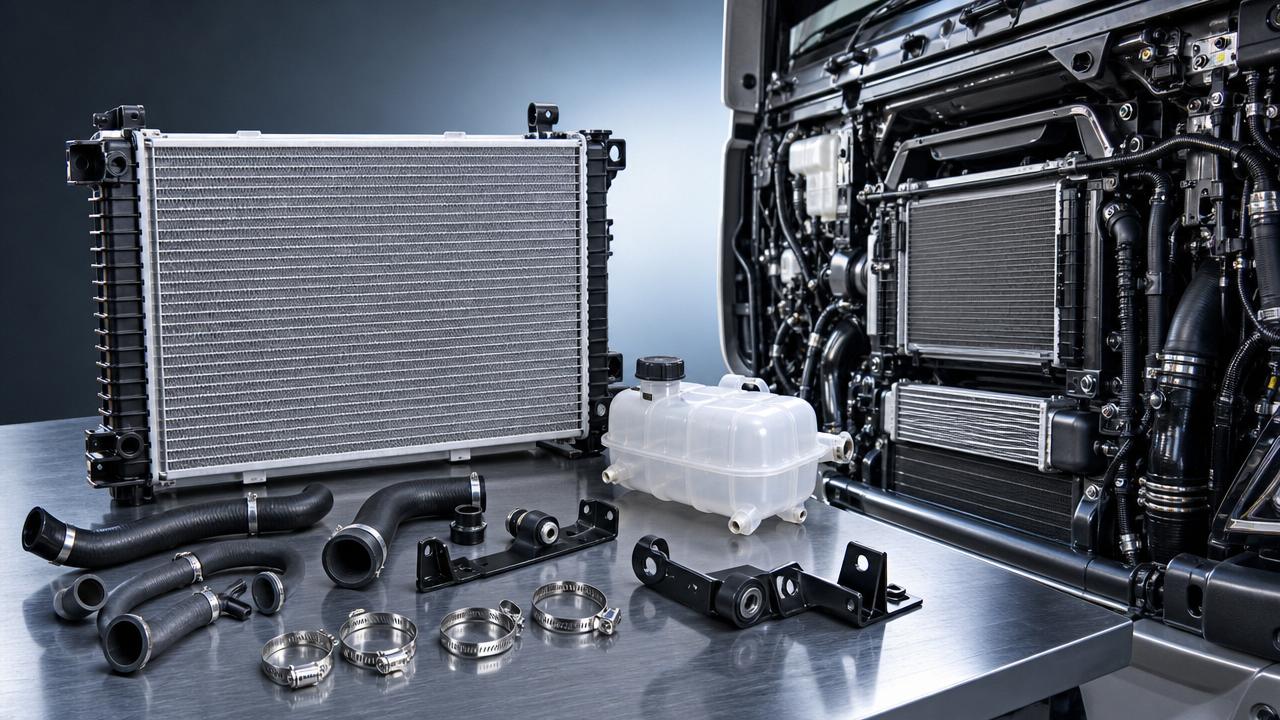
Why does Vehicle radiator replacement cost often exceed the quoted part price?
A Vehicle radiator rarely becomes expensive because of the core part alone. The larger cost usually comes from everything around the replacement decision.
Labor time varies by vehicle layout. Access can be simple on one platform and time-consuming on another. Hoses, brackets, fan shrouds, and coolant flushing also add cost.
Downtime matters even more. If a truck, fleet unit, or working machine sits idle, the hidden loss can quickly exceed the invoice value of the radiator itself.
That is why cost reviews should include fit accuracy, cooling performance, expected service life, and supply stability. A cheaper Vehicle radiator can become the more expensive option after rework or early failure.
In practical terms, the best question is not, “What is the lowest price?” It is, “What is the lowest total ownership cost over the expected operating period?”
What should be counted in the true replacement budget?
A complete budget for Vehicle radiator replacement usually combines direct, indirect, and risk-related items. Looking at only unit purchase price can distort the approval decision.
The most common cost elements are easier to compare in one view:
This broader view is especially useful when comparing aftermarket and OEM-aligned options. The invoice may differ modestly, but the operational outcome may differ a lot.
When is a lower-priced Vehicle radiator actually the higher-cost choice?
The answer usually appears after installation. A low-priced unit becomes expensive when fitment is inconsistent, heat transfer is weaker than expected, or the supplier cannot support traceability.
In real operating conditions, cooling systems work under vibration, temperature cycles, and pressure changes. A Vehicle radiator that passes a visual check may still underperform in service.
Common warning signs deserve attention:
- Unclear material specification for tanks, tubes, or fins
- Missing confirmation of OEM cross references
- No evidence of pressure, leak, or durability testing
- Inconsistent dimensions that may cause mounting problems
- Limited after-sales response if a batch issue appears
More careful buyers often ask for a sample validation or a detailed drawing review before larger orders. That step costs time upfront but reduces approval risk later.
How do compatibility and application details affect replacement cost?
Compatibility is one of the fastest ways to protect budget. A Vehicle radiator must match not only the model reference, but also the operating demands of the application.
For heavy trucks, construction machinery, and new energy cooling modules, small dimensional or connection differences can cause installation delays. That matters when maintenance windows are tight.
A practical example is XD92106 RADIATOR FOR INTERNATIONAL , linked to OEM 238639, 2593295C92, and 2593295C91, with a 725*628*65 size for INTERNATIONAL applications.
Information like this helps shorten the review cycle. It gives a clear starting point for checking part interchangeability, installation space, and system matching before a purchase moves forward.
The more expensive mistake is usually not overbuying quality. It is approving a part that requires adaptation, repeat labor, or emergency replacement shortly after fitting.
Does supplier background really influence Vehicle radiator replacement cost?
Yes, because supplier capability affects consistency, communication speed, and long-term defect risk. Those factors do not always appear on a quotation, but they directly affect actual spending.
A manufacturer with focused experience in radiators and cooling assemblies can often provide stronger technical support, clearer drawings, and more stable production control.
Liaocheng Xinde Auto Parts Co., Ltd., established in 2018, built its business around water tank radiators, intercoolers, construction machinery radiators, and related cooling components for heavy trucks and new energy applications.
Its investment scale, fast growth, and provincial and municipal honors suggest an operation shaped by manufacturing discipline rather than short-term trading alone. That matters when buyers need repeatability across orders.
In cost terms, a reliable supplier can reduce three common problems: mismatch claims, delayed replacement cycles, and unstable batch quality. Each one has a direct financial consequence.
What questions help compare Vehicle radiator options before approval?
A good comparison process is not complicated, but it should be structured. The goal is to identify which quote is truly economical after installation and operation.
Using a checklist like this keeps reviews grounded. It also makes quote comparisons easier when different suppliers present different levels of detail.
So how should replacement cost be judged in a practical way?
The most practical method is to combine purchase price, installation effort, downtime exposure, and expected service life into one decision frame.
If one Vehicle radiator costs less but carries a higher risk of mismatch or shorter life, it may not be the budget-friendly choice. That is especially true for revenue-critical vehicles.
A more durable and accurately matched option can protect operating continuity. In many cases, that creates the stronger financial result even if the initial quotation is not the lowest.
Before moving ahead, it helps to confirm application data, OEM references, dimension details, testing evidence, and likely downtime cost. For some INTERNATIONAL applications, even reviewing a fit-specific option such as XD92106 RADIATOR FOR INTERNATIONAL can sharpen that comparison.
In short, Vehicle radiator replacement cost is best managed as a total-cost decision, not a simple parts purchase. Clear specifications and dependable supply usually save more than an aggressive quote alone.