



Does a larger intercooler improve towing performance in hot weather?
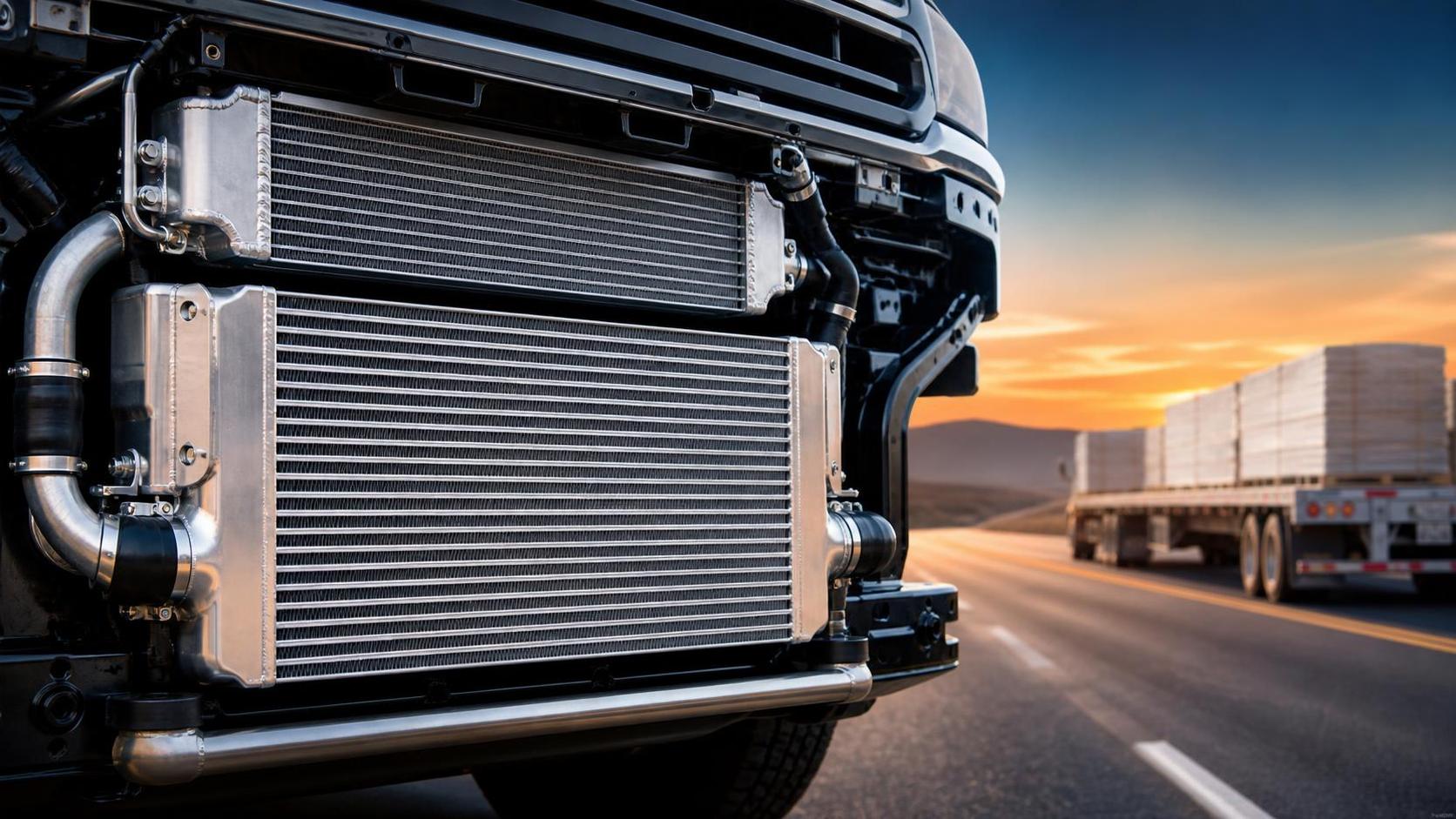
On a hot afternoon, a loaded truck can feel completely different from the same truck on a cool morning. The route may be familiar, the trailer weight may be within the normal operating range, and the engine may have no obvious fault codes. Yet on a long grade or during repeated stop-and-pull work, coolant temperature climbs, power feels less consistent, and the driver has to reduce throttle to keep temperatures under control.
In this situation, “install a larger intercooler” is a common suggestion. It can be the right move, but it is not an automatic cure for every hot-weather towing problem. A larger core may lower charge-air temperature and reduce heat stress at sustained load, but only when airflow, piping, engine calibration, coolant-system condition, and installation space all support it. The useful question is not simply whether bigger is better; it is whether the existing charge-air cooling system is the limiting factor.
Why towing exposes charge-air cooling weaknesses
Turbocharged diesel engines compress intake air before it enters the cylinders. Compression raises air temperature. Under light driving, the intercooler may have enough time and airflow to remove much of that heat. Towing changes the situation: boost pressure remains elevated for longer, exhaust heat increases, road speed may be low on climbs, and the front cooling stack is exposed to high ambient temperature and dust.
When charge air remains too hot, it becomes less dense. The engine receives less oxygen for a given intake volume, and combustion control becomes more difficult under load. Depending on the engine strategy, this can lead to reduced available power, increased exhaust temperature, protective derate behavior, or a combination of those effects. The driver experiences this as a truck that pulls well for a short period but loses consistency when the work becomes sustained.
An intercooler does not create engine power by itself. Its job is to remove heat from compressed intake air. If it can keep outlet air temperature more stable during a long pull, the engine has a better chance of maintaining the air density and operating conditions expected by its calibration. That is where a larger intercooler can improve towing performance in hot weather.
The larger-core assumption needs a closer look
A physically larger unit usually offers more heat-transfer area and may hold more air volume. Those features can be useful, especially when the original cooler is operating near its thermal limit. But core size alone does not describe real cooling performance. Fin density, tube layout, internal flow design, tank geometry, airflow through the fins, pressure drop, and the condition of the surrounding cooling package all matter.
A replacement that is taller, thicker, or wider can underperform if it blocks airflow to the radiator or air-conditioning condenser, has restrictive internal passages, or is installed with gaps around the shroud. Conversely, a well-designed replacement with modest dimensional change may perform better than a much larger but poorly matched core.
The risk is especially relevant in trucks used around construction areas, quarries, agricultural sites, and slow-moving haul routes. Dirt, insects, oily residue, and debris can fill the spaces between cooling fins. The truck may appear to have an intercooler capacity problem when the real issue is that outside air cannot pass through the existing cooling stack.
Start with the symptom pattern rather than the part
Before selecting a larger intercooler, observe when the problem occurs. A useful assessment begins with operating conditions rather than a single temperature reading taken at idle.
- If power loss appears mainly on long climbs or extended pulls, charge-air temperature control may be relevant.
- If the issue occurs at low road speed but improves immediately at higher speed, restricted airflow through the front stack, a weak fan system, or poor shrouding deserves attention.
- If the problem began after impact damage, hose work, turbo service, or cooling-package repair, inspect charge-air pipes, clamps, seals, and mounting points before changing core size.
- If coolant temperature rises together with intake temperature, the radiator, fan, thermostat, pump, and cooling-stack cleanliness must be considered alongside the intercooler.
- If the engine has persistent low-boost faults, smoke changes, or unusual turbo noise, a larger core should not be used to mask a leak or turbocharger issue.
This distinction matters because an air-to-air intercooler depends on a temperature difference between compressed intake air and outside air. In severe heat, its cooling margin naturally becomes smaller. At the same time, towing may reduce road speed, which reduces ram-air flow. A bigger core can provide more surface area, but it cannot compensate for a fan that does not engage properly or a cooling stack that is packed with debris.
Measure the existing system under meaningful load
Workshop observations at idle are rarely enough. If diagnostic access is available, review charge-air temperature, intake manifold temperature where applicable, boost pressure, coolant temperature, ambient temperature, and engine load during the type of towing that causes concern. The key is to look for trends. Does charge-air temperature rise steadily through a pull and remain high afterward? Does boost pressure fail to reach the expected level? Does the cooling fan command increase while airflow remains weak?
A pressure test of the charge-air system is equally important. Small leaks can become significant under sustained boost. They may reduce delivered air mass while allowing hot compressed air to escape around a hose connection or cracked end tank. Oil traces around joints can be a clue, although they are not proof by themselves. Inspect clamps for correct seating, look for distorted pipes, and check flexible hoses for soft spots, splitting, or internal delamination.
Then inspect the external face of the cooling package. Many vehicles have the condenser, transmission cooler, radiator, and intercooler arranged closely together. Material caught between these layers can be more damaging than debris visible from the front. Cleaning must be done carefully to avoid bending fins or forcing contamination deeper into the stack. The correct method depends on the equipment layout and service guidance, but the objective is simple: restore open airflow rather than merely make the front surface look clean.
When a larger intercooler is likely to help
An upgrade is worth considering when the original system is intact, airflow is adequate, boost control is normal, and logged operating conditions still show that charge-air temperature rises excessively during sustained high-load work. It is most relevant where the vehicle repeatedly operates at high ambient temperature, carries or tows near its working load for long periods, and spends enough time at speed for a larger core to receive airflow.
It can also be justified when the original equipment has been damaged and a replacement is being selected anyway. In that case, compare the available packaging space, inlet and outlet position, mounting layout, pipe diameter, and the effect of core thickness on airflow to components behind it. The aim is to improve heat rejection without creating a new restriction or service problem.
For cooling packages used on equipment associated with construction activity, a component such as XD228 RADIATOR FOR CASE & JCB illustrates another important point: charge-air cooling should not be evaluated separately from engine coolant cooling. Its listed core size is 470*528, but fitment and thermal suitability depend on the complete system arrangement, not dimensions alone. A radiator and an intercooler serve different fluid circuits, yet both rely on the same available airflow in many installations.
Where an oversized intercooler can create new problems
More core volume is not always harmless. A larger intercooler may increase pressure drop across the charge-air path. If the turbocharger must work harder to achieve the same manifold pressure, the expected gain can shrink. The effect depends on internal core design, not just external dimensions, but it should be evaluated rather than assumed away.
Packaging is another concern. Thick cores can crowd fan shrouds, interfere with hoses, reduce clearance for vibration movement, or make routine cleaning difficult. Mounting brackets need to support the component without transferring excessive stress into tanks or pipe connections. Poorly supported charge-air coolers are more vulnerable to fatigue damage on rough routes.
There is also the front-stack tradeoff. If a larger intercooler sits ahead of the radiator and creates a larger airflow restriction, engine coolant temperature may rise at the very time the intake-air temperature improves. That does not mean the upgrade is wrong; it means the whole stack must be assessed. Sealing panels, shrouds, fan capacity, and spacing between heat exchangers can have as much influence as added core area.
A practical selection path
First define the operating problem in plain terms: ambient conditions, typical towing duration, road speed, grade, load profile, and whether the truck runs in dust or debris. This prevents a component decision from being based on a general impression that the engine “runs hot.”
Next, separate coolant overheating from charge-air overheating. They can occur together, but they do not always have the same cause. Confirm cooling fan operation, inspect the radiator and condenser, verify fluid condition and circulation components, and inspect the air side for leaks or restrictions. Repairing a basic fault before upgrading parts keeps the diagnosis honest.
Then compare candidate intercoolers using application-specific details. Check the core face area and thickness, but also review connection orientation, pipe size, mounting provisions, estimated flow restriction, service access, and compatibility with the existing fan and radiator stack. Do not assume that a universal high-capacity core will fit the pressure, vibration, and thermal requirements of a work vehicle.
After installation, verify hose alignment and clamp security before placing the truck under load. Monitor the same operating values used during the initial assessment. The useful outcome is not a single cooler reading on a short run; it is more stable behavior through the working conditions that originally caused concern.
Maintenance often protects towing performance more than expected
Even a correctly sized intercooler will lose effectiveness if its external fins are blocked or its internal air path is compromised. Hot-weather preparation should include inspection of the front stack, fan shroud condition, rubber seals that guide air through the cores, charge-air hose condition, and the cleanliness of gaps between heat exchangers. A missing seal can allow air to bypass the core instead of passing through it.
Pay attention to post-repair changes as well. A replacement bumper, auxiliary lamp bracket, mesh guard, winch mount, or improperly positioned condenser can alter airflow. Protective screens may be necessary in some environments, but they need regular cleaning because every added layer can become a restriction when covered with debris.
For fleets that encounter repeated hot-weather towing, it is sensible to record recurring operating symptoms and maintenance findings. Over time, this makes it easier to distinguish a genuine thermal-capacity limitation from a repeat contamination issue, an installation problem, or a pattern tied to one route type.
The decision in practical terms
A larger intercooler can improve towing performance in hot weather when high charge-air temperature is the real constraint and the rest of the intake and cooling systems are healthy. It may help the engine maintain more consistent air density and reduce the likelihood of heat-related power reduction during sustained heavy work.
However, it should be treated as part of a cooling-package decision, not as a standalone power upgrade. Inspect airflow first, test for boost leaks, distinguish radiator issues from charge-air issues, and select a core that fits the vehicle’s piping, mounting, fan, and service requirements. That approach avoids spending on extra size when the real fix is cleaning, sealing, repair, or better system matching.