



Signs Your Condenser Is Losing Efficiency
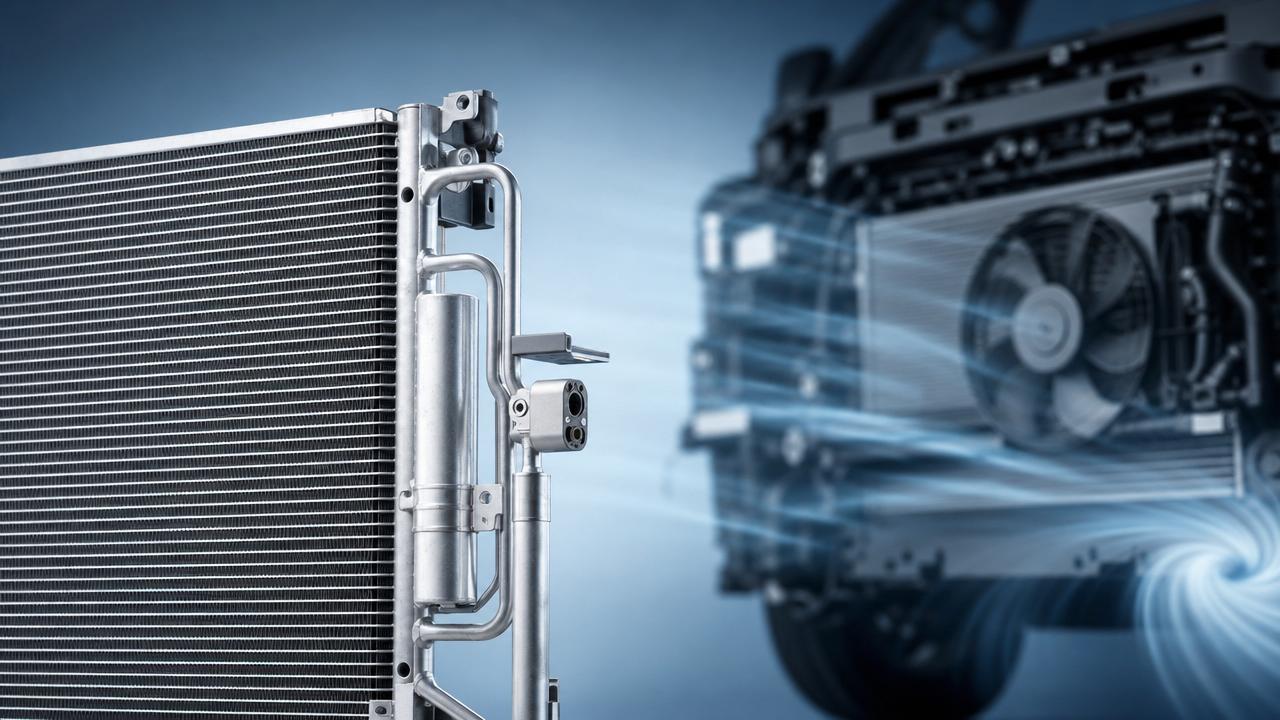
A failing Condenser can quietly reduce your vehicle’s cooling performance, increase fuel consumption, and put extra stress on the entire air conditioning system.
For everyday drivers, early warning signs are often easy to overlook until comfort drops or repair costs rise.
Understanding how efficiency loss appears helps you act before a minor issue becomes a major replacement.
This guide explains the key signs your Condenser may be losing efficiency and what they mean for your vehicle.
What Does a Condenser Do in a Vehicle?
The Condenser is a heat exchanger in the air conditioning system.
It receives hot, high-pressure refrigerant vapor from the compressor.
As air passes through its fins, the refrigerant releases heat and changes into liquid form.
This process allows the evaporator to produce cold air inside the cabin.
When the Condenser loses efficiency, heat cannot leave the system fast enough.
The result is weak cooling, unstable pressure, and higher operating load on related components.
In heavy trucks, construction machinery, and new energy platforms, thermal control is especially important.
A reduced-performance Condenser may affect comfort, equipment uptime, and long-term component reliability.
Why Is Weak Cooling the First Sign of Condenser Efficiency Loss?
Weak cooling is the most common early warning sign.
The air conditioner may still run, but cabin temperature drops slowly.
This often happens when the Condenser cannot remove enough heat from the refrigerant.
The problem may feel worse in traffic, high ambient heat, or under heavy engine load.
At highway speed, stronger airflow may temporarily hide the issue.
That makes diagnosis more difficult without a pressure and temperature check.
Common cooling symptoms to notice
- Cold air becomes mildly cool after several minutes.
- Cooling changes when vehicle speed changes.
- Cabin comfort drops quickly during idle.
- The compressor cycles more often than usual.
- The system cools poorly after long operation.
These symptoms do not always prove Condenser failure.
They do suggest that heat exchange performance should be inspected soon.
Can Blocked Fins or Dirt Make a Condenser Less Efficient?
Yes, blocked fins are a major cause of Condenser efficiency loss.
Dust, insects, road debris, mud, leaves, and oil mist can restrict airflow.
Even a thin layer of contamination can reduce heat transfer.
Bent fins create a similar problem by limiting air movement across the core.
For vehicles working in mines, construction sites, or dusty logistics routes, this risk increases.
Regular visual inspection is useful because external blockage is often visible.
How to check external blockage safely
- Park on level ground and allow components to cool.
- Inspect the front heat exchanger area with adequate lighting.
- Look for clogged fins, oily stains, corrosion, or impact marks.
- Avoid sharp tools that may puncture tubes or flatten fins.
- Use proper cleaning methods recommended for the vehicle type.
If contamination returns quickly, check for nearby leaks or fan system problems.
A clean Condenser still performs poorly when airflow or refrigerant flow is restricted internally.
What Do Leaks, Oil Marks, and Pressure Changes Indicate?
Oil marks around the Condenser often indicate a refrigerant leak.
Refrigerant carries lubricant through the air conditioning circuit.
When a small crack or pinhole forms, oil residue may appear near the leak point.
Low refrigerant reduces cooling capacity and may trigger compressor protection.
High-side pressure readings can also reveal Condenser restrictions or airflow problems.
However, pressure diagnosis should be performed with suitable gauges and safety procedures.
Leak-related warning signs
- Visible oily residue on the Condenser surface.
- Repeated need to recharge refrigerant.
- Hissing sounds near the front cooling module.
- Cooling performance declines soon after service.
- Compressor clutch behavior becomes irregular.
A leak should not be solved by repeated refrigerant charging alone.
The source must be found, repaired, and verified to protect the complete system.
Can Unusual Noises Point to Condenser or Cooling Module Problems?
A Condenser itself usually has no moving parts.
Still, unusual noises around the front cooling module deserve attention.
Rattling may indicate loose mounting brackets, damaged fins, or debris trapped near the fan.
A loud fan may suggest excessive heat load or poor heat exchange.
Whining or harsh compressor noise may happen when system pressure becomes abnormal.
These noises are indirect signs, but they should not be ignored.
Noise and fault comparison
How Does Condenser Efficiency Affect Fuel Use and Component Life?
When a Condenser works poorly, the compressor may need more effort.
That extra load can increase fuel consumption in conventional vehicles.
In electric or new energy platforms, it may reduce energy efficiency and driving range.
High operating pressure also stresses hoses, seals, compressor parts, and control valves.
Over time, one inefficient component may create a chain of failures.
That is why early Condenser inspection is often cheaper than late system repair.
Thermal management parts should be considered as a connected system, not isolated pieces.
Radiators, intercoolers, fans, pipes, and condensers all influence temperature control.
For example, cooling module quality matters in demanding commercial applications.
Products such as RADIATOR FOR VOLVO XD029 reflect the importance of precise size matching and dependable heat exchange.
Its listed references include 100314589, 21649619, 100316845, and 65624, with 945*728*48 dimensions.
When Should a Condenser Be Cleaned, Repaired, or Replaced?
The right action depends on the failure cause.
If external dirt blocks airflow, careful cleaning may restore performance.
If fins are slightly bent, a fin comb may help improve airflow.
If the Condenser leaks, replacement is usually the more reliable option.
Severe corrosion, crushed tubes, or internal blockage also point toward replacement.
Repair decisions should consider vehicle age, operating environment, downtime cost, and part availability.
Decision guide for common Condenser conditions
FAQ: Practical Questions About Condenser Efficiency
Can a Condenser fail without a visible leak?
Yes, efficiency can drop without obvious leakage.
Blocked fins, internal restriction, poor airflow, or fan malfunction can reduce heat transfer.
Is weak air conditioning always caused by the Condenser?
No, weak cooling can come from many components.
Common causes include low refrigerant, compressor faults, expansion valve issues, or cabin filter blockage.
How often should the Condenser be inspected?
Inspection is useful during routine service or before hot seasons.
Vehicles in dusty or off-road environments may need more frequent checks.
Can driving with a weak Condenser damage the compressor?
Yes, prolonged high pressure can increase compressor stress.
Ignoring symptoms may turn a heat exchange issue into a costly system failure.
What matters when choosing a replacement Condenser?
Fitment, material quality, tube design, fin density, and leak testing are important.
Correct matching supports stable cooling, easier installation, and longer service life.
Summary: Take Action Before Condenser Efficiency Drops Further
A losing-efficiency Condenser often starts with small signs.
Weak cooling, oil marks, noise changes, high fan activity, and unstable pressure all matter.
Early inspection helps reduce fuel use, protect compressors, and prevent avoidable downtime.
For demanding vehicle parts, dependable heat exchange components are essential.
Liaocheng Xinde Auto Parts Co., Ltd. focuses on radiators, intercoolers, construction machinery radiators, and new energy radiator modules.
With professional research, production, and global sales experience, it supports reliable thermal management solutions.
If your Condenser shows efficiency loss, schedule a system inspection and choose matched parts based on application needs.