



Scania Radiator Replacement: Signs It Is Time to Repair or Replace the Unit
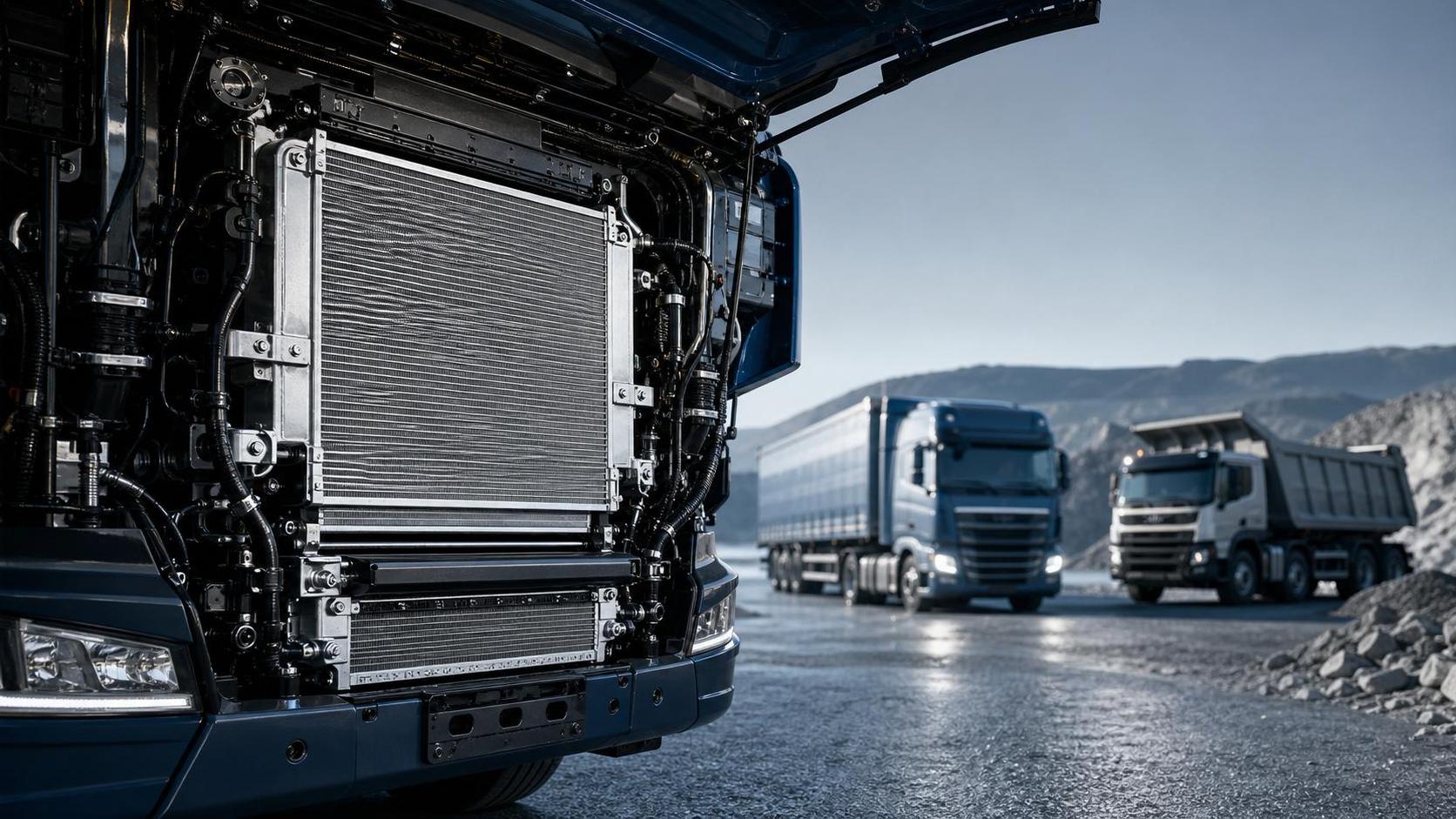
When a Scania Radiator Problem Becomes a Downtime Risk
A weak Scania Radiator rarely fails without warning. Heat rises slowly, coolant loss becomes more frequent, and engine response starts to feel less stable under load.
In daily transport work, that shift matters. Overheating does not only threaten the engine. It also affects fuel efficiency, route timing, and maintenance cost across the vehicle.
The practical question is not simply whether the unit leaks. The real issue is whether repair still makes sense, or whether replacement will reduce longer-term risk.
That judgment changes with operating conditions. A highway tractor, a construction support truck, and a regional distribution vehicle do not stress a Scania Radiator in the same way.
Actual Operating Conditions Change the Diagnosis
In real use, the same temperature warning can have different causes. One truck may suffer from external fin blockage, while another may have internal scaling or a damaged core.
Heavy trucks working in dusty yards often face airflow restriction first. Long-haul vehicles, by contrast, more often show wear from mileage, vibration, and repeated thermal cycling.
This is why experienced parts manufacturers pay attention to application context. Liaocheng Xinde Auto Parts Co., Ltd., established in 2018, focuses on radiator and intercooler development for heavy trucks, construction machinery, and new energy cooling modules.
That background matters because radiator decisions are rarely isolated. Material quality, brazing consistency, tube structure, and fit accuracy all influence how a replacement performs after installation.
Early signs that deserve attention
- Coolant level drops even when no obvious hose failure is visible.
- The temperature gauge climbs higher on inclines or in traffic.
- A sweet coolant smell appears after shutdown.
- Corrosion marks form around the tank seams or core area.
- Cab heating becomes inconsistent during cold starts.
Any one symptom may seem minor. Together, they usually indicate that the Scania Radiator is no longer maintaining stable thermal control.
Highway Haulage and Stop-Start Routes Do Not Stress the Unit Equally
On long highway runs, airflow is usually strong. If a Scania Radiator still runs hot at cruising speed, internal blockage or reduced coolant circulation becomes more likely.
In this setting, repeated top-ups should not be dismissed as normal consumption. They often point to hairline leaks that expand when pressure rises over distance.
Urban or regional routes create a different pattern. The truck spends more time idling, accelerating, and braking, so cooling demand rises when airflow is less consistent.
Here, fan performance and external debris buildup deserve closer inspection. A repair may be enough if the core remains structurally sound and heat exchange recovers after cleaning.
If the core has already thinned from corrosion, however, cleaning alone may expose fresh leaks. That is the point where replacement becomes more predictable than repeated patch work.
Construction and Harsh Environments Usually Expose Weakness Faster
A Scania Radiator working near construction zones deals with mud, dust, and constant vibration. Even a small fin deformation can reduce airflow enough to push temperatures upward.
This is also where mounting integrity matters. If brackets, cushions, or surrounding hardware are worn, the radiator may crack from movement rather than from age alone.
Repair tends to work only when damage is local and the rest of the assembly is healthy. Once multiple rows are blocked or the tanks show stress marks, replacement is usually the cleaner decision.
A similar logic applies across other platforms. For example, some operators comparing heavy-duty cooling parts also review units such as XD341 RADIATOR FOR MERCEDES-BENZ, model A9605000801, sized 982*868*48mm, to understand how fitment and structure vary by application.
Repair or Replace Depends on What Has Actually Failed
The most useful approach is to separate serviceable faults from structural faults. That avoids replacing a good unit too early, but also avoids repairing one that will fail again soon.
This kind of distinction is more useful than relying on age alone. A newer radiator can fail early in harsh service, while an older unit may remain serviceable if cooling conditions stay clean and stable.
Different Scenarios Change What You Should Prioritize
Before making a decision, it helps to compare the operating pattern with the failure mode. That shows whether the current Scania Radiator issue is isolated or part of a broader cooling system problem.
- Long-distance routes: prioritize internal flow, pressure stability, and leak recurrence.
- Short-cycle distribution: prioritize fan efficiency, airflow interruption, and idle heat buildup.
- Dusty or rough sites: prioritize fin condition, external blockage, and vibration-related cracks.
- Mixed seasonal work: prioritize coolant compatibility, corrosion resistance, and maintenance timing.
In actual workshops, misjudgment often comes from focusing on the visible leak only. The better method is to ask why the leak appeared in that location at that time.
Common Mistakes When Assessing a Scania Radiator
One common mistake is to judge the radiator only by external appearance. A clean-looking core may still be restricted internally by scale, degraded coolant, or contamination from earlier system issues.
Another mistake is to compare only purchase price. A cheaper repair can become more expensive if the truck returns to service with unstable cooling and suffers another shutdown.
Compatibility is also overlooked. Fitment, core thickness, mounting points, and cooling capacity need to match the vehicle configuration rather than only the broad model family.
This is why established suppliers matter in the spare parts sector. Companies with ongoing radiator research and global supply experience are usually better positioned to maintain dimensional consistency and production quality.
A Practical Way to Decide the Next Step
If the Scania Radiator has one local defect and the rest of the system tests well, repair may still be reasonable. That choice works best when downtime pressure is moderate and failure history is limited.
If overheating has become recurrent, replacement usually delivers better control over future maintenance. It also reduces the risk of hidden weakness spreading through the core after the truck returns to work.
A useful checklist includes pressure testing, coolant inspection, airflow review, mount condition, and confirmation of operating environment. These points say more than a quick visual check.
When comparing options, it is worth documenting route type, load pattern, ambient temperature, and service interval history. Those details make radiator selection and replacement timing far more accurate.
The best decisions around a Scania Radiator come from matching the part to the real working scene, not from treating every overheating event as the same problem. Clarify the failure pattern, compare the operating conditions, and confirm the critical parameters before moving forward.