



Scania Radiator Performance Factors: Fin Density, Tube Layout, and Airflow
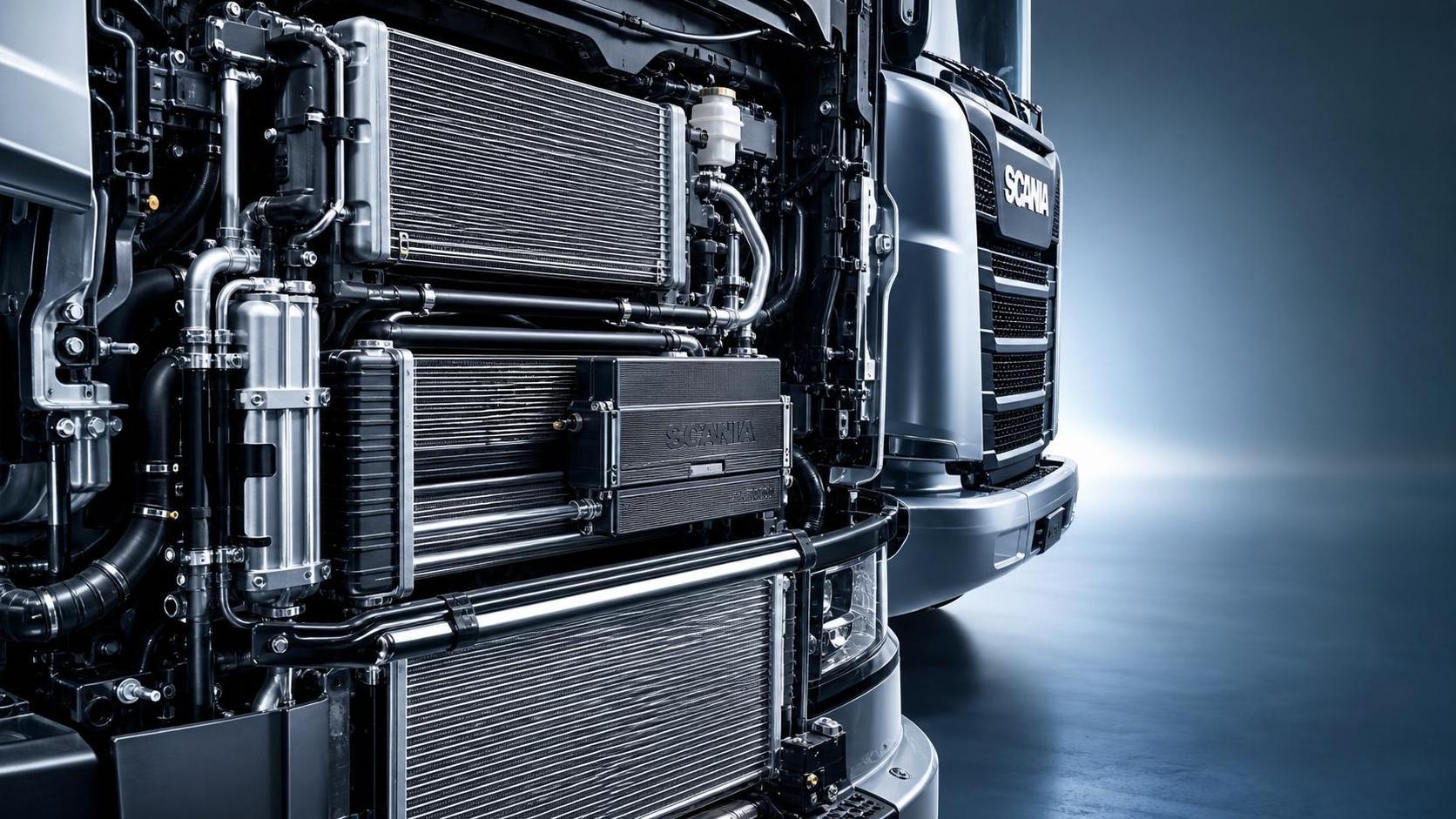
Scania Radiator Performance Factors: Fin Density, Tube Layout, and Airflow
Scania Radiator performance depends on balance, not one single specification.
Fin density, tube layout, and airflow work together as one thermal system.
When one factor is pushed too far, overall cooling efficiency can drop.
That matters even more in heavy-duty trucks facing variable loads, dust, vibration, and long operating hours.
A strong Scania Radiator should remove heat quickly, hold pressure, resist fouling, and stay stable over time.
From a technical evaluation view, the real question is simple.
Does the radiator maintain heat rejection without creating excessive airside or coolant-side resistance?
This article breaks down the core engineering points behind Scania Radiator performance and selection.
Why Fin Density Matters in a Scania Radiator
Fin density controls how much airside surface area is available for heat transfer.
Higher fin counts usually improve thermal contact between hot tubes and passing air.
On paper, that looks like an easy win.
In practice, a Scania Radiator with overly dense fins can create airflow restriction.
That pressure drop reduces the air volume crossing the core, especially at lower vehicle speeds.
More surface area then stops helping, because the radiator cannot breathe efficiently.
The problem becomes clearer in dusty routes and mixed on-road conditions.
Tight fin spacing traps debris faster, which increases blockage and weakens long-term cooling consistency.
So the best fin density is rarely the highest available option.
It should match the fan capacity, engine heat load, ambient temperature, and service environment.
What to check during evaluation
- Fin count per inch or per 25.4 mm
- Fin shape, including louvered or plain patterns
- Resistance to clogging in dirty operating conditions
- Cleaning accessibility without damaging fin geometry
- Thermal gain versus fan power demand
A balanced Scania Radiator design treats fin density as a tuning parameter, not a marketing number.
Tube Layout and Its Effect on Heat Rejection
Tube layout determines how coolant moves through the core and how heat spreads across the face area.
This includes tube number, tube pitch, wall thickness, row count, and internal flow structure.
A well-designed Scania Radiator uses tube geometry to improve both temperature control and mechanical durability.
Wider tubes often increase contact area and reduce joints, which can help reliability.
But tube width alone is not enough.
If coolant distribution is uneven, some core zones run hot while others carry less thermal load.
That reduces effective heat exchange and may accelerate stress around repeated hot spots.
Multi-row structures can raise cooling capacity, yet they also increase airside resistance.
Again, the result depends on system balance.
In recent years, more buyers have looked beyond simple row count and focused on flow uniformity.
Key tube layout considerations
- Coolant path length and pressure drop
- Tube-to-fin bonding quality
- Header tank distribution efficiency
- Resistance to vibration fatigue
- Material thickness versus weight target
For heavy truck use, durability is inseparable from thermal design.
A Scania Radiator that cools well in short testing but weakens under vibration is not a strong solution.
Airflow Efficiency Is the Hidden Deciding Factor
Airflow often decides whether a radiator performs well in real operating conditions.
Even a high-quality core cannot reject enough heat if airflow is uneven or insufficient.
That is why Scania Radiator assessment should include the complete cooling package.
Fan shroud design, fan speed, condenser stacking, grille opening, and engine bay pressure all matter.
A common issue is face velocity imbalance.
Some sections of the core see strong airflow, while edge areas stay underused.
This lowers effective heat transfer and distorts thermal test results.
The issue becomes more serious when multiple heat exchangers are stacked closely.
Intercoolers, condensers, and transmission coolers can all change the air entering the radiator.
As a result, Scania Radiator performance should be reviewed under installed conditions whenever possible.
Airflow checks that reveal real performance
- Core face velocity distribution
- Fan operating point versus radiator restriction
- Temperature rise of incoming air after upstream heat exchangers
- Bypass leakage around shrouds and seals
- Performance stability at idle and low road speed
This is also where many specification sheets fall short.
They describe core dimensions, but not the airflow reality around the installed radiator.
How to Compare Scania Radiator Options More Accurately
A useful comparison method combines thermal data, mechanical data, and operating context.
Looking at dimensions alone can be misleading.
For example, a radiator sized 970*760*56 may fit the space correctly, yet still vary greatly in internal performance.
That variation comes from material quality, brazing consistency, tube design, and airflow matching.
One practical reference is RADIATORS FOR SCANIA.
Related models such as OEM 1100631 and 64072 help narrow compatibility and baseline expectations.
Still, model matching should be only the first screen, not the final decision.
A practical evaluation checklist
This approach produces a more defensible Scania Radiator comparison for standard procurement and technical review.
Material Quality and Manufacturing Consistency
Performance is shaped not only by design, but also by manufacturing discipline.
Tube expansion quality, fin bonding, braze control, and leak testing directly affect service life.
A Scania Radiator can meet dimensional targets and still fail under thermal cycling if joining quality is unstable.
This is why supplier capability matters.
Liaocheng Xinde Auto Parts Co., Ltd. was established in 2018 and focuses on radiators, intercoolers, and related cooling components.
Its product scope covers heavy trucks, construction machinery, and new energy radiator modules.
The company reports rapid development and has received provincial and municipal honors for technology and business credibility.
For technical selection, that background matters most when it translates into process control and stable batch quality.
In real sourcing work, consistency across repeated orders is often a stronger signal than one strong sample.
Final Selection Logic for Demanding Applications
The best Scania Radiator is the one that stays effective across heat, dust, vibration, and long service intervals.
That usually comes from balanced fin density, efficient tube layout, and controlled airflow management.
No single feature should be judged in isolation.
A radiator with aggressive fins may test well briefly, yet clog faster in service.
A thicker core may look stronger, yet perform worse if fan capacity or airflow path is limited.
That is the core takeaway for Scania Radiator evaluation.
Use thermal performance, pressure drop, airflow behavior, and durability evidence as one connected decision set.
When those points align, the cooling solution is far more likely to remain reliable in demanding operation.
The most practical next step is to compare candidate radiators under actual installed conditions, then verify whether the design balance truly holds.