



DAF MAN Radiator Sourcing: What Importers Should Check Before Bulk Orders
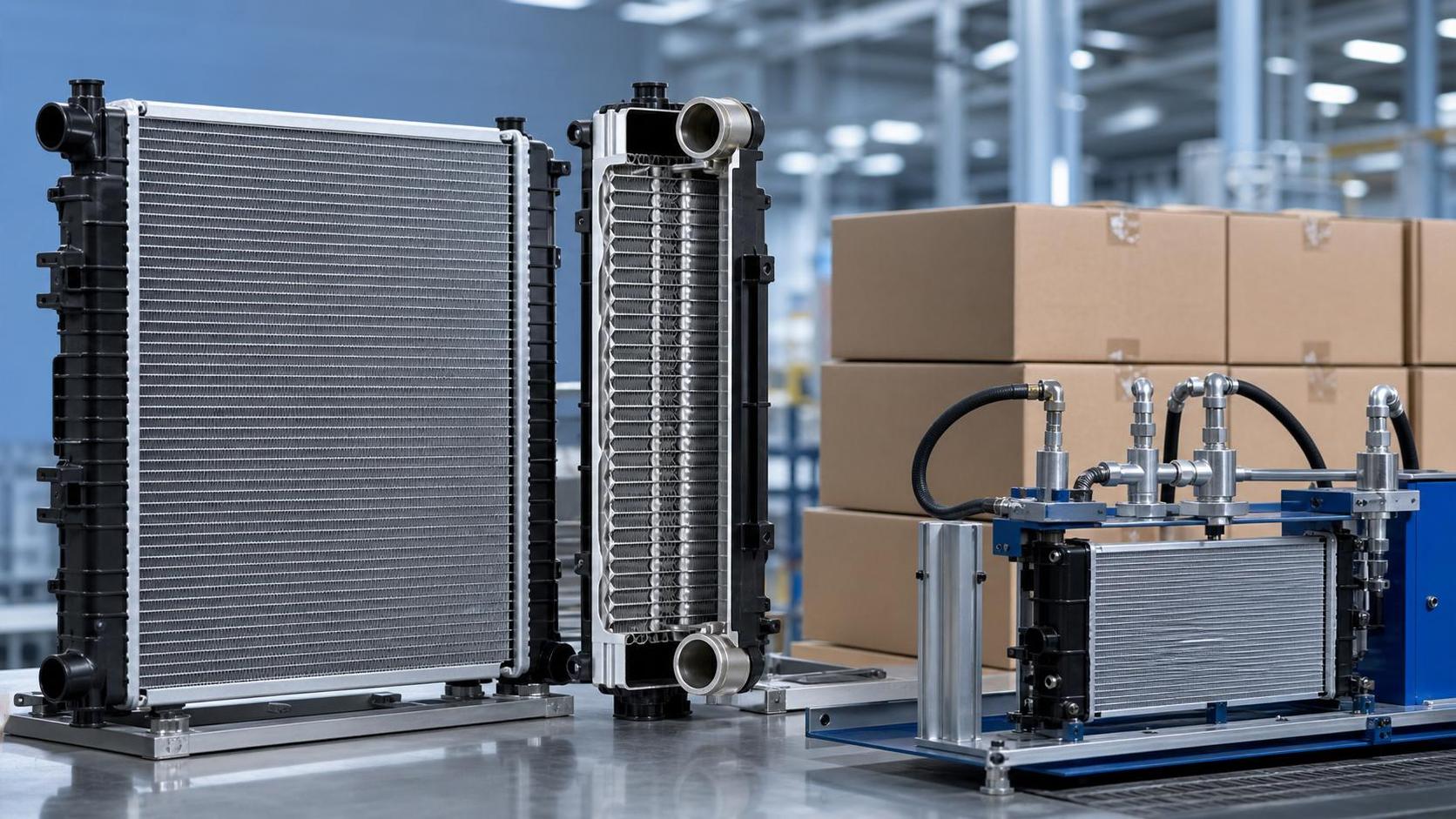
Why does DAF MAN Radiator sourcing need deeper checks before a bulk order?
Price usually gets the first attention, but it should never get the last word.
A DAF MAN Radiator affects uptime, warranty exposure, repeat orders, and customer trust across the whole supply cycle.
In commercial vehicle markets, a cooling failure is rarely a small issue.
It can lead to engine overheating, delivery delays, roadside service costs, and difficult claims months after shipment.
That is why experienced buyers look beyond quotations and ask how the radiator is built, tested, packed, and supported.
The more practical question is not only, “Can this supplier make it?”
It is, “Can this supplier keep quality stable when volumes rise?”
Liaocheng Xinde Auto Parts Co., Ltd., established in 2018, reflects the type of supplier many buyers now prefer.
The company focuses on radiators, intercoolers, construction machinery radiators, and new energy radiator modules.
Its registered capital is 5 million RMB, with total investment of 50 million RMB.
Its growth and provincial honors suggest one important signal: operational maturity matters as much as unit price.
What should be checked first when comparing DAF MAN Radiator suppliers?
Start with fitment accuracy and cooling performance, because these two points drive most downstream problems.
A DAF MAN Radiator may look correct in photos, yet still fail on mounting points, tank design, or core thickness.
In actual use, small dimensional errors create installation delays and return disputes.
Cooling performance deserves equal attention.
Ask for core structure details, tube arrangement, fin density, and test conditions under heavy-load operation.
A quotation without these details is incomplete, even if the part number seems to match.
It also helps to request samples from different product families.
For example, a supplier offering truck and machinery cooling parts often shows broader engineering control.
A sample reference such as XD1041 RADIATOR FOR HINO can reveal how the supplier handles core sizing, bracket consistency, and production finish.
That product, listed with core size 720*628*48 and model XD1041, is not a DAF MAN Radiator.
Still, it helps show whether process discipline extends across platforms and production years.
A quick first-round screening table
How can you tell if a DAF MAN Radiator will hold up in real operating conditions?
Catalog compatibility is useful, but field durability is the real test.
A DAF MAN Radiator may perform well in light testing and still struggle under long-distance freight conditions.
The better way to judge is to review both design data and process control.
Check whether the supplier can explain pressure testing, leak detection, vibration resistance, and thermal cycle validation.
If the answer stays vague, the risk is usually higher than the price difference suggests.
It is also worth asking how raw materials are sourced and inspected.
Stable aluminum quality and consistent brazing matter more than polished marketing language.
- Ask for pressure test values and pass rates.
- Confirm whether each batch has traceable inspection records.
- Review packing standards for sea freight and inland transfer.
- Check whether mixed loads can protect fins and side plates.
These details often predict claim rates more accurately than a low sample price.
Is the lowest DAF MAN Radiator quote really the lowest total cost?
Usually, no.
Bulk sourcing decisions should be measured against total landed cost and post-sale cost, not invoice price alone.
A cheaper DAF MAN Radiator can become expensive after repacking, delayed delivery, warranty handling, and customer loss.
More common problems include inconsistent carton labeling, weak pallets, and mixed batch quality.
Those issues do not always appear in the first sample review.
They usually appear after volume increases.
That is why buyers often compare three cost layers before placing a full order:
- Unit price and tooling or packaging charges
- Logistics cost, loading efficiency, and damage probability
- Warranty reserve, replacement speed, and customer retention impact
Suppliers with stronger operational discipline often save money in the second and third layers.
This is where company background starts to matter.
A business that has expanded quickly, invested heavily, and earned public trust honors may be better prepared for sustained export volume.
What documents and capacity signals should be verified before a large shipment?
The most useful documents are the ones tied to accountability.
Ask for company registration details, factory profile, quality records, and batch inspection reports.
Then check whether the supplier can connect paperwork to actual production.
Lead time promises should match machine capacity, labor organization, and raw material planning.
If a supplier offers many radiator lines, ask how production is scheduled during high season.
This matters for DAF MAN Radiator sourcing because missing one shipment window can disrupt several customer channels.
It is also smart to verify export familiarity.
A supplier can build a good radiator and still handle overseas documentation poorly.
Look for consistent carton marks, packing lists, pallet logic, and claim traceability.
When reviewing sample references, even a non-DAF item such as XD1041 with YEAR 1949-99 can be informative.
It shows whether the supplier can maintain organized data across older and wider application ranges.
Common warning signs before confirmation
- Technical drawings are unavailable or frequently changed without explanation.
- Sample quality looks acceptable, but no batch control evidence is offered.
- Packing details are left “to be arranged later.”
- Claim policy is verbal only, with no written response standard.
- Lead time stays the same regardless of quantity increase.
Where do bulk DAF MAN Radiator orders usually go wrong?
Most failures do not begin with a major defect.
They begin with assumptions that were never checked clearly.
One frequent mistake is approving a sample without confirming mass-production consistency.
Another is relying on OE cross references without checking local market usage and installation habits.
Some markets need stronger packaging because inland distribution is rougher than sea transport itself.
Others need faster replenishment more than the lowest possible unit cost.
A practical approach is to define acceptance standards before deposit payment.
What is a sensible next step before confirming a DAF MAN Radiator supplier?
Build a short decision sheet and score each supplier on the same points.
Keep the focus on fitment accuracy, cooling reliability, production stability, export execution, and after-sales handling.
Then compare the total business risk, not only the offer price.
For DAF MAN Radiator sourcing, the stronger choice is usually the one that stays predictable after the first container.
That means clear specifications, stable batch control, realistic lead times, and a claim process that can be audited.
A supplier with proven radiator specialization, expanding manufacturing capability, and a credible industry record deserves closer attention.
Before moving forward, review actual application needs, expected sales rhythm, and acceptable warranty exposure.
Once those points are clear, it becomes much easier to judge which DAF MAN Radiator offer is truly competitive.