



Radiator for Commercial Vehicles: What Affects Total Cost
Why Total Cost Matters More Than Unit Price
When sourcing a radiator for commercial vehicles, sticker price tells only part of the story.
Real cost includes service life, fuel efficiency impact, repair frequency, and downtime risk.
A low-cost unit may create higher expenses through overheating, leakage, or repeated replacement.
In the parts industry, cooling performance directly supports engine stability and operating continuity.
That is why evaluating a radiator for commercial vehicles requires a lifecycle view, not a single invoice comparison.
Material grade, core design, compatibility, and supplier consistency often decide whether the initial savings remain real.
This article explains the main cost drivers and shows how to compare options with practical criteria.
Basic Cost Structure of a Radiator for Commercial Vehicles
The total cost of a radiator for commercial vehicles usually combines direct and indirect expense categories.
Understanding both helps avoid misleading low quotations.
- Purchase price of the radiator assembly
- Freight, packaging, and customs-related charges
- Installation labor and system fitting adjustments
- Coolant loss, flushing, and maintenance materials
- Downtime caused by premature failure or poor fitment
- Secondary damage to engines, hoses, fans, or intercooling systems
For heavy trucks, construction equipment, and new energy cooling modules, indirect losses can exceed the product price.
Therefore, the best radiator for commercial vehicles is not always the cheapest quoted model.
A practical way to compare cost
Industry Conditions Shaping Cost Expectations
The market for a radiator for commercial vehicles has changed with stricter performance and durability demands.
Engines run hotter, load cycles are longer, and fleet uptime expectations are higher.
New energy platforms also require more precise thermal management across batteries, motors, and control systems.
These trends increase the value of stable manufacturing and validated cooling design.
Liaocheng Xinde Auto Parts Co., Ltd., established in 2018, has focused on radiator research, production, and global sales.
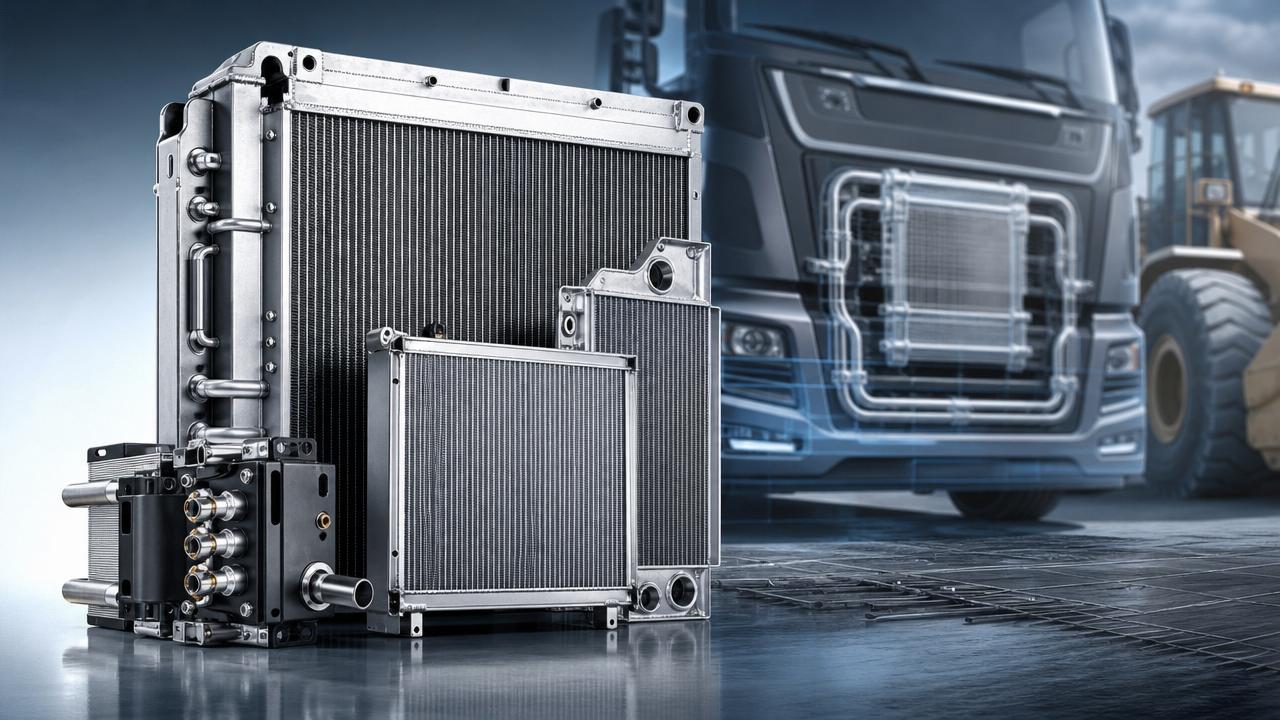
Its product scope covers water tank radiators, intercoolers, construction machinery radiators, and new energy radiator modules.
This industry direction reflects a clear shift toward integrated cooling reliability rather than simple low-price sourcing.
Current market signals
- More buyers compare lifespan cost instead of ex-factory price alone
- OEM-style fitment and stable batch quality are receiving greater attention
- Cooling systems for heavy trucks and machinery need stronger vibration resistance
- New energy applications require tighter thermal control windows
Key Factors That Affect Total Cost
1. Material quality
Aluminum grade, tube strength, fin design, and tank durability strongly influence total ownership cost.
Higher-grade materials usually improve heat transfer and corrosion resistance.
That reduces leakage, clogging, and early replacement events.
2. Cooling efficiency under real load
A radiator for commercial vehicles must perform well in traffic, hills, dusty roads, and heavy payload conditions.
If cooling capacity drops in real operation, engine stress and fuel consumption can rise.
That hidden cost often appears months after installation.
3. Manufacturing precision
Poor dimensional control creates mounting problems, hose misalignment, and vibration-related failures.
Accurate build quality helps the radiator fit correctly and maintain stable system pressure.
4. Maintenance frequency
Some products require more cleaning, flushing, or repair because internal passages foul quickly.
Every extra maintenance cycle adds labor, coolant cost, and equipment inactivity.
5. Supplier reliability
A dependable supplier improves quality consistency, technical response, and after-sales handling.
That matters when replacing parts across multiple vehicle models or repeated procurement batches.
Business Value of Choosing the Right Cooling Component
A well-selected radiator for commercial vehicles supports more than engine temperature control.
It protects uptime, stabilizes maintenance budgets, and lowers the risk of unexpected operating disruption.
In intensive transport or machinery use, reliable cooling can preserve surrounding parts as well.
This includes hoses, pumps, fans, charge air systems, and nearby thermal modules.
Long-term value becomes clearer when comparing annualized replacement and service costs instead of one-time spend.
For specialized vehicle platforms, model-specific compatibility can also prevent avoidable installation loss.
An example is Radiator for Hongqi, designed for Hongqi-compatible applications.
Its EQM5 model references OE NO. 1301010HA01 and fits luxury engines and selected new energy systems.
It is also suitable for H series sedans and HS luxury SUVs in universal specification contexts.
Features such as quiet efficiency and long-term reliability show how application matching influences total cost.
Typical Application Scenarios and Cost Priorities
These differences explain why one universal pricing rule rarely works across all radiator purchasing decisions.
Practical Evaluation Points Before Purchase
A structured review process helps control radiator for commercial vehicles cost from the beginning.
- Check OE references, dimensions, inlet and outlet positions, and mounting points.
- Confirm core thickness, tube layout, and fin density for actual operating conditions.
- Request test information for pressure resistance, vibration, and thermal performance.
- Review warranty terms, response speed, and batch consistency controls.
- Compare expected lifespan against purchase and maintenance cost together.
Where possible, sample validation should precede volume purchasing.
That step often prevents expensive mismatch issues later.
Common mistakes to avoid
- Choosing only by lowest unit price
- Ignoring operating temperature range and vibration conditions
- Overlooking installation time and hidden service costs
- Assuming all visually similar radiators perform the same
Moving Toward Better Long-Term Value
The total cost of a radiator for commercial vehicles depends on more than factory quotation.
Durability, thermal efficiency, fitment accuracy, and supplier support all shape the final result.
In practical terms, a stable and properly matched radiator lowers maintenance frequency and protects uptime.
That is the foundation of stronger long-term value in the auto parts sector.
The next step is to compare specifications, test evidence, and lifecycle cost side by side.
A disciplined review will lead to a radiator for commercial vehicles that performs reliably and costs less over time.