



Radiator for Commercial Vehicles: Common Sourcing Mistakes to Avoid
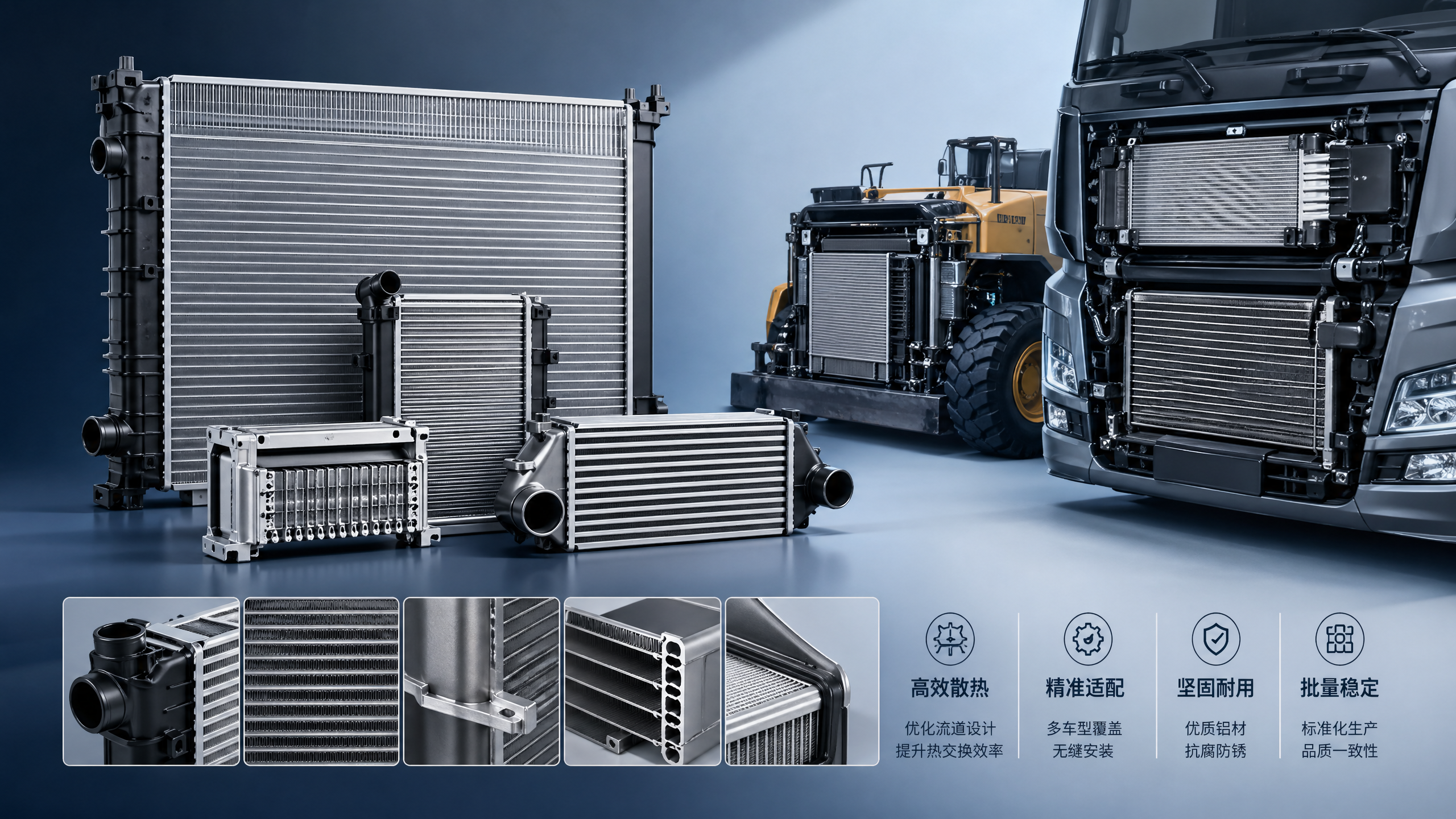
Choosing the right radiator for commercial vehicles can directly affect fleet uptime, maintenance costs, and supplier reliability. For business evaluators, avoiding common sourcing mistakes is essential when comparing quality standards, production capacity, and long-term value. This guide highlights the key pitfalls buyers should watch for before selecting a manufacturing partner in the commercial vehicle parts market.
Understanding the role of a radiator for commercial vehicles
A radiator for commercial vehicles is not just a replacement part. In heavy trucks, buses, construction machinery, and new energy platforms, it is a core thermal management component that helps maintain engine or system temperature within a stable operating range. For evaluators assessing suppliers, this means the radiator should be judged not only by price, but also by heat dissipation performance, material quality, compatibility, and production consistency over repeated orders.
In practical sourcing, many failures happen before the product even reaches the vehicle. A mismatch in core thickness, tube structure, fin density, or mounting position can lead to installation delays of 2 to 7 days, extra adaptation work, or early failure in field use. For commercial fleets, every additional maintenance hour can create downstream losses in scheduling, labor, and vehicle availability. That is why the radiator for commercial vehicles should be evaluated as an uptime-critical component rather than a simple commodity.
The industry focus has also changed in the last 5 to 10 years. Buyers increasingly look at heat exchange efficiency, durability under vibration, anti-corrosion capability, and the supplier’s ability to support both conventional heavy-duty applications and emerging thermal management needs. Companies with manufacturing specialization in water tank radiators, intercoolers, construction machinery radiators, and new energy radiator modules are often better positioned to understand application differences across multiple vehicle categories.
Why sourcing errors are common
The commercial vehicle parts market is broad, and different sourcing teams often work with incomplete technical data. Some buyers receive only an OEM number, while others rely on photos, old drawings, or cross-reference lists. When the decision process is compressed into a 1- to 2-week quotation cycle, critical checks may be skipped. This is where mistakes begin: the supplier may quote a similar part, but not the exact radiator for commercial vehicles required for the target operating conditions.
Another reason is that evaluators are often balancing at least 4 dimensions at once: purchase cost, quality stability, lead time, and after-sales risk. If one dimension dominates too early, such as a low initial quote, the total landed value can be misunderstood. A cheaper radiator can become more expensive within 6 to 12 months if return rates, replacement labor, and delivery disruptions are not considered from the start.
For this reason, a standard evaluation framework is useful. It helps procurement and technical teams speak the same language, especially when comparing manufacturers in China or other major supply markets for heavy-duty cooling components.
Key evaluation dimensions at a glance
Before reviewing specific mistakes, the following table shows the most common assessment areas and why they matter when selecting a radiator for commercial vehicles supplier.
For business evaluators, this table is a reminder that sourcing quality is multidimensional. A valid supplier review should combine engineering fit, manufacturing control, and commercial responsiveness rather than treating them as separate decisions.
Common sourcing mistakes that weaken long-term value
The most frequent mistake is selecting a supplier based mainly on unit price. In the commercial vehicle aftermarket and OE-support environment, a price gap of 5% to 12% may look attractive at quotation stage, but it can hide major differences in aluminum grade, brazing integrity, or pressure resistance. Evaluators should always ask what has been optimized to reach the lower price, and whether those changes affect service life or compatibility.
A second mistake is failing to verify the intended operating scenario. A radiator for commercial vehicles used in urban logistics may face different airflow, vibration, and thermal cycling conditions than one installed in construction machinery or long-haul heavy trucks. If the supplier is not asked about application context, the quoted product may meet dimensional requirements but still underperform in high-dust, high-load, or stop-and-go environments.
A third mistake is overlooking production consistency. One approved sample does not guarantee stable quality across 500, 1,000, or 5,000 units. Buyers should ask how raw materials are controlled, how core assemblies are monitored, and how leak testing or final inspection is handled per batch. In cooling system components, variation between lots can be as damaging as a clearly defective design.
Mistakes that appear small but create large downstream costs
Seemingly minor documentation issues can create major disruptions. Missing labels, incomplete packaging details, or unclear model correspondence can slow receiving and warehouse processing by 24 to 72 hours. For evaluators handling multiple SKUs, this becomes especially important when the supplier offers radiators, intercoolers, and related cooling components across several vehicle platforms.
Another hidden risk is not clarifying communication responsibility. If technical questions, order follow-up, and claim handling are managed by different people without a clear response process, even a technically qualified radiator for commercial vehicles program can become difficult to maintain. Buyers should confirm response time expectations, escalation paths, and sample approval procedures before placing recurring orders.
Finally, some sourcing teams do not compare lifecycle value. They compare only ex-works price, while ignoring shipping damage risk, replacement rate, support speed, and engineering cooperation. In parts categories where downtime has a direct operating cost, the lowest visible price is rarely the most reliable commercial decision.
Typical sourcing mistakes and their consequences
The following table summarizes common errors and the operational consequences they may trigger within the first 3 to 12 months of supply.
These risks are not theoretical. In the heavy-duty parts sector, supply inconsistency often affects several departments at once: procurement, warehousing, technical service, and customer support. A disciplined evaluation method reduces friction across the full order cycle.
Industry background and what business evaluators should look for
The cooling component market for commercial vehicles is shaped by two parallel trends. First, traditional heavy trucks and construction machinery still demand robust, repairable radiator solutions that can withstand sustained load and variable climates. Second, electrified and new energy applications are increasing attention on integrated thermal management modules. This means supplier selection increasingly rewards technical breadth, not just a narrow catalog of part numbers.
For evaluators, the best suppliers are usually those that combine manufacturing specialization with practical application knowledge. Liaocheng Xinde Auto Parts Co., Ltd., established in 2018 with a registered capital of 5 million RMB and a total investment of 50 million RMB, focuses on research, production, and global sales of water tank radiators, intercoolers, construction machinery radiators, and related components for heavy trucks and new energy radiator modules. This type of product concentration matters because cooling system sourcing often requires engineering understanding beyond catalog matching.
Rapid growth alone should not be the only criterion, but it can indicate market acceptance when supported by process capability and customer communication. Buyers should still verify the essentials: product development responsiveness, export handling, inspection routines, and the ability to support different order scales, from pilot samples to regular production over 6-month or 12-month demand forecasts.
A practical supplier review checklist
A good review process should move from concept fit to execution fit. That means confirming not only whether the supplier can make the part, but whether the supplier can repeatedly deliver the correct radiator for commercial vehicles with the expected quality and communication standard.
- Confirm application data: OEM reference, dimensions, tank layout, mounting structure, and expected cooling demand.
- Review manufacturing capability: material sourcing, brazing process, leak testing, and batch traceability.
- Check service responsiveness: quotation speed, sample lead time, issue feedback within 24 to 48 hours, and claim handling method.
- Evaluate scalability: ability to support low-volume trial orders and larger monthly schedules without quality drift.
This checklist helps evaluators compare suppliers on a common basis. It is especially useful when internal teams include both commercial and technical stakeholders who need a structured approval process.
Application categories in the cooling parts market
Because not every cooling product serves the same duty cycle, category awareness is important. The table below shows how demand profiles can differ across major application types.
This category view helps procurement teams avoid using a single benchmark across very different applications. A supplier strong in one segment may not automatically be strong in another, even if the product family appears similar.
Application value and practical selection guidance
The real value of choosing the correct radiator for commercial vehicles appears over time. Better thermal control contributes to more predictable vehicle performance, fewer service interruptions, and reduced pressure on maintenance teams. In purchasing terms, the benefit is often seen in lower exception handling, smoother replenishment planning, and stronger confidence in repeat ordering over quarterly or annual cycles.
Business evaluators should also recognize that a supplier’s product portfolio can signal technical depth. For example, a company that develops heavy-truck radiators, intercoolers, and construction machinery cooling products is often more familiar with workload extremes and platform differences than a trader with a broad but shallow catalog. In some mixed sourcing programs, even a passenger-vehicle item such as Radiator for AION can demonstrate how the manufacturer applies cooling efficiency, advanced fluid dynamics, premium thermal materials, and stable process control across different fitment requirements.
That does not mean evaluators should generalize across all categories without checks. It means they should look for evidence of engineering logic, such as whether the supplier can explain core function, replacement intent, and performance priorities in practical terms. Product data like model AIONV-1301010-0030, fitment scope, and replace-or-repair use case are useful when presented clearly, because they reflect documentation discipline that is also important in commercial vehicle sourcing.
What a balanced decision usually includes
The most effective sourcing decisions usually combine 3 layers: technical validation, supply reliability, and commercial clarity. If one layer is weak, the overall result becomes fragile. A strong sample with poor delivery discipline still creates risk. Likewise, a fast supplier with unclear process control can become expensive once claims begin to accumulate.
- Validate product fit through drawings, dimensions, and where possible, sample comparison.
- Confirm process reliability through inspection steps, leak testing, and batch management.
- Align commercial terms, including lead time, packaging, claim response, and reorder support.
This balanced method is especially useful when the sourcing objective is not a one-time purchase, but an ongoing program covering multiple SKUs and several delivery periods per year.
How to reduce risk before placing repeat orders
Before moving from sample approval to recurring purchases, evaluators should establish a simple but documented control path. In many cases, the most useful approach is to define 5 checkpoints: drawing confirmation, sample review, packaging verification, pilot batch monitoring, and post-delivery feedback. Even for experienced buyers, these checkpoints help reduce preventable errors that tend to appear only after the first 100 to 300 units.
It is also wise to clarify lead time assumptions. A quoted lead time of 20 to 30 days may apply only to standard materials and stable production scheduling. If your project includes custom specifications, branded packaging, or mixed containers, the actual cycle can extend by 1 to 3 weeks. Clear planning prevents unrealistic purchasing expectations and helps avoid urgent substitutions that reduce quality control.
Finally, keep a record of post-shipment performance. For a radiator for commercial vehicles program, useful indicators include fitment success rate, visible damage rate on arrival, claim frequency, and response time for corrective action. These metrics do not need to be complex, but they should be reviewed regularly so that supplier evaluation remains evidence-based rather than impression-based.
Why choose a specialized manufacturing partner
A specialized manufacturer is often better equipped to support business evaluators because cooling components require both production discipline and application understanding. Liaocheng Xinde Auto Parts Co., Ltd. has focused its business on water tank radiators, intercoolers, construction machinery radiators, heavy-truck related components, and new energy radiator modules. This specialization supports more informed communication when customers need to compare structural options, discuss replacement requirements, or review application-specific thermal demands.
For buyers, the practical advantage is not only product availability, but also the ability to discuss selection logic in a structured way. Whether you are reviewing dimensions, model matching, sample schedules, or future volume planning, a focused supplier can usually respond more effectively than a general trading source managing many unrelated categories.
If you are evaluating a radiator for commercial vehicles supplier, contact us to discuss parameter confirmation, model selection, sample support, delivery cycle planning, customization options, packaging requirements, and quotation details. A clear technical and commercial review at the beginning can save substantial time and cost over the next 6 to 12 months of supply.