



Radiator Types Explained: Aluminum, Copper-Brass, Plastic Tank, and All-Metal Designs
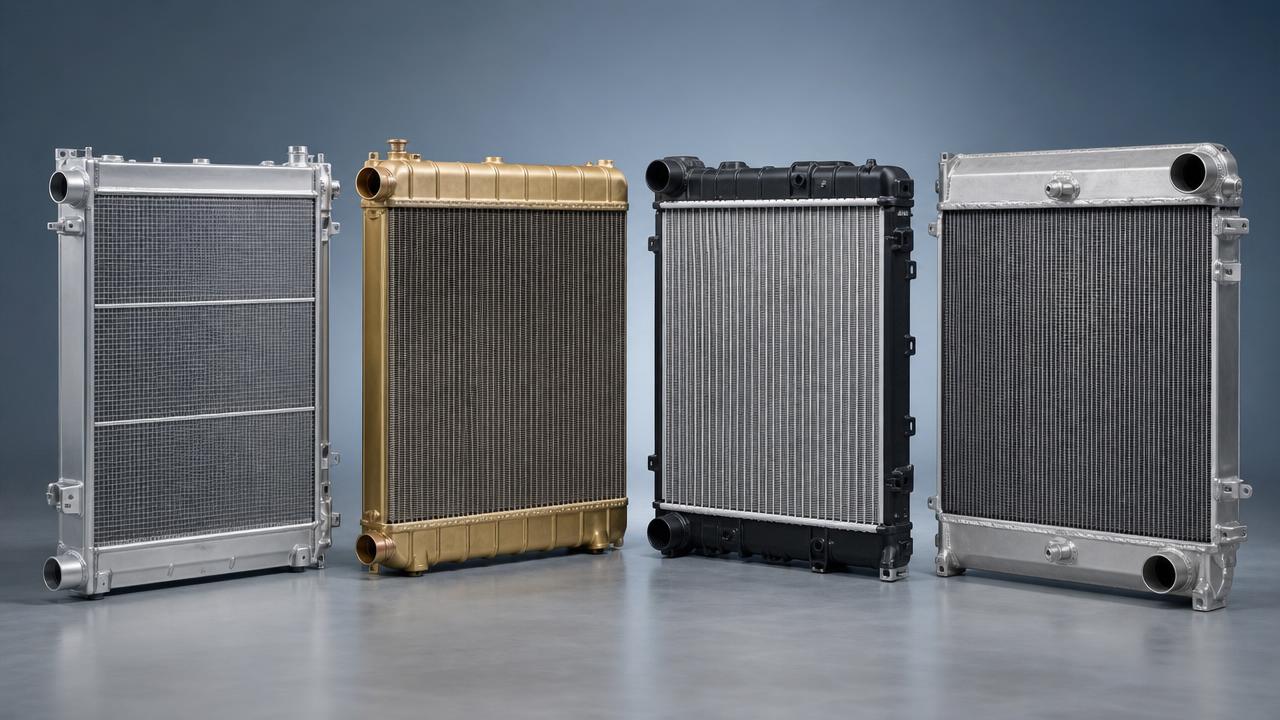
Choosing the right Radiator starts with understanding how material and construction affect cooling efficiency, durability, weight, and service life. This guide explains the key differences between aluminum, copper-brass, plastic tank, and all-metal designs to help technical evaluators compare performance, application fit, and long-term value with greater confidence.
In heavy truck, construction machinery, and new energy thermal systems, Radiator selection is rarely a one-variable decision. Material conductivity, brazing method, tank structure, pressure resistance, repairability, corrosion behavior, and lifecycle cost all influence whether a unit performs reliably after 6 months, 3 years, or 10,000 operating hours.
For technical evaluators, the challenge is balancing heat rejection targets with mass, packaging space, vibration exposure, coolant chemistry, and service expectations. A lighter core may improve fuel efficiency, while a more repairable design may reduce downtime in remote fleets. The right answer depends on operating conditions, not just catalog labels.
Liaocheng Xinde Auto Parts Co., Ltd., established in 2018 with a registered capital of 5 million RMB and total investment of 50 million RMB, focuses on the research, production, and global sales of water tank radiators, intercoolers, construction machinery radiators, and related cooling components for heavy trucks and new energy radiator modules. That manufacturing focus reflects a market reality: buyers increasingly need application-specific cooling parts rather than generic replacements.
Why Radiator Material and Construction Matter in Technical Evaluation
A Radiator is not only a heat exchanger core. It is a structural part exposed to thermal cycling, pressure pulses, road vibration, salt spray, and maintenance variability. In commercial vehicle use, coolant temperatures often operate around 85°C to 105°C, while pressure caps and system peaks can create operating stress that weak joints over time.
Material choice directly affects 4 core evaluation criteria: heat transfer, weight, durability, and serviceability. Construction choice adds another 3 variables: seam reliability, tank integrity, and field repair options. These 7 factors usually determine whether a Radiator is suitable for long-haul trucks, urban fleets, off-road equipment, or high-vibration machinery.
Key performance variables to compare
- Thermal conductivity of the tube and fin material
- Core thickness, fin density, and airflow resistance
- Weight impact on total vehicle mass
- Resistance to corrosion from coolant and external contaminants
- Fatigue behavior under vibration and repeated heating cycles
- Repairability in workshop or field conditions
- Total cost over a 3-year to 5-year service window
Typical application priorities by equipment type
Heavy trucks usually prioritize low weight, stable supply, and consistent thermal performance at highway speed. Construction machinery often values thicker structure, stronger mounting support, and easier repair. New energy cooling modules may place tighter emphasis on packaging density, corrosion control, and multi-loop system integration.
The table below gives a practical comparison framework for evaluators reviewing Radiator options across different applications.
The key takeaway is that the best Radiator is often the one that matches operating stress and maintenance reality, not simply the one with the lowest unit price or the highest nominal conductivity figure.
Aluminum Radiator Designs: Lightweight, Efficient, and Common in Modern Platforms
Aluminum Radiator designs dominate many current OE and aftermarket applications because they combine low mass with efficient heat transfer and scalable production. In commercial transport, reducing several kilograms per cooling assembly can support broader lightweighting goals without major redesign of brackets or airflow paths.
Where aluminum performs well
An aluminum core is often preferred in highway trucks, bus platforms, and compact engine bays where airflow packaging is tight. Braze-welded aluminum structures can deliver strong thermal performance with thinner walls, helping maintain coolant temperature stability under sustained load. In many cases, aluminum also supports faster thermal response during load changes.
Advantages
- Lower weight than copper-brass alternatives in comparable sizes
- Good compatibility with automated mass production
- Effective heat rejection for modern engine cooling architectures
- Suitable for modular integration with charge air coolers and condensers
Limitations
- Repair in the field may be more difficult than with traditional metal assemblies
- Sensitive to coolant quality and galvanic corrosion if system matching is poor
- Fatigue at joints must be controlled through good design and process consistency
For evaluators, the main question is not whether aluminum is modern, but whether the specific Radiator uses stable brazing quality, proper tube geometry, and adequate support against vibration. A weak mount or poor coolant path can shorten service life even when the material choice is correct.
Copper-Brass Radiator Designs: Repairability and Legacy Strength
Copper-brass Radiator designs remain relevant where maintenance teams value repairability and where operating environments are harsh, unpredictable, or remote. While heavier than aluminum in many comparable builds, these units can still offer practical lifecycle value when workshop repair is easier than full replacement.
Why copper-brass is still selected
In older fleets, industrial machines, and some construction applications, copper-brass designs are appreciated because tank and core sections can be serviced by technicians familiar with metal repair methods. If a vehicle works 200 to 300 kilometers from the nearest supply center, serviceability may outweigh weight concerns.
Common trade-offs
The main trade-off is mass. Higher weight can increase handling burden during installation and may not fit lightweight platform targets. Copper-brass also needs careful evaluation for cost, as material pricing and production method can change total unit economics over a 12-month sourcing cycle.
However, where downtime costs are high and replacement access is limited, a repairable Radiator can still be the more economical choice over 3 to 5 years.
Plastic Tank vs All-Metal Radiator Construction
Beyond core material, technical evaluators must distinguish between plastic tank and all-metal Radiator construction. This design choice directly affects sealing reliability, thermal aging behavior, vibration tolerance, and maintenance strategy.
Plastic tank Radiator assemblies
Plastic tank designs are common because they lower manufacturing cost, reduce mass, and support high-volume production. In well-controlled applications, crimped aluminum core plus engineered plastic tank construction can perform reliably for years. This is especially true where engine compartment temperatures, pressure pulses, and mounting conditions stay within design limits.
The main risk is long-term aging at sealing points. Repeated thermal cycles, especially over 1,000 to 2,000 hot-cold cycles, can gradually affect gasket compression and tank integrity. For fleets with long service intervals or severe vibration, this deserves close review.
All-metal Radiator assemblies
All-metal designs are often selected for tougher duty cycles. They usually provide stronger structural confidence in high-vibration, high-temperature, or repair-intensive applications. In off-road machinery or vehicles exposed to frequent impact and contamination, the stronger mechanical profile can justify a higher initial cost.
The following comparison helps clarify where each construction type fits best.
In practice, plastic tank does not automatically mean low quality, and all-metal does not automatically mean best choice. The evaluation should focus on temperature exposure, pressure load, duty cycle hours, and expected replacement or repair model.
How to Evaluate Radiator Fit for Heavy Truck and Machinery Applications
A structured selection process reduces sourcing risk. For technical teams, it helps to review 5 checkpoints before approving a Radiator: thermal target, dimensional fit, joint reliability, corrosion control, and service plan. Missing even 1 of these can turn a low-price purchase into a recurring warranty problem.
Five-step evaluation method
- Confirm heat load, operating temperature band, and airflow conditions.
- Check core dimensions, inlet and outlet position, and mounting points.
- Review material and tank construction against vibration and pressure conditions.
- Verify coolant compatibility, corrosion resistance, and maintenance intervals.
- Assess replacement cycle, repair options, and supply continuity.
Dimensional and interface verification
Even small dimensional differences can create airflow bypass, hose strain, or mounting stress. For example, a mismatch of only a few millimeters at bracket or pipe locations can increase vibration loading over thousands of road cycles. Technical evaluators should confirm not only core size, but also neck orientation, thread or hose specification, and fan shroud clearance.
Related cooling component integration
In many powertrain layouts, Radiator performance is linked with charge air cooling. One relevant example is intercooler for benz xd330, with model references oem 9405010301 and 97024, sized 630*892*68 for Benz applications. For evaluators, this illustrates how adjacent heat exchangers must be reviewed together to prevent airflow restriction or thermal stacking inside a shared module space.
Common Risks, Misjudgments, and Procurement Advice
Many Radiator failures are caused less by material category and more by incorrect selection assumptions. Technical teams often focus on core material while underestimating mounting stress, coolant contamination, or low-quality joining processes. Procurement decisions should therefore combine engineering review with supplier process understanding.
Frequent evaluation mistakes
- Choosing by price only without checking service life assumptions
- Ignoring duty cycle differences between highway and off-road use
- Comparing core size without reviewing fin structure and airflow resistance
- Assuming all aluminum Radiator products have the same brazing quality
- Failing to match the cooling part with the full module layout
Supplier review points for B2B buyers
When reviewing a manufacturer, buyers should ask about production scope, application experience, and inspection consistency. In the parts industry, suppliers serving heavy trucks, construction machinery, and new energy modules usually understand broader operating ranges than suppliers focused only on standard passenger applications.
A company such as Liaocheng Xinde Auto Parts Co., Ltd. has built its business around radiators, intercoolers, and related components for demanding commercial uses. For technical evaluators, that matters because application knowledge often shortens the path from drawing review to workable sample verification and batch supply planning.
What to request before final approval
Before releasing a purchase order, request at least 6 practical checks: dimensional confirmation, material statement, pressure test method, leak inspection process, packing protection approach, and after-sales response timeline. A normal review cycle may take 7 to 15 days depending on whether samples, drawings, or fitment verification are required.
The right Radiator choice depends on duty cycle, maintenance model, and total ownership cost more than on simple material preference. Aluminum often fits modern lightweight and high-volume needs. Copper-brass remains valuable where repairability matters. Plastic tank construction suits controlled operating conditions, while all-metal designs are better aligned with severe vibration, impact, and heavy-duty service demands.
If you are comparing cooling components for heavy trucks, machinery, or integrated thermal modules, a structured technical review will reduce replacement risk and improve lifecycle performance. Contact us to discuss application details, request a tailored solution, or learn more about Radiator and intercooler options for your platform.