



Radiator Cost Factors That Affect Sourcing
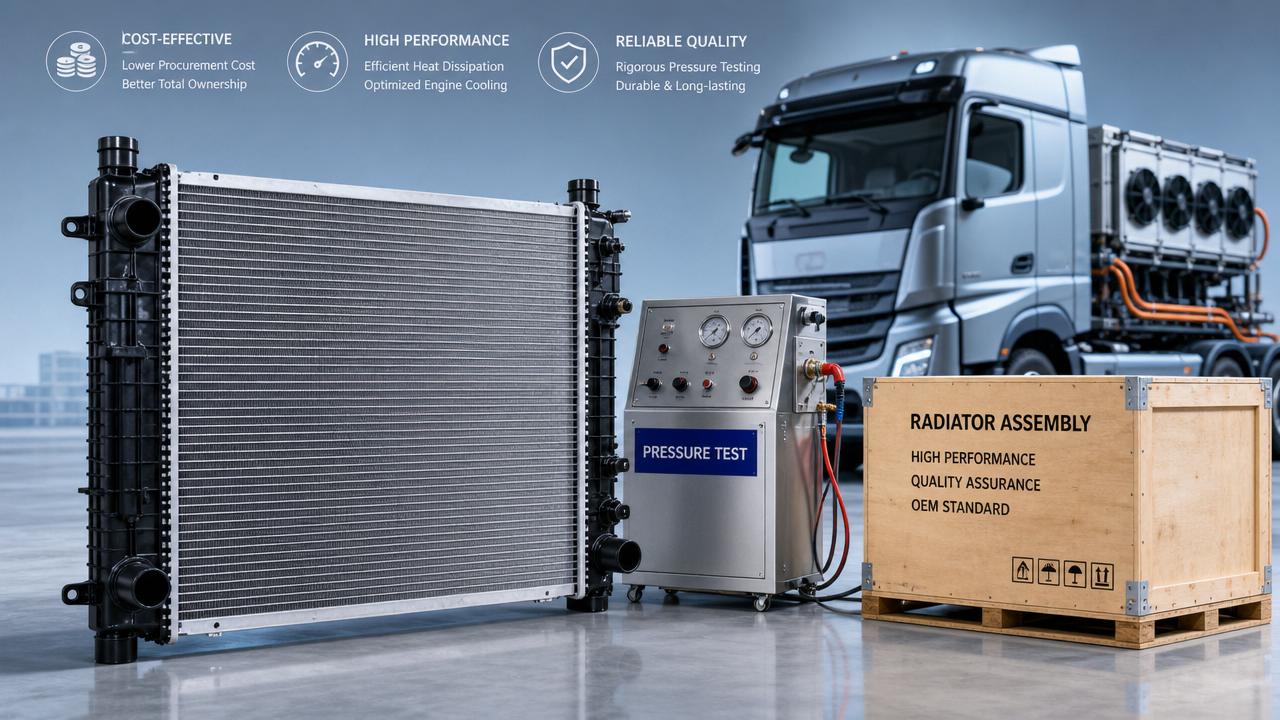
For sourcing decisions, the true cost of a Radiator goes beyond comparing unit prices.
Material selection, cooling performance, application type, production capacity, quality control, and supplier reliability all affect long-term value.
Whether used in heavy trucks, construction machinery, or new energy radiator modules, each scenario requires different cost judgment.
This guide explains the main Radiator cost factors that influence sourcing, pricing stability, and profitable purchasing decisions.
Why Radiator Cost Changes by Application Scenario
A Radiator is not priced only by size or model number.
Its cost changes when heat load, vehicle duty cycle, mounting space, airflow, and vibration level change.
A highway truck Radiator may focus on stable cooling and fuel efficiency.
A construction machinery Radiator must resist dust, shock, mud, and long working hours under low-speed operation.
A new energy radiator module may require compact structure, controlled temperature zones, and closer dimensional accuracy.
These differences affect raw material use, production process, testing requirements, packaging, and after-sales risk.
Heavy Truck Radiator Sourcing: Cost Drivers to Check First
Heavy truck operation places constant pressure on Radiator performance.
Long-distance routes, high loads, and changing climates require stable heat exchange and reliable pressure resistance.
The first cost factor is core design.
Tube thickness, fin density, fin pitch, and core height all affect cooling capacity and material consumption.
A cheaper Radiator with insufficient core efficiency may increase engine temperature and maintenance downtime.
Mounting compatibility also matters.
Bracket position, inlet diameter, outlet diameter, and tank shape must match the target vehicle platform.
For Kenworth applications, model matching can reduce installation risk and return cost.
One relevant option is xd94382 radiator for kenworth, designed around a defined application scenario.
Material Choice and Truck Radiator Price
Aluminum, copper, brass, plastic tanks, and welded structures create different cost profiles.
Aluminum Radiator products often balance weight, heat transfer, and scalable production efficiency.
Copper-brass designs may support repairability, but raw material cost can fluctuate sharply.
Plastic tank structures can reduce weight, while sealing quality becomes a key inspection point.
Construction Machinery Radiator: Cost Under Harsh Conditions
Construction machinery Radiator sourcing is strongly linked to working environment.
Excavators, loaders, graders, cranes, and mining equipment often run in dust, vibration, and unstable airflow.
In this scenario, price differences usually come from reinforced structure and contamination resistance.
Stronger tanks, robust side plates, reinforced welds, and durable fins increase production cost.
However, these features help reduce leakage, clogging, overheating, and unplanned stoppage.
Fin design deserves special attention.
Very dense fins may improve heat transfer in clean conditions.
In dusty sites, dense fins may clog faster and raise cleaning frequency.
A suitable Radiator should balance heat exchange, maintenance access, and contamination tolerance.
When Reinforcement Is Worth the Extra Cost
Reinforcement is valuable when machines operate continuously under high torque or low travel speed.
It is also important when the Radiator is exposed to vibration from rough ground or heavy attachments.
The added cost should be compared against downtime, field repair, and replacement frequency.
New Energy Radiator Modules: Precision and Thermal Control Cost
New energy applications bring different Radiator cost factors.
Battery systems, motor controllers, and power electronics require stable thermal management in compact layouts.
Here, the key cost driver is not only heat dissipation.
Dimensional precision, sealing reliability, cleanliness, corrosion resistance, and module integration become equally important.
A new energy Radiator module may involve more complex interfaces than traditional vehicle cooling parts.
Small tolerance errors can affect assembly, pressure stability, and long-term cooling consistency.
Testing cost may also be higher.
Air leakage testing, pressure cycling, corrosion checks, and dimensional inspection all support safer application performance.
Comparing Radiator Requirements Across Scenarios
This comparison shows why the lowest Radiator quotation is not always the best sourcing result.
The better choice is the product that fits the working condition, risk level, and lifecycle cost.
Production Capacity and Lead Time Affect Radiator Sourcing Cost
A stable Radiator supplier should offer more than product drawings and quotations.
Production capacity affects delivery time, order flexibility, and emergency replenishment ability.
When capacity is limited, urgent orders may require higher prices or longer waiting periods.
When process control is weak, rework and inconsistent quality may increase hidden cost.
Liaocheng Xinde Auto Parts Co., Ltd. focuses on water tank radiators, intercoolers, construction machinery radiators, and new energy radiator modules.
Established in 2018, the company has developed rapidly with investment in production and technical capability.
Its honors include High-tech Enterprise, Civilized and Honest Enterprise, and Trustworthy Unit for Consumers.
Such background helps support Radiator supply stability, especially for repeated orders and global sales projects.
Quality Control Costs That Protect Long-Term Value
Radiator quality control adds cost, but it reduces risk after shipment.
Important inspections include pressure testing, leakage testing, weld inspection, dimension checking, and appearance review.
For heavy truck Radiator products, pressure resistance and vibration performance are especially important.
For construction machinery, inspection should also consider fin damage, bracket strength, and contamination tolerance.
For new energy modules, cleanliness and dimensional consistency should be checked more strictly.
- Confirm drawings, samples, and application information before mass production.
- Ask for pressure test standards and inspection frequency.
- Check packaging strength for export transportation.
- Review defect handling procedures before placing repeat orders.
Scenario-Based Radiator Adaptation Suggestions
A practical sourcing decision starts with application data, not only catalog matching.
The following steps help connect Radiator cost with real operating requirements.
- Define the vehicle model, engine type, and cooling system layout.
- Identify load conditions, ambient temperature, dust level, and operating hours.
- Compare core design, material structure, tank type, and mounting details.
- Request sample validation before large-volume Radiator purchasing.
- Evaluate lead time, production capacity, packaging, and after-sales support.
For known vehicle platforms, choosing a confirmed model can shorten the evaluation cycle.
For example, xd94382 radiator for kenworth may be considered when the application information matches.
Common Radiator Sourcing Misjudgments
One common mistake is comparing Radiator price without comparing core specifications.
Two products may look similar, yet differ in tube thickness, fin quality, and pressure resistance.
Another mistake is ignoring packaging.
A Radiator can be damaged during long-distance transport if cartons, foam, or pallets are weak.
A third mistake is selecting excessive specifications for a simple replacement market.
Over-designed products may increase cost without improving practical value.
The opposite problem is under-specification.
A low-cost Radiator may fail early if used in high-load or dusty conditions.
How to Build a More Profitable Radiator Sourcing Plan
A profitable Radiator sourcing plan should combine price, performance, supply stability, and scenario fit.
Start by separating heavy truck, construction machinery, and new energy module requirements.
Then compare suppliers by material control, testing capability, production scale, and technical response speed.
This approach reduces hidden cost from mismatch, overheating, leakage, returns, and delayed delivery.
For the next step, prepare vehicle data, target quantity, drawings, and required delivery schedule.
With accurate application information, a Radiator supplier can recommend a suitable structure and quotation more efficiently.
The best sourcing result is not the cheapest part, but the Radiator that performs reliably in its intended scenario.