



Common Radiator Failures and Early Warning Signs
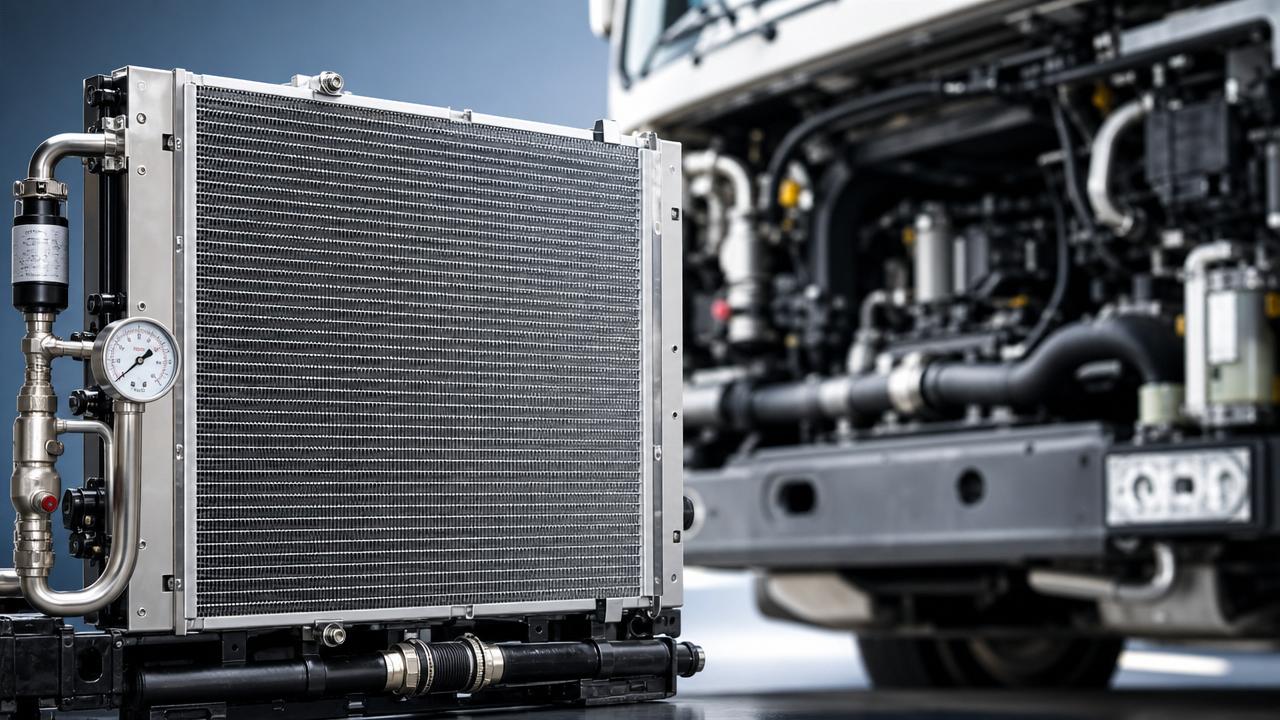
A Radiator failure can quickly turn routine maintenance into costly downtime, especially for heavy trucks, construction machinery, and new energy vehicles.
Early warning signs help prevent engine damage, route interruption, and expensive component replacement under demanding working conditions.
This guide explains common Radiator failures, practical inspection methods, and decision points for safer aftermarket maintenance.
What does a Radiator do, and why do failures develop?
A Radiator removes excess engine heat by transferring coolant temperature to outside air through tubes, fins, and airflow channels.
When heat exchange drops, coolant temperature rises. The engine then operates outside its designed thermal range.
Heavy trucks and construction machinery face higher thermal loads because they often work under long idle time, heavy torque, and dusty environments.
New energy vehicle cooling modules also require stable thermal control for batteries, electronic components, and auxiliary systems.
Radiator failures usually develop from pressure, vibration, corrosion, blocked airflow, poor coolant quality, or aging seals.
A small leak or minor blockage may seem manageable, but it can reduce cooling performance quickly during peak load.
Regular inspection is therefore not only preventive maintenance. It is also protection for the engine, transmission, and uptime plan.
Which Radiator leak signs should be checked first?
Coolant leakage is one of the most visible Radiator problems. It usually starts near seams, hose joints, tanks, or damaged cores.
Fresh coolant stains may appear bright green, red, yellow, or blue, depending on the coolant specification.
Dried coolant often leaves powdery marks, sticky residue, or pale tracks around the leaking area.
Leakage may increase only when the system is hot and pressurized. A cold visual check can miss early defects.
Pressure testing helps confirm whether the Radiator core, cap, tank, or connected hoses are losing pressure.
- Inspect upper and lower hose connections for wetness or swelling.
- Check tank-to-core joints for dried coolant deposits.
- Look for impact damage on the front cooling surface.
- Test the pressure cap when repeated coolant loss appears.
Never ignore unexplained coolant loss. Even slow Radiator leakage can cause overheating during a long climb or heavy loading cycle.
How does abnormal temperature rise reveal Radiator trouble?
A rising temperature gauge is a clear warning, but the cause is not always inside the engine.
A restricted Radiator can reduce heat transfer even when coolant volume appears normal.
Temperature rise under load often indicates insufficient cooling capacity, blocked fins, internal scale, or weak coolant circulation.
If the temperature returns to normal at idle, airflow or fan performance may require inspection.
If the temperature remains high at idle, coolant flow blockage or severe Radiator contamination may be involved.
Thermal imaging can help locate cold zones across the Radiator surface. Cold areas may show blocked tubes.
Technicians should compare inlet and outlet temperatures. A very small difference can suggest poor heat exchange.
A very large difference may indicate restricted flow or insufficient coolant movement through the system.
Overheating should not be solved only by adding coolant. The root cause must be confirmed before operation continues.
What corrosion, clogging, and contamination symptoms matter most?
Corrosion damages Radiator tubes, tanks, and brazed joints. It usually begins when coolant chemistry is wrong or overdue.
Poor coolant can lose its anti-corrosion additives. Mixed coolant types can also create deposits and reduce protection.
Rust color, floating particles, or sludge in the expansion tank should be treated as important warning signs.
External clogging is also common in construction machinery. Dust, mud, insects, and plant fibers can block fin passages.
Blocked fins reduce airflow through the Radiator. The cooling fan then works harder but removes less heat.
Internal scale is harder to see. It forms inside tubes and limits coolant contact with metal surfaces.
Cleaning must be careful. High-pressure washing at the wrong angle can bend fins and worsen airflow restriction.
- Use compatible coolant according to vehicle requirements.
- Avoid mixing unknown coolant brands or formulas.
- Clean fins from the correct direction with controlled pressure.
- Flush the cooling circuit when contamination is confirmed.
If corrosion has weakened the core, cleaning alone may not restore Radiator reliability.
How can vibration and pressure damage a Radiator?
Commercial vehicles experience constant vibration, road shock, and engine movement. These forces can fatigue Radiator mounting points.
Loose brackets allow extra movement. Over time, seams, plastic tanks, aluminum tubes, and welded areas may crack.
Pressure spikes can also damage the Radiator. A faulty cap or blocked overflow line may increase system stress.
Hose collapse, cap failure, and air pockets can create unstable pressure conditions during heating and cooling cycles.
Mounting inspection should include rubber cushions, frame alignment, fan shroud clearance, and surrounding component interference.
A replacement Radiator may fail early if the installation environment remains damaged or misaligned.
Before replacing parts, confirm that no external structure is forcing the Radiator into an abnormal position.
When should a Radiator be repaired, cleaned, or replaced?
The correct decision depends on failure location, operating duty, vehicle value, downtime cost, and safety risk.
Minor external dirt can often be solved through proper cleaning. Light coolant contamination may require flushing and coolant replacement.
However, cracked tanks, severe corrosion, repeated leakage, or blocked cores usually point toward replacement.
For Scania-related service needs, RADIATOR FOR SCANIA offers model 1776026 with size 860*928*40.
Matching dimensions, connection layout, cooling capacity, and vehicle application is essential before ordering any Radiator component.
Liaocheng Xinde Auto Parts Co., Ltd. focuses on water tank radiators, intercoolers, construction machinery radiators, and new energy radiator modules.
Established in 2018, the company integrates research, production, and global sales for demanding vehicle cooling applications.
Its honors include High-tech Enterprise, Civilized and Honest Enterprise, and Trustworthy Unit for Consumers.
Radiator warning signs and recommended actions
FAQ: practical Radiator inspection questions
Can a vehicle run with a small Radiator leak?
It may run briefly, but it should not continue normal operation without diagnosis.
A small Radiator leak can become serious once system pressure and engine load increase.
Is overheating always caused by the Radiator?
No. Thermostat faults, fan problems, water pump issues, air pockets, or sensor errors may also cause overheating.
Still, the Radiator should be checked early because heat exchange is central to cooling performance.
How often should coolant be inspected?
Coolant level, color, and visible contamination should be inspected during routine maintenance intervals.
Vehicles in dusty, hot, or heavy-load service require more frequent Radiator and coolant checks.
What is the biggest mistake during Radiator cleaning?
The biggest mistake is using excessive pressure directly against delicate fins.
Bent fins can restrict airflow and reduce Radiator efficiency, even after dirt is removed.
When is replacement safer than repair?
Replacement is safer when cracks, severe corrosion, repeated overheating, or internal blockage are confirmed.
A reliable Radiator replacement reduces repeated downtime and protects the engine from thermal damage.
Conclusion: act before a minor Radiator symptom becomes downtime
Radiator problems rarely improve by themselves. Leaks, corrosion, clogging, vibration damage, and overheating signs should be handled early.
A structured inspection can identify whether cleaning, flushing, repair, or replacement is the right next step.
For heavy trucks, construction machinery, and new energy vehicles, stable cooling is directly connected to performance and reliability.
Record warning signs, verify pressure and temperature data, and select a compatible Radiator solution for the vehicle application.