



Radiator Core Types: Tube-and-Fin vs Bar-and-Plate for Different Cooling Demands
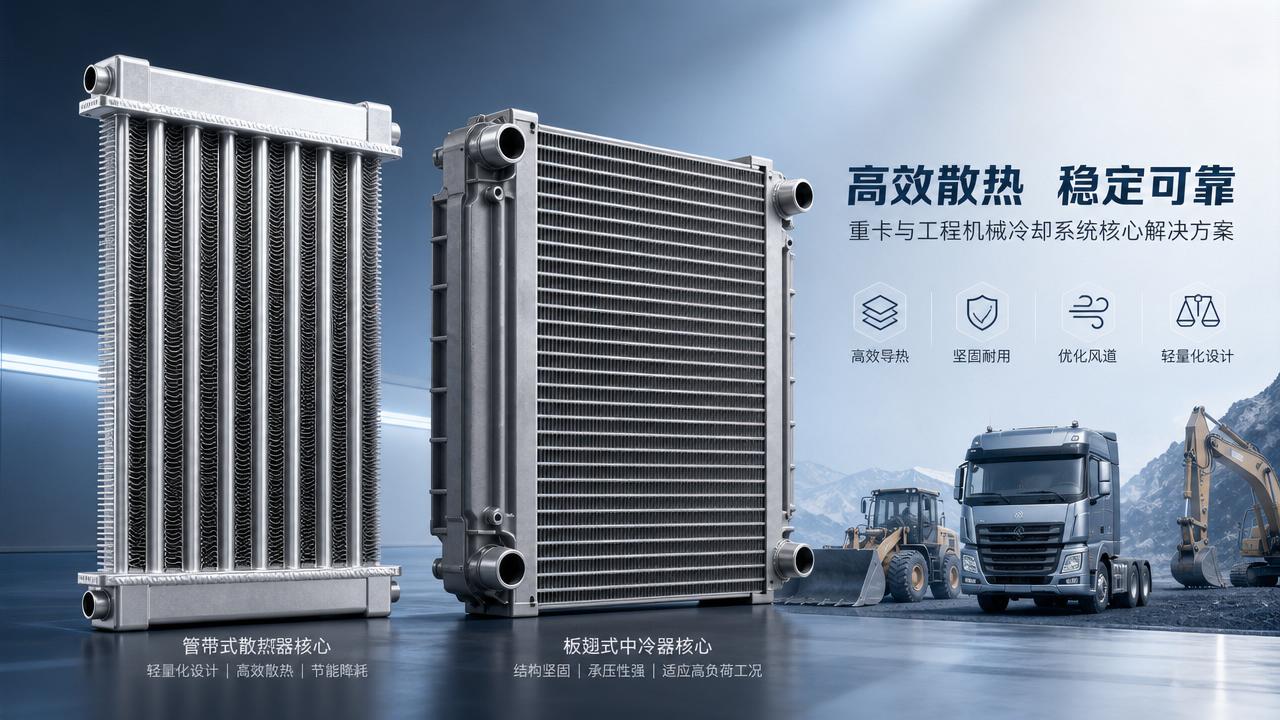
Radiator Core Types: Tube-and-Fin vs Bar-and-Plate for Different Cooling Demands
Choosing the right radiator core affects cooling efficiency, durability, packaging, and lifecycle cost.
That decision becomes more important when equipment runs under heavy loads, long duty cycles, or unstable ambient temperatures.
In practice, most selection work narrows to two mainstream radiator core designs.
They are tube-and-fin and bar-and-plate.
Each radiator core type solves heat rejection in a different way.
Each also brings trade-offs in airflow resistance, structural strength, repairability, and weight.
For heavy trucks, construction machinery, and new energy thermal systems, those trade-offs are rarely minor.
They shape operating margins and real field reliability.
This comparison explains how to match a radiator core to actual cooling demands, not just catalog numbers.
Why radiator core selection matters
A radiator core is the heat exchange center of the cooling assembly.
Its internal passages transfer heat from coolant or charge air to the outside airflow.
If the radiator core is mismatched, overheating may appear even when fan power and coolant flow seem adequate.
More importantly, poor selection can increase pressure drop, raise fuel consumption, and reduce component life.
From recent project trends, operating environments are getting tougher.
Machines now face higher engine outputs, tighter installation space, and stronger durability expectations.
That means radiator core design can no longer be treated as a generic commodity choice.
It needs application-based evaluation.
Tube-and-fin radiator core: lightweight and airflow-friendly
A tube-and-fin radiator core uses flat or oval tubes connected by thin external fins.
Coolant or compressed air flows inside the tubes.
Heat moves outward through the tube walls and into the fins.
Air passing across the fin field then removes that heat.
Main advantages
- Lower weight helps vehicle efficiency and eases module packaging.
- Lower airside resistance supports better airflow under limited fan capacity.
- Good thermal performance in applications with cleaner airflow paths.
- Usually more cost-effective for high-volume production.
Typical limits
- Thinner fin structures can be more vulnerable to vibration and impact.
- Dirty environments may clog narrow fin passages faster.
- Severe duty cycles can expose fatigue risks over time.
So, a tube-and-fin radiator core often fits highway trucks, controlled fleet routes, and systems where weight and airflow efficiency matter most.
Bar-and-plate radiator core: stronger under harsh duty
A bar-and-plate radiator core is built from thicker bars, plates, and internal turbulators.
This structure is generally heavier, but also much more robust.
The design creates strong internal heat transfer and higher mechanical strength.
That matters when vibration, debris, pressure pulses, or shock loads are part of normal operation.
Main advantages
- Higher structural strength supports rough terrain and severe vibration.
- Better resistance to pressure and thermal cycling.
- Often preferred for charge air cooling in high-boost systems.
- Longer service confidence in construction and off-road equipment.
Typical limits
- Higher weight can affect module targets and total system efficiency.
- Airside pressure drop may be higher in some layouts.
- Manufacturing cost is usually higher than a tube-and-fin radiator core.
In short, bar-and-plate is usually the safer radiator core choice for harsh conditions and high reliability demands.
Direct comparison for cooling decisions
This side-by-side view makes one point clear.
There is no universally better radiator core.
The right option depends on thermal load, contamination level, pressure targets, and structural risk.
How operating conditions change the right radiator core
Application context should drive every radiator core decision.
A design that performs well in one platform may underperform in another.
Heavy trucks
Long-haul heavy trucks often prioritize stable airflow, lower weight, and fuel efficiency.
In these cases, a tube-and-fin radiator core may deliver a strong balance.
However, high-output engines or aggressive turbo systems may still favor bar-and-plate intercooling sections.
Construction machinery
Dust, vibration, impact, and stop-start load swings are much more common here.
That pushes many programs toward a bar-and-plate radiator core.
The extra strength often justifies the additional mass and cost.
New energy thermal modules
Thermal management for batteries, power electronics, and hybrid systems adds new constraints.
Packaging is tighter, and temperature control windows are narrower.
Here, radiator core selection usually requires balancing compactness, low pressure drop, and long-term stability.
That is why system-level testing matters more than assumptions.
Practical evaluation checklist
A useful radiator core review should move beyond basic dimensions.
It should test how the design behaves in real operating windows.
- Define the peak heat load, not only the average load.
- Check coolant-side and airside pressure drop together.
- Review vibration levels, shock exposure, and contamination risk.
- Confirm available fan power and actual airflow path quality.
- Estimate lifecycle cost, including cleaning and maintenance downtime.
- Validate brazing quality, material consistency, and supplier process control.
This is where supplier capability becomes part of technical risk control.
Liaocheng Xinde Auto Parts Co., Ltd. focuses on water tank radiators, intercoolers, construction machinery radiators, and heavy truck cooling products.
Since 2018, the company has expanded quickly and built a strong manufacturing profile in China.
Its product scope also supports new energy radiator modules, which reflects the broader shift in thermal management demand.
A product example in real selection work
In charge air cooling projects, core architecture often determines whether intake temperatures stay within target during sustained load.
A practical reference is INTERCOOLER FOR MAN XD163.
This solution matches MAN OEM 8161300216 and uses a size of 665*892*62.
Details like these matter because radiator core sizing alone does not guarantee fit.
The final decision still depends on flow demand, installation space, pressure resistance, and service conditions.
That is also why comparing tube-and-fin and bar-and-plate early can reduce redesign risk later.
Common mistakes when comparing radiator core types
- Choosing only by initial price instead of total operating value.
- Ignoring airflow restrictions created by the full cooling stack.
- Assuming a stronger radiator core is always the better option.
- Using nominal dimensions without checking thermal and pressure performance.
- Skipping durability validation in vibration-heavy applications.
These mistakes are common because cooling decisions often happen under time pressure, yet their downstream impact is large.
Final selection guidance
If the priority is lower weight, better airflow, and cost efficiency, a tube-and-fin radiator core is often the logical starting point.
If the application faces harsh vibration, dirt, high boost, or severe thermal cycling, bar-and-plate usually offers more protection.
The smarter path is to compare each radiator core against real load cases, not generic assumptions.
That approach improves cooling reliability and avoids costly overdesign.
When selection is tied to performance data, structural risk, and operating context, the right radiator core becomes much easier to identify.