



How to Choose a Radiator Core: Material, Thickness, Fin Pitch, and Tube Layout
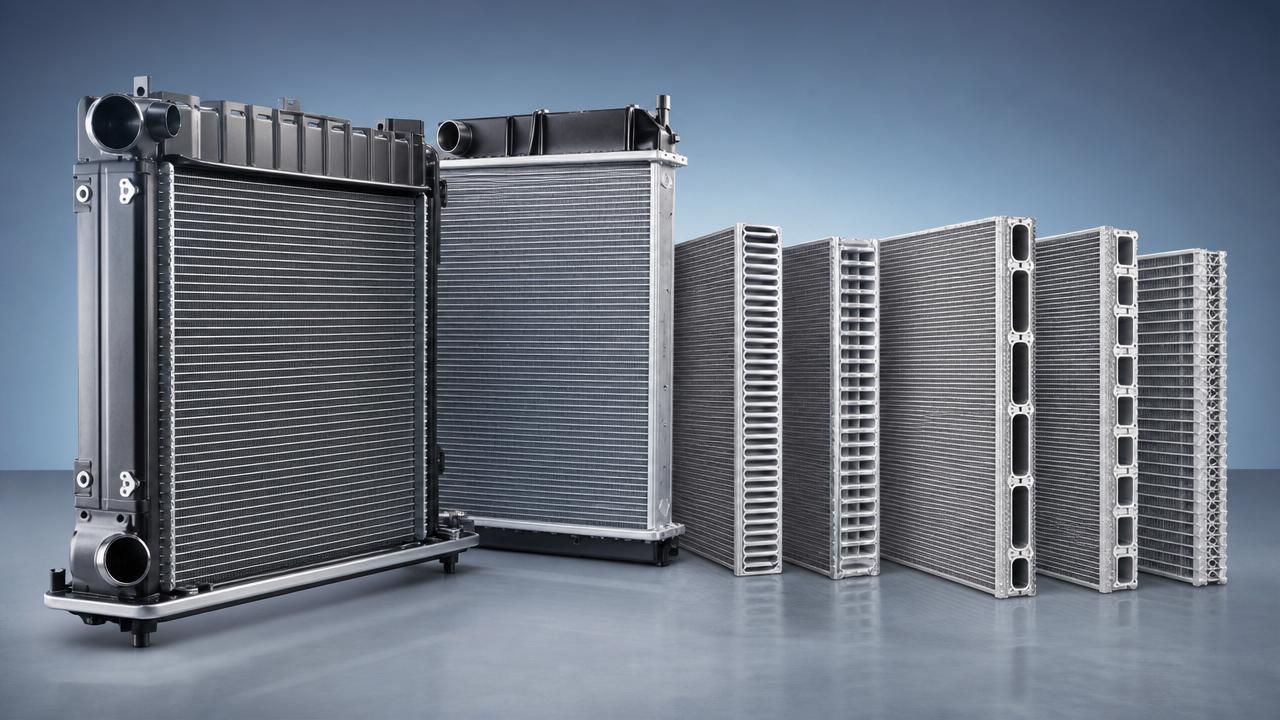
Choosing a radiator core is rarely a single-parameter decision. In heavy trucks, passenger vehicles, construction equipment, and new energy cooling systems, the right core affects heat rejection, pressure stability, packaging efficiency, and long-term durability. Material, thickness, fin pitch, and tube layout must be judged together, because a radiator core that performs well in one duty cycle may underperform in another.
That is why radiator core selection has become a practical engineering issue rather than a catalog exercise. In the parts sector, especially where operating loads vary widely, the evaluation process needs to connect thermal targets with airflow conditions, coolant quality, vibration exposure, and service expectations.
Why radiator core choice matters now
Cooling systems are under more pressure than before. Higher engine output, tighter installation space, emissions-related heat loads, and electrified auxiliary systems all increase the demand placed on each radiator core.
A mismatch often appears in familiar ways. Coolant temperature rises during climbing, fan duty becomes excessive, or core blockage reduces stable performance over time. These are not always system-level faults. Often, the radiator core specification itself is the limiting factor.
This is especially relevant in supply chains that serve multiple vehicle platforms. Liaocheng Xinde Auto Parts Co., Ltd., established in 2018, has focused on radiators, intercoolers, construction machinery radiators, and heavy truck as well as new energy radiator modules. That background reflects a broader market reality: application diversity makes careful radiator core evaluation more valuable, not less.
Start with the thermal job, not the drawing
Before comparing designs, define the operating envelope. A radiator core should be selected against real conditions, not nominal engine power alone.
- Peak heat rejection requirement under worst ambient temperature
- Available frontal area and installation depth
- Vehicle speed profile and fan dependence at low airflow
- Coolant chemistry, contamination risk, and maintenance intervals
- Vibration level, pressure pulses, and expected service life
Once these inputs are clear, the four main variables become easier to judge. Without that context, even a high-performance radiator core may be oversized, restrictive, or unnecessarily costly.
Material selection shapes efficiency and durability
Material affects more than weight. It influences thermal conductivity, corrosion resistance, forming methods, repairability, and total module cost. In most current applications, aluminum dominates modern radiator core design because it balances heat transfer, mass, and manufacturability.
Copper-brass still has value in some repair-oriented or specialized environments. It can be easier to service in the field and remains familiar in certain legacy systems. However, it usually brings more weight and different packaging tradeoffs.
In practice, the better material choice depends on corrosion exposure, duty cycle, service model, and mass targets. A radiator core for stop-and-go logistics equipment may need a different balance than one for long-haul heavy trucks or construction machinery.
Core thickness is a balance, not a maximum
A thicker radiator core usually offers more heat transfer area, but that does not automatically mean better cooling. As thickness increases, airflow resistance also rises. If the air cannot pass through the rear portion effectively, part of the core contributes less than expected.
This is where real operating conditions matter. A vehicle with strong ram air at speed can tolerate a different thickness than a machine that spends long hours at low speed with dust-loaded fins and fan-driven airflow.
A practical review should compare three things together: thermal gain from added rows or depth, fan power or pressure drop penalty, and the risk of fouling in the field. If one side of that balance is ignored, the radiator core may look strong on paper and weak in service.
This is also why platform-specific solutions matter. In some passenger and commercial vehicle applications, a compact but efficient design such as radiator for benz can illustrate how packaging limits shape the preferred radiator core thickness.
Fin pitch affects airflow, blockage resistance, and usable performance
Fin pitch is often underestimated during early screening. Tighter fin spacing increases heat transfer surface, but it also raises airside resistance and can trap dust, mud, insects, or oily debris more easily.
In a clean, highway-oriented environment, a denser fin pitch may support stronger performance. In mining, construction, agricultural, or mixed-road use, a wider pitch may deliver more stable real-world cooling because it stays open longer.
The best radiator core is therefore not always the one with the highest theoretical surface density. It is the one that keeps exchanging heat after weeks or months of actual service.
What to compare when reviewing fin pitch
- Expected contamination level around the vehicle or machine
- Ease of cleaning without damaging fins
- Airflow source, including fan curve and shroud design
- Noise and pressure drop implications at system level
A radiator core that remains serviceable under contamination often has higher lifecycle value than one that only excels in laboratory conditions.
Tube layout determines flow behavior inside the core
Tube layout shapes coolant distribution, pressure drop, burst strength, and local heat transfer. Flat tubes, multi-channel tubes, and different row arrangements are not small geometric details. They define how effectively the radiator core uses its available area.
A well-designed layout helps avoid dead zones, uneven coolant velocity, and temperature imbalance across the face of the core. It also affects how the core responds to thermal cycling and vibration.
When reviewing samples, it helps to look beyond nominal dimensions. Header design, braze consistency, and internal passage uniformity can change the real performance of the radiator core more than a simple catalog comparison suggests.
Application context changes the right answer
The same radiator core logic does not apply equally across all platforms. Heavy trucks usually emphasize long service life, vibration resistance, and sustained load cooling. Construction machinery often places more emphasis on fouling resistance and low-speed airflow behavior.
New energy radiator modules introduce another layer. Thermal management may involve batteries, motors, power electronics, or hybrid cooling loops. In these cases, radiator core selection must align with multi-circuit integration and tighter thermal control windows.
That industry shift explains why experienced suppliers invest in both manufacturing and design capability. A company with active development across truck, machinery, and new energy applications is usually better positioned to match radiator core architecture to operating reality rather than rely on generic substitutions.
A practical checklist for comparing options
A useful comparison process should stay simple enough to apply, but detailed enough to catch mismatch risk.
- Confirm heat load, ambient range, and airflow condition
- Check whether material suits coolant and corrosion exposure
- Review thickness against fan capacity and package depth
- Match fin pitch to contamination and cleaning conditions
- Examine tube layout for pressure drop and flow uniformity
- Ask for validation data, not only nominal specifications
If a reference product is needed for benchmarking in a vehicle-specific context, solutions like radiator for benz can be useful as comparison points for packaging, fitment, and expected cooling behavior.
What to do next with a radiator core evaluation
The most reliable decisions come from narrowing the gap between design data and field conditions. That means building a short list based on thermal and mechanical requirements, then checking samples or validation reports against actual duty cycles.
A radiator core should not be judged only by size or price. Material choice, core thickness, fin pitch, and tube layout work as one system. When those four factors are aligned with the application, the result is more stable cooling, fewer service issues, and a clearer basis for long-term parts selection.
The next step is usually straightforward: define the operating scenario in detail, compare at least two radiator core structures against that scenario, and treat validation data as the final filter before approval.