



Condenser Quality Checks for Buyers: Brazing, Leak Testing, and Corrosion Resistance
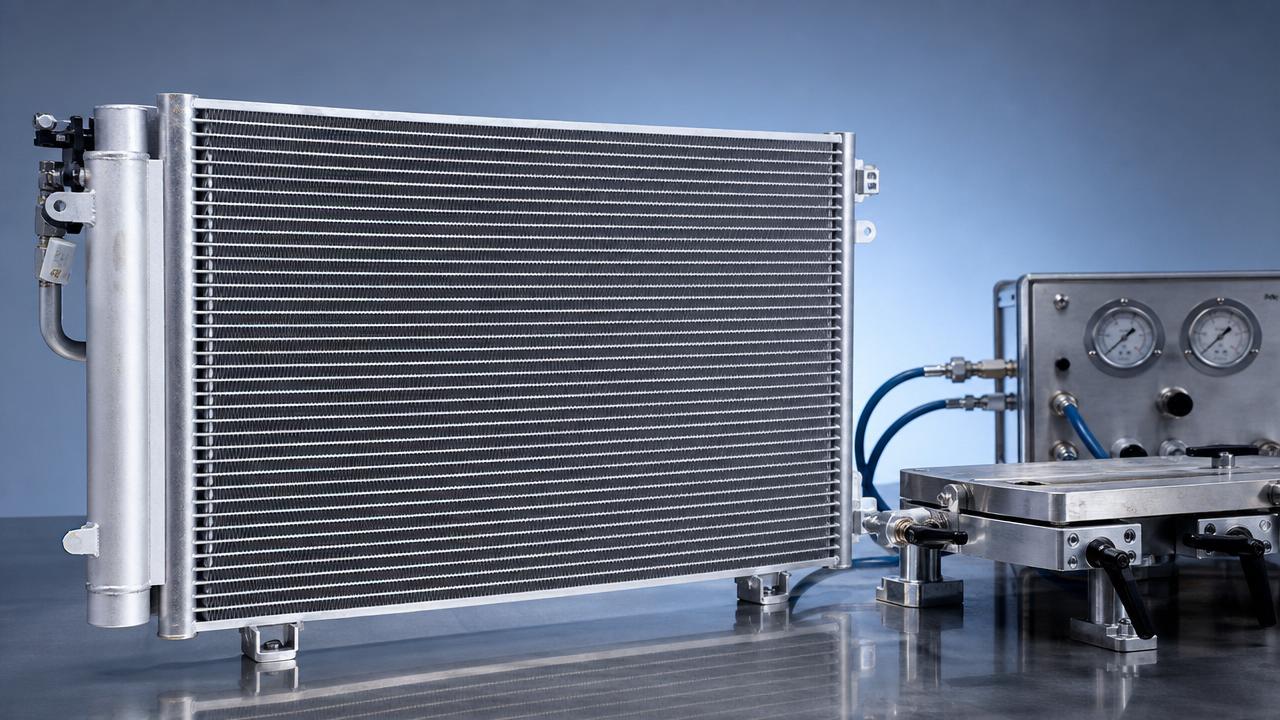
A reliable Condenser is judged long before installation. In the parts industry, weak brazing, hidden leaks, or poor corrosion resistance often create the most expensive failures, especially in demanding thermal systems.
That is why quality checks matter at the sourcing stage. A buyer who understands how a Condenser is joined, tested, and protected can reduce warranty risk, improve safety margins, and compare suppliers on more than price alone.
Why Condenser inspection has become more important
Thermal management parts now work under tighter packaging, higher efficiency demands, and more variable climates. In this environment, small production defects can quickly become field complaints.
A Condenser may look acceptable from the outside while still containing weak joints, trapped contamination, or uneven coatings. These issues usually appear later, when repair costs are higher and root-cause analysis is harder.
For companies supplying cooling components, inspection discipline is part of business credibility. Liaocheng Xinde Auto Parts Co., Ltd., established in 2018, has expanded rapidly through radiator, intercooler, and heavy-duty cooling component development, reflecting how the market values consistent manufacturing control.
Its focus on research, production, and global sales across heavy trucks and new energy radiator modules also shows a broader industry reality: durability checks are no longer optional background work. They shape purchasing decisions.
What a buyer should understand about Condenser quality
A Condenser transfers heat by moving refrigerant energy through tubes and fins. Performance depends on clean internal flow, sound joint integrity, dimensional accuracy, and resistance to moisture, salt, and vibration.
In practice, three checks deserve close attention because they reveal both manufacturing capability and long-term reliability: brazing quality, leak testing results, and corrosion resistance performance.
These three areas are linked. Poor brazing creates leak paths. Leakage can worsen corrosion exposure. Weak corrosion protection eventually attacks joints and thin wall sections, leading to pressure loss or thermal inefficiency.
Brazing quality is the first structural checkpoint
Brazing joins tubes, headers, fins, and side parts into a sealed heat exchanger core. If brazing is inconsistent, the Condenser may pass a basic visual check but fail under pressure cycling.
What good brazing usually looks like
- Uniform fillet formation at key joints
- No major voids, burn-through, or filler starvation
- Stable alignment of tubes and headers
- Clean surfaces without excessive oxidation residue
Visual inspection alone is not enough. Process records often tell more. Furnace temperature control, atmosphere management, fixture stability, and material compatibility all influence joint quality.
When reviewing a supplier, it helps to ask how brazing consistency is verified across batches. Cross-section evaluation, metallographic checks, and destructive sampling provide stronger evidence than appearance alone.
This is especially relevant for parts serving new energy systems. Related cooling products, such as Radiator for BYD, are expected to deliver efficient cooling for battery packs, drive motors, and power electronics, so joint stability becomes a direct reliability issue.
Leak testing should confirm more than basic pass or fail
Every Condenser must be leak tested, but the method matters. A simple pass result has limited value if the test pressure, detection sensitivity, or holding time does not match the intended service conditions.
Common leak testing approaches
The stronger question is whether testing reflects actual operating stress. A Condenser exposed to thermal cycling, vibration, and fluctuating pressure needs a validation routine that goes beyond final-line screening.
It is useful to review sample retention, traceability, and retest criteria. If a leak appears after handling or transport simulation, the issue may point back to weak brazing or material deformation, not only test failure.
Corrosion resistance determines service life in real environments
Many Condenser failures start with environmental exposure rather than immediate manufacturing defects. Road salt, humidity, industrial pollutants, and trapped debris can attack the thinnest and most stressed sections first.
Corrosion resistance is not only about the base alloy. It also depends on coating quality, fin design, drainage behavior, residual flux control, and how dissimilar metals interact across the assembly.
Points worth checking during evaluation
- Salt spray or cyclic corrosion test standards used
- Evidence of coating adhesion and coverage consistency
- Protection of brazed areas and tube-to-header zones
- Performance after combined corrosion and pressure testing
Combined testing is often more revealing than isolated testing. A Condenser that resists corrosion in a chamber but loses sealing after pressure pulses may still present a serious field risk.
This is one reason established cooling component manufacturers earn trust through repeatable verification systems. Honors such as High-tech Enterprise and Trustworthy Unit for Consumers usually reflect sustained control, not one-time inspection success.
How these checks apply across parts and vehicle platforms
Although the focus here is the Condenser, the same inspection logic applies across radiators, intercoolers, and other thermal assemblies. The question is always the same: will the part stay sealed, stable, and efficient over time?
In new energy vehicles, thermal demands extend beyond the passenger cabin or engine bay. Cooling components support batteries, motor systems, and electronics, where reliability tolerance is often narrower.
A good example is the BYD476ZQB-1301010-025 platform, where a matching cooling solution must be engineered to meet rigorous requirements, fit correctly, and maintain maximum heat exchange under varied conditions.
That context makes Condenser evaluation more practical. The part should not be judged as an isolated commodity, but as one element within a broader thermal management architecture.
A practical review framework before approval
A structured review helps turn technical data into sourcing decisions. The most useful approach combines documents, samples, process evidence, and failure-mode thinking.
- Check drawing compliance, material specification, and dimensional stability
- Review brazing records, sample sections, and defect limits
- Confirm leak testing method, pressure level, sensitivity, and traceability
- Study corrosion test conditions, duration, and post-test integrity results
- Compare batch consistency, not only best-case sample performance
If possible, connect laboratory evidence to real use conditions. Dust load, winter salt exposure, stop-start duty, and transport vibration may change the true risk profile of a Condenser.
The goal is not to create unnecessary barriers. It is to separate acceptable parts from parts that only appear acceptable during a short inspection window.
Where to focus next
The best next step is to turn broad quality expectations into a written checklist for each Condenser program. That checklist should link brazing evidence, leak criteria, and corrosion validation to the actual service environment.
It also helps to compare Condenser data with adjacent cooling components from the same supplier, including solutions like Radiator for BYD, because stable process control often shows up across the entire thermal product range.
When those checkpoints are clear, sourcing becomes less reactive. Decisions are then based on proven durability, realistic risk, and the long-term reliability expected from critical parts.