



Radiator Core Materials Compared: What Really Affects Heat Transfer
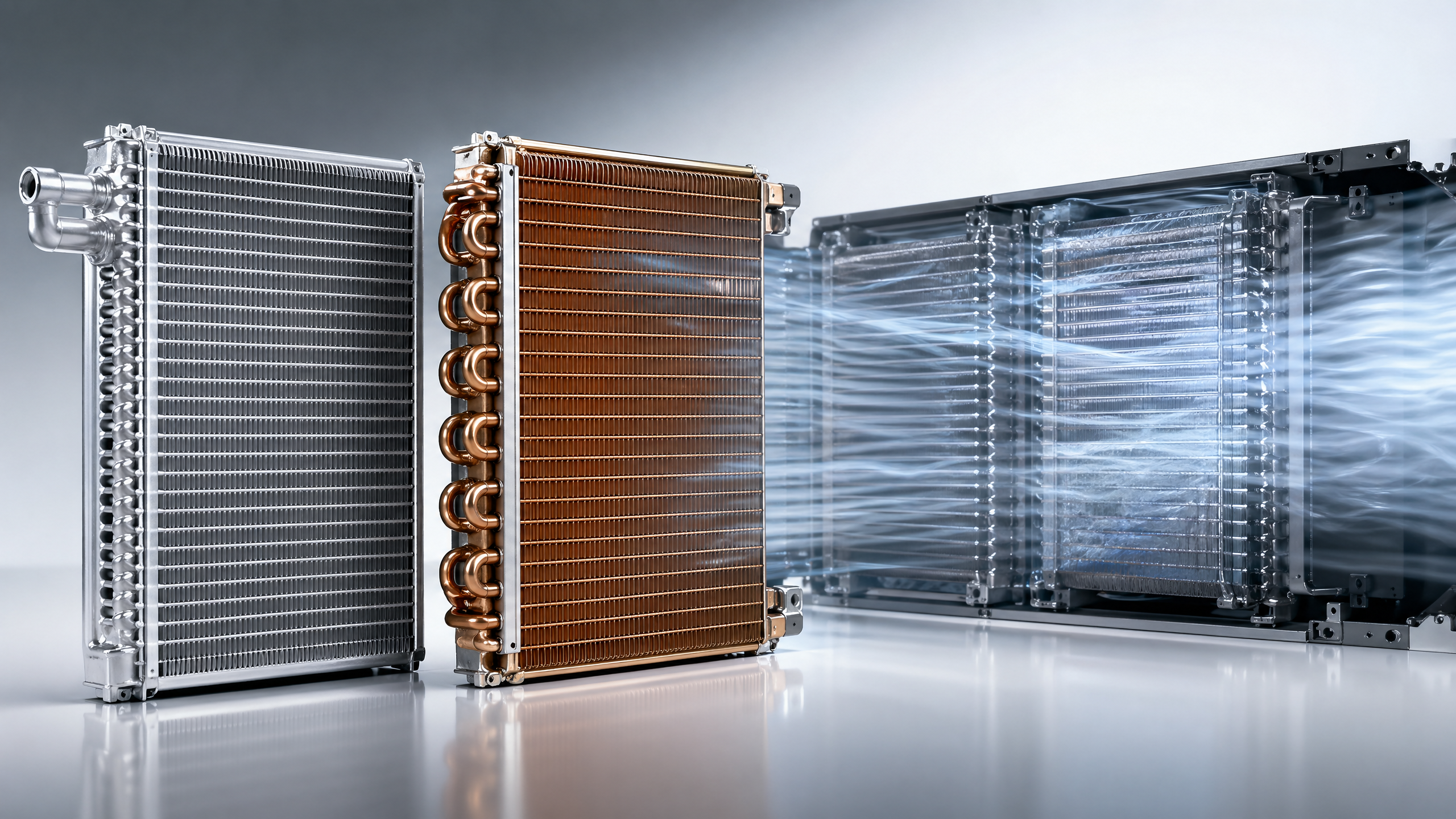
When evaluating a radiator core, material choice is only one part of the heat-transfer equation. Factors such as fin design, tube structure, airflow efficiency, coolant flow, and operating conditions often have a greater impact on real-world performance than many buyers expect. This article compares common core materials and explains what truly matters when selecting a radiator for heavy-duty and industrial applications.
Understanding What a Radiator Core Really Does
A radiator core is the active heat-exchange section of a radiator assembly. It typically consists of tubes, fins, headers, and brazed or mechanically joined interfaces that transfer heat from coolant to ambient air. In heavy trucks, buses, construction machinery, and new energy thermal systems, the radiator core is not just a passive component. It directly affects engine temperature stability, powertrain durability, maintenance intervals, and operating uptime across temperature ranges that may extend from below 0°C winter starts to above 45°C summer duty cycles.
For information researchers in the auto parts field, the key point is that a radiator core should be assessed as a system rather than a single material choice. Aluminum and copper-brass are often the first comparison, but actual thermal performance depends on total surface area, fin density, coolant-side turbulence, air-side pressure drop, and the cleanliness of both airflow and internal passages over time. A core that performs well in a lab may behave differently after 1,000 to 3,000 hours of dusty or stop-and-go operation.
In practical terms, buyers should ask not only “What is the radiator core made of?” but also “How is it built?” and “What duty cycle is it designed for?” In sectors such as heavy commercial vehicles and public transportation, the wrong core design can lead to elevated coolant temperature, fan overuse, fuel efficiency loss, and more frequent service interruption. That is why heat-transfer analysis should include structure, application environment, and long-term serviceability.
Why the topic matters in modern vehicle cooling
Cooling demands have become more complex in the past 5 to 10 years. Engines are expected to run hotter for efficiency, emission control systems increase thermal load, and electric platforms introduce battery, motor, and controller cooling requirements. As a result, the radiator core has become central to broader thermal management, not merely engine cooling in isolation. This trend is especially visible in fleets that run 8 to 16 hours per day and cannot afford unexpected temperature spikes.
Manufacturers focused on radiator modules for heavy-duty and new energy applications increasingly treat core design as a performance-engineering issue rather than a commodity decision. Companies serving global replacement and OE-related channels, including specialized producers of water tank radiators, intercoolers, and construction machinery cooling parts, pay close attention to matching material and structure to actual operating conditions instead of assuming one universal answer.
Main functions of a radiator core
- Transfer heat from coolant to air through tube walls and fin surfaces.
- Maintain stable operating temperature during variable load, speed, and ambient conditions.
- Support durability by reducing thermal stress on engines, batteries, and auxiliary systems.
- Contribute to overall system efficiency by balancing cooling capacity and airflow resistance.
Common Radiator Core Materials and Their Real Characteristics
The most common radiator core materials in commercial and industrial applications are aluminum and copper-brass, while some specialized systems may also involve mixed-material assemblies. The popular belief is that copper always transfers heat better because its thermal conductivity is higher in pure material terms. However, a radiator core is not a solid block of metal. It is a carefully engineered geometry, and modern manufacturing methods can allow aluminum cores to achieve very competitive, and often superior, practical heat rejection for many vehicle platforms.
Aluminum radiator core designs are widely used because they combine relatively low weight, good manufacturability, and compatibility with high-volume brazed construction. Weight matters in heavy vehicles more than some assume. Saving even 10 to 25 kg in a cooling module can benefit payload efficiency, assembly integration, and front-end packaging. Aluminum also supports compact multi-row or optimized single-row designs where airflow and space are limited.
Copper-brass cores still retain value in certain repair-oriented or niche heavy-duty applications because they are traditionally seen as easier to rework and may be preferred in environments where field repair culture is strong. Still, they are often heavier, and material conductivity alone does not guarantee better thermal output if fin bonding, fin shape, and airflow management are less efficient than those of a well-designed aluminum radiator core.
The following comparison helps clarify where material matters and where structure matters more.
This comparison shows why material should not be separated from manufacturing technology. A premium-grade aluminum radiator core built with advanced brazing and optimized fin geometry may outperform a heavier alternative in everyday operation, especially when airflow is constrained or installation space is limited. That is why heat-transfer evaluation should focus on the assembled core, not only on textbook conductivity values.
Material properties versus assembled performance
In assembled form, several interfaces influence thermal efficiency: coolant-to-tube contact, tube wall conduction, tube-to-fin bond quality, and fin-to-air heat release. If any one of these steps is weak, the benefit of raw material conductivity can be reduced. In many modern platforms, the difference between acceptable and poor performance comes from bond integrity, fin louver angle, tube flattening ratio, and contamination resistance over service periods of 12 to 36 months.
This is one reason advanced brazing technology is often emphasized in current aluminum products. Consistent brazed joints help maintain stable thermal contact across the entire radiator core, improving both heat transfer and durability under vibration. For buses and heavy vehicles exposed to frequent start-stop cycles, road shock, and temperature swings, this consistency can matter more than a simple metal-to-metal comparison chart.
What Really Affects Heat Transfer Beyond Material
If the goal is to understand what truly drives cooling performance, five factors usually deserve more attention than material alone: fin design, tube structure, airflow management, coolant flow, and contamination control. In many field applications, these variables create larger performance differences than switching from one core material to another. A radiator core with poor airflow exposure can lose significant efficiency even if the metal itself is excellent.
Fin design directly affects the surface area available for air-side heat rejection. Higher fin density can increase capacity, but only up to the point where airflow restriction becomes too high. In dusty roads, construction sites, or agricultural routes, very tight fin spacing may clog faster, reducing effective heat transfer within weeks or months. So the best radiator core is often not the densest one, but the one that matches the contamination level and cleaning routine of the equipment.
Tube structure also matters. Multi-port flat tubes, internal turbulence features, and row configuration influence how coolant spreads and how quickly heat moves to fins. A 2-row core may outperform a 3-row design if the air-side resistance is lower and the tube-fin bonding is better. This is why thermal design should consider the complete pressure-drop balance instead of assuming that more rows always mean more cooling.
Key performance drivers in real operating conditions
- Airflow velocity across the full core face, especially at low vehicle speed or idle.
- Coolant flow rate and distribution, often evaluated in liters per minute across expected RPM bands.
- Fin pitch and louver geometry, which affect both heat rejection and dirt retention.
- Tube wall thickness and internal design, balancing durability and thermal responsiveness.
- Operating environment, including ambient temperature, humidity, altitude, and debris exposure.
Why airflow is often the hidden limiter
A radiator core can only reject the heat that airflow allows it to reject. If the fan shroud, grille opening, stack arrangement, or nearby components restrict air passage, the core may operate far below its theoretical capacity. This issue is common in tightly packaged engine bays, rear-engine buses, and multi-heat-exchanger arrangements where the radiator shares space with charge air coolers, condensers, or battery cooling units.
In practical engineering reviews, a 10% to 15% airflow shortfall can be more damaging than a modest difference in material conductivity. That is why thermal management teams often evaluate pressure drop, fan performance curves, and heat exchanger stacking sequence alongside radiator core specification. For fleet operators, repeated overheating at low speed may point more to airflow imbalance than to core material weakness.
Coolant quality is another hidden variable. Scale, corrosion products, or incompatible coolant chemistry can coat internal surfaces and reduce heat transfer over time. A high-quality radiator core may still underperform if coolant replacement intervals are ignored or if mixed coolant types create deposits inside narrow passages.
Industry Context: How Application Changes the Right Core Choice
The best radiator core for one vehicle class may be the wrong solution for another. Heavy trucks on long-haul routes, city buses with repeated idling, wheel loaders operating in dust, and electric commercial vehicles with multiple thermal loops all place different demands on the core. Understanding the application profile is essential before drawing conclusions about material or design.
In public transportation, thermal stability and uptime are especially important because vehicles may operate on fixed schedules for 10 to 18 hours daily. A bus radiator core must handle repeated low-speed conditions, limited ram air, and frequent thermal cycling. In these cases, robust brazed aluminum solutions are commonly selected for their packaging efficiency and system integration advantages.
A good example is Radiator for Ankai, developed for public transportation use. Built with premium-grade aluminum and advanced brazing technology, this type of product is designed to support optimal thermal management for both traditional diesel and new energy electric buses. In practical fleet service, the value is not only cooling capacity but also reduced downtime and support for longer component life.
The table below outlines how application context influences radiator core priorities.
This application view explains why “best material” questions often produce incomplete answers. The more useful question is: which radiator core architecture best fits the thermal load, space limit, contamination level, and maintenance pattern of the target vehicle? Once that is clear, material selection becomes more logical and less speculative.
Why industry users increasingly favor integrated thinking
For heavy-duty and industrial sectors, cooling parts are evaluated not just by peak performance but by stability over service intervals. A radiator core that performs well for the first 100 hours but loses efficiency quickly due to clogging or poor joint durability may raise total operating cost. This is why suppliers with dedicated focus on radiators, intercoolers, and related heavy-vehicle components often invest in application-specific engineering rather than one-size-fits-all products.
Liaocheng Xinde Auto Parts Co., Ltd., established in 2018, operates in this context as a specialized manufacturer engaged in the research, production, and global sales of water tank radiators, intercoolers, construction machinery radiators, and related components for heavy trucks and new energy radiator modules. For information researchers, this matters because supplier capability in these product categories often influences how well a radiator core is matched to real working conditions.
Practical Evaluation Methods for Selecting a Radiator Core
A structured evaluation process helps buyers avoid overemphasizing raw material while missing more decisive factors. Whether the project involves replacement parts, fleet upgrades, or new equipment development, the radiator core should be reviewed through operating data, physical design, and service requirements. This approach is especially useful when comparing several suppliers that all claim high efficiency.
Start with the thermal duty: engine or system heat rejection target, ambient temperature band, expected road speed or fan operating pattern, and coolant circuit characteristics. Then review packaging dimensions, mounting points, stack configuration, and cleaning access. Finally, consider durability needs such as vibration exposure, pressure cycling, and corrosion risk. In many industrial cases, a 3-step review like this is more reliable than choosing based on material label alone.
The checklist below can help information researchers build a practical comparison framework for any radiator core project.
Selection checklist for heavy-duty and industrial use
- Define heat load and duty cycle, including idle time, climbing load, and ambient range.
- Check core dimensions, row layout, tube type, fin pitch, and expected airflow resistance.
- Confirm coolant compatibility, corrosion protection approach, and maintenance interval assumptions.
- Review manufacturing method such as brazed construction and consistency of tube-fin bonding.
- Assess service environment, including dust, vibration, stop-start frequency, and wash-down conditions.
- Ask about lead time, sample support, and whether custom optimization is available for unique platforms.
Typical evaluation ranges worth confirming
Even when exact figures vary by project, certain ranges are useful during early comparison. Ambient design assumptions may span -20°C to 50°C. Coolant operating temperature targets often sit around 85°C to 105°C depending on system design. Fan-dominant applications should be reviewed carefully at low vehicle speed, while dust-prone equipment may need more moderate fin density to preserve performance over 6 to 12 months between major service checks.
If the application is a bus or other public transport platform, it is also worth asking whether the radiator core supports both conventional and electrified thermal layouts. In such cases, products like Radiator for Ankai represent the direction many fleets prefer: premium-grade aluminum construction combined with thermal management suited to diesel and new energy electric buses, with the practical aim of minimizing downtime and supporting long service life.
When these questions are asked early, buyers are less likely to confuse material preference with actual operating suitability. That leads to better thermal stability, fewer field complaints, and more predictable lifecycle performance.
Why Choosing the Right Manufacturing Partner Also Matters
A radiator core is only as reliable as its design execution and production consistency. Two cores made from similar aluminum stock can perform differently if fin forming, brazing control, cleanliness, leak testing, or dimensional accuracy are not managed well. For this reason, supplier evaluation should include technical communication quality and category specialization, not just catalog availability.
In the auto parts industry, especially for heavy trucks, buses, and construction machinery, buyers often need support on more than one variable at the same time. They may require confirmation of core configuration, adaptation to regional climate, integration with intercoolers or other modules, and realistic delivery planning over production windows of 2 to 8 weeks depending on complexity. A supplier familiar with these needs can reduce both technical risk and purchasing friction.
That is one reason specialized manufacturers continue to gain attention in the global market. A company focused on radiator systems and related thermal parts is generally better positioned to discuss the full picture of radiator core performance: not just the metal, but also the application logic, manufacturing route, and long-term use conditions.
Why choose us
If you are evaluating a radiator core for heavy trucks, buses, construction machinery, or new energy vehicle modules, we can help you move beyond basic material comparison and focus on what truly affects heat transfer. Our business covers the research, production, and global sales of water tank radiators, intercoolers, construction machinery radiators, and related thermal components, allowing us to support both standard and application-driven requirements.
You can contact us for specific support on radiator core parameter confirmation, material and structure selection, delivery cycle discussion, custom thermal solutions, sample arrangements, and quotation communication. If your project involves public transportation, heavy-duty duty cycles, or new energy cooling layouts, sharing key data such as vehicle type, operating environment, installation space, and temperature targets will help us provide a more accurate recommendation.
In short, material matters, but it is only one variable in radiator core performance. The better decision comes from matching material, core geometry, airflow, coolant behavior, and service environment as one integrated system. Contact us to discuss your application details and identify the radiator solution that best fits your operating conditions and reliability goals.