



Radiator Core Failure Often Starts Here: 5 Signs to Check
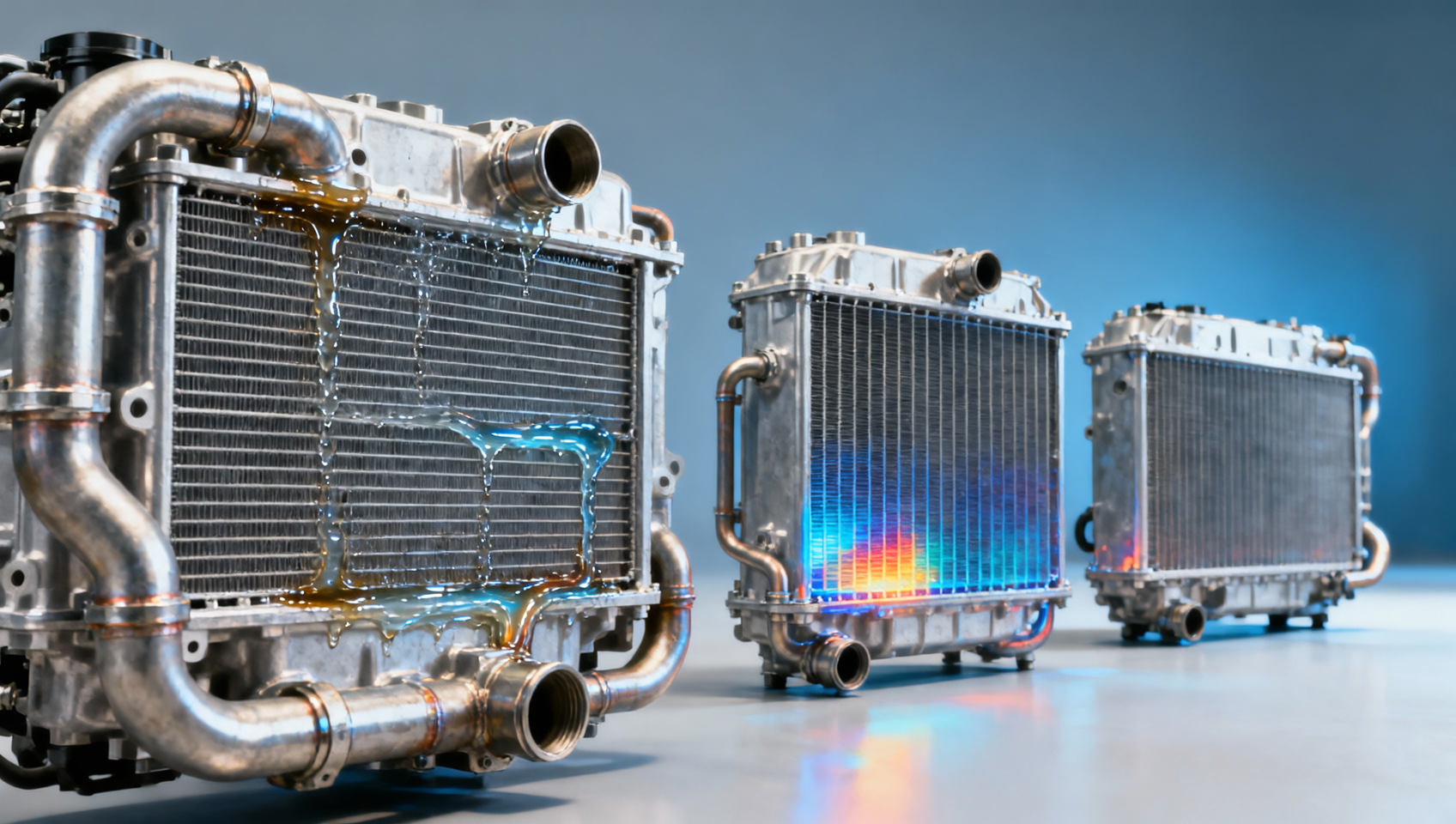
Radiator core damage rarely happens overnight. For technical reviewers, quality teams, project managers and business decision-makers, early warning signs in an auto radiator or radiator module can reveal deeper risks in performance, safety and lifecycle cost. This article highlights five key indicators that often appear before major failure, helping you assess reliability, prevent downtime and make more informed sourcing or maintenance decisions.
Why Radiator Core Failure Usually Begins with Small, Measurable Changes
In the auto parts industry, radiator core failure is rarely a single-event problem. It usually develops across 3 stages: early thermal inefficiency, visible structural degradation, and then leakage or pressure instability. For heavy trucks, passenger vehicles, construction machinery, and new energy cooling modules, this progression affects not only engine or system temperature control, but also maintenance planning, sourcing decisions, and field reliability evaluation.
Technical evaluators often focus on heat exchange performance, while business evaluators look at total cost, warranty exposure, and replacement intervals. Quality and safety teams are more concerned with brazing consistency, material integrity, and resistance to vibration, thermal cycling, and coolant contamination. A practical review therefore needs more than a visual inspection. It should combine 5 key check points with application context, service history, and basic operating data collected over 30 days, 90 days, or a full seasonal cycle.
Liaocheng Xinde Auto Parts Co., Ltd., established in 2018 with a registered capital of 5 million RMB and a total investment of 50 million RMB, focuses on research, production, and global sales of water tank radiators, intercoolers, construction machinery radiators, and related components for heavy trucks and new energy radiator modules. For buyers comparing suppliers, this specialization matters because radiator core reliability depends on manufacturing discipline, thermal material selection, and production consistency rather than catalog appearance alone.
A radiator core should be assessed as a performance-critical component, not a commodity line item. Even a small deviation in fin density, tube cleanliness, brazed joint quality, or coolant passage uniformity can increase thermal stress over 2–4 quarters of real operation. That is why early signs deserve structured attention before failure creates downtime, project delays, or emergency procurement at a higher cost.
- Thermal efficiency decline often appears before leakage becomes visible.
- Pressure retention issues may start at joints, tube ends, or localized corrosion points.
- Repeated overheating can damage adjacent components and increase lifecycle cost.
- Procurement teams should evaluate both unit price and replacement frequency over 12–24 months.
What Are the 5 Early Signs of Radiator Core Failure?
1. Localized coolant seepage around the core area
One of the first warning signs is slight coolant seepage rather than a full leak. This may appear as damp residue near the tube-to-header region, along brazed seams, or at areas exposed to repeated thermal shock. In many operating environments, seepage develops gradually over several weeks and becomes more obvious after pressure changes during startup and shutdown cycles.
For quality inspectors, this sign should trigger a broader review instead of a surface repair only. Seepage can indicate micro-cracks, weak brazing, vibration fatigue, or internal corrosion caused by coolant quality issues. If the radiator core is used in high-load or stop-and-go applications, even low-volume leakage can lead to temperature instability and unplanned service interventions within 1–3 months.
2. Uneven temperature distribution across the radiator surface
When one section of the radiator core remains significantly hotter or cooler than adjacent areas, internal flow restriction is often developing. Causes may include tube blockage, debris accumulation, scale, or partial collapse of coolant pathways. A surface temperature difference that keeps recurring under similar load conditions deserves attention, especially in systems expected to maintain stable heat rejection over long operating hours.
This sign matters for project managers and technical reviewers because uneven heat transfer reduces the effective working area of the core. The result is a system that appears functional under light duty but struggles under peak demand, towing, uphill operation, or hot-weather service. In sourcing reviews, poor internal cleanliness control during production can also contribute to this problem.
3. Fin deformation, clogging, or external airflow restriction
A radiator core depends on both coolant flow and airflow. Bent fins, dirt loading, oil contamination, or debris trapped across the front face reduce heat dissipation even if the core is not leaking. In construction machinery, fleet vehicles, and mixed-road environments, external blockage can build up quickly and may need review every month or every quarter depending on dust exposure and cleaning frequency.
For commercial and technical decision-makers, this is where product design and material quality influence serviceability. Fins that deform too easily during transport, installation, or maintenance create avoidable performance losses. A high-performance design using advanced fluid dynamics and premium thermal materials can support more stable cooling behavior under grueling workloads, which is why some buyers review model-specific solutions such as Radiator for AION when evaluating replacement or repair planning for car fitment applications.
4. Repeated pressure loss or unstable coolant level
If coolant level drops repeatedly without a clear hose or reservoir fault, the radiator core should be checked early. Pressure instability may come from pinholes, weak joints, or fatigue stress caused by vibration and thermal cycling. In many cases, teams replace caps, hoses, or clamps first, but the core remains the hidden source of the issue.
From a cost perspective, repeated top-ups and small service calls create a hidden expense pattern. For a fleet or project-based operation, these incidents may seem minor individually, but across 6–12 service events they increase labor cost, downtime exposure, and replacement uncertainty. That is why business evaluators should connect pressure stability to total operating cost, not only maintenance records.
5. Overheating under load even when the rest of the system appears normal
A radiator core can be approaching failure even when fans, thermostats, and pumps appear functional. If overheating happens mainly under load, during climbing, at high ambient temperatures, or after extended operation, the core may no longer be transferring heat efficiently enough. This is a common evaluation challenge because the symptom often shows up only in demanding scenarios, not during a short idle inspection.
For enterprise decision-makers, this sign directly affects operational risk. Delayed replacement can lead to collateral damage, lost project time, and emergency sourcing. In B2B purchasing, the question is not only whether the radiator still works today, but whether it can maintain stable performance through the next service interval, production cycle, or seasonal demand peak.
How to Check These Signs in a Procurement or Maintenance Review
A structured review helps teams move from symptom spotting to decision-making. The most effective approach is to combine a 5-point visual and performance inspection with application data, service history, and supplier information. This method supports both replacement decisions and new supplier evaluation in the parts industry.
The table below summarizes practical checks for radiator core failure indicators, what they usually suggest, and how procurement, quality, and engineering teams can interpret them during assessment.
This framework is useful because it links visible symptoms to procurement and maintenance consequences. A radiator core is not judged only by whether it leaks today. It should be judged by consistency under load, expected service life, and whether the supplier can support repeatable quality across batches and applications.
For quality teams, a 4-step review process is practical: visual inspection, operating behavior check, basic pressure verification, and supplier traceability review. For project managers, adding a replacement threshold before seasonal high-load periods can reduce emergency downtime and avoid rushed sourcing decisions.
- Confirm application type, load profile, and maintenance interval.
- Inspect fins, seams, tube areas, and signs of coolant residue.
- Compare field symptoms with pressure, temperature, and coolant-loss patterns.
- Review supplier capability for material control, delivery timing, and replacement support.
What Should Buyers Compare When Selecting a Replacement Radiator or Module?
Selection should not stop at dimensions and fitment. In a B2B environment, buyers usually compare at least 6 dimensions: application match, cooling performance stability, material quality, production consistency, delivery window, and after-sales response. These factors affect not only initial procurement but also field reliability and maintenance planning over the next 12–24 months.
Liaocheng Xinde Auto Parts Co., Ltd. has built its business around radiator, intercooler, construction machinery cooling, and related component manufacturing, with global sales and fast development since 2018. For sourcing teams, a specialist supplier is often better positioned to support technical communication, batch consistency, and application-specific recommendations than a general trading source with limited production visibility.
The table below highlights common procurement dimensions for radiator core replacement or module sourcing. It is intended to support technical evaluation, commercial review, and risk control at the same time.
A replacement decision should also consider whether the use case is repair-oriented or performance-upgrade oriented. In some passenger vehicle applications, buyers may need a solution designed to replace or repair while maintaining stable cooling efficiency. In that context, model-specific options such as AIONV-1301010-0030 can be relevant when application confirmation is clear and sourcing teams want a balance between fitment accuracy and dependable thermal behavior.
Commercially, the lowest quotation is not always the lowest cost. If a supplier cannot maintain consistent core quality or cannot support technical clarification within a practical 7–15 day procurement cycle, project risk increases. That is why experienced buyers compare lifecycle value, not only unit price.
Which Risks Are Commonly Overlooked by Technical and Business Teams?
Mistake 1: Treating radiator core issues as isolated maintenance events
A recurring overheating or coolant-loss issue is often handled as a one-time repair problem. In reality, repeated radiator core symptoms may indicate deeper mismatches in application design, duty cycle, maintenance practice, or supplier quality control. Looking only at the latest incident can hide a pattern that has been building across 2–3 service intervals.
Mistake 2: Comparing only price and basic dimensions
Buyers under time pressure may compare only dimensions, mounting layout, and unit price. This approach can miss key details such as airflow resistance, joint consistency, material grade, or durability under vibration. In heavy-duty and project-based use, these details often determine whether the radiator core remains stable through seasonal peaks or fails earlier than planned.
Mistake 3: Ignoring service environment and maintenance access
A radiator that performs adequately in a cleaner road environment may struggle in dusty, muddy, or high-debris conditions. External fouling, cleaning difficulty, and repeated fin deformation shorten effective service life. For quality and safety managers, maintenance access should be part of procurement review because an otherwise acceptable radiator can become a risk if field cleaning is too difficult or too infrequent.
Mistake 4: Delaying replacement until visible failure becomes severe
Waiting for obvious leakage or repeated overheating before acting may seem cost-conscious, but it often increases total expense. The longer a weak radiator core remains in service, the higher the chance of secondary damage, project interruption, and urgent replacement shipping. A planned review every quarter or before high-temperature operating periods is usually more efficient than reacting after breakdown.
- Do not rely on appearance alone; internal blockage can exist without major external damage.
- Do not separate procurement from field feedback; maintenance records improve sourcing accuracy.
- Do not assume all replacement radiators have the same thermal stability under continuous workload.
- Do not postpone supplier discussion when repeated symptoms emerge over 60–90 days.
FAQ for Buyers Assessing Radiator Core Failure and Replacement
How do we know whether to repair or replace a radiator core?
If the issue is limited to external contamination or minor serviceable damage, repair may be practical. If you see recurring coolant loss, uneven temperature distribution, repeated overheating under load, or signs of structural fatigue, replacement is often the safer decision. A useful rule is to review failure pattern, service frequency, and downtime impact across the last 3–6 months before choosing the lower short-term cost option.
What should technical reviewers request from a supplier before approval?
At minimum, confirm application fitment, material and structure details, delivery timing, and technical communication support. For project-based procurement, it is also practical to ask about sample support, production consistency, and the supplier’s experience with similar radiator, intercooler, or module applications. The goal is to reduce uncertainty before batch commitment, not after field complaints appear.
Which scenarios are most sensitive to radiator core quality?
High-load and variable-load scenarios are the most sensitive. These include heavy trucks, construction machinery, stop-and-go urban cycles, hot-weather operation, and systems exposed to dust or vibration. New energy radiator modules and passenger vehicle applications also require stable thermal behavior because localized efficiency loss can affect broader system performance and maintenance predictability.
What is a practical lead time expectation for radiator sourcing?
Lead time depends on model complexity, batch size, and whether confirmation is needed for drawings or fitment. In common B2B practice, sample review, technical confirmation, and production planning may take 7–15 days for early coordination, while larger or customized orders can extend into 2–4 weeks or more. Early communication reduces schedule pressure and avoids mistakes in application matching.
Why Work with a Specialized Radiator Manufacturer for Evaluation and Supply
When radiator core failure starts with subtle warning signs, buyers need more than a seller. They need a manufacturer that understands thermal performance, production discipline, and application-specific risk. Liaocheng Xinde Auto Parts Co., Ltd. focuses on radiators, intercoolers, construction machinery radiators, and related components for heavy trucks and new energy radiator modules, giving procurement and engineering teams a stronger basis for technical discussion and sourcing alignment.
This matters when your team must balance 4 priorities at the same time: performance stability, quality consistency, delivery timing, and commercial feasibility. Whether the need is replacement planning, new project sourcing, or quality review after repeated field symptoms, a specialized partner can help narrow risk faster than a generic catalog approach.
If you are reviewing radiator core warning signs, you can consult on key items such as parameter confirmation, application fitment, model selection, typical delivery cycle, sample support, custom solution discussion, and quotation comparison. If your project involves passenger vehicle fitment, heavy truck cooling parts, construction machinery radiators, or new energy radiator modules, early technical alignment helps reduce later rework and sourcing delay.
For teams that need a practical reference during replacement review, you can also discuss product-specific options including Radiator for AION based on confirmed fitment and operating requirements. The most effective next step is to share your model information, application scenario, quantity range, and timeline so that technical and commercial evaluation can move forward with fewer assumptions and clearer decision points.