



Radiator Core Capacity Changes That Impact Cooling Output
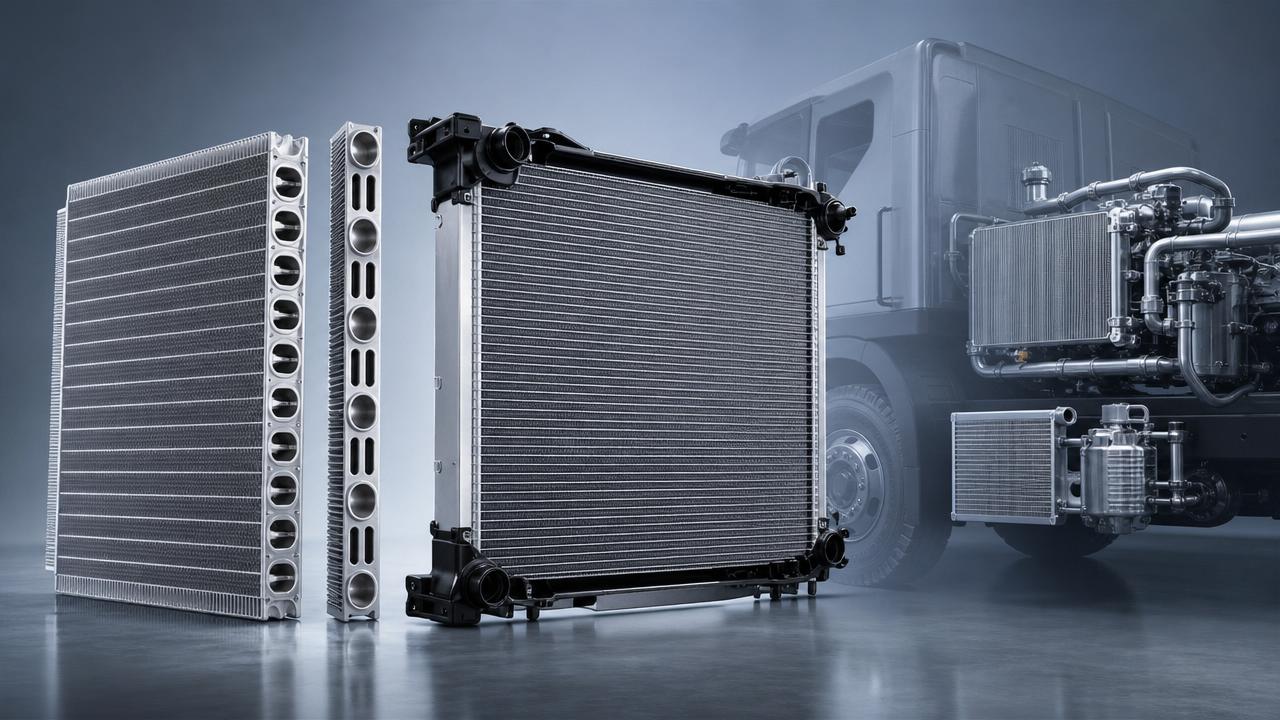
For project managers responsible for equipment reliability and thermal performance, understanding how radiator core capacity changes affect cooling output is essential.
From heavy trucks to construction machinery and new energy systems, the right radiator core design directly influences heat dissipation, durability, and operating efficiency.
This guide explains what radiator core capacity means, why it changes, and how those changes impact real cooling output in parts applications.
What does radiator core capacity actually mean?
Radiator core capacity refers to the heat exchange potential inside the radiator core.
It is shaped by core thickness, tube count, fin density, airflow exposure, coolant path design, and material conductivity.
Many people assume a larger radiator core always delivers better cooling output.
In practice, capacity must match airflow, pump performance, engine heat load, and installation space.
A radiator core with excessive density can restrict air passage.
That may reduce cooling output at low vehicle speed or in dusty off-road conditions.
A balanced radiator core supports stable coolant temperature, lower thermal stress, and improved component life.
This is especially important in heavy-duty parts systems where operating loads change quickly.
Which radiator core changes have the biggest effect on cooling output?
Several design changes can raise or reduce cooling performance.
The most important factors are not always visible from outside dimensions alone.
1. Core thickness
A thicker radiator core can increase heat transfer area.
However, too much thickness may block airflow through rear layers.
That means the first section cools well, but the last section contributes less.
2. Tube size and tube count
More tubes usually increase coolant contact area.
Larger tubes may reduce pressure drop and support stronger flow stability.
But poor tube layout can create uneven thermal zones inside the radiator core.
3. Fin density and fin geometry
Higher fin density often improves heat exchange surface area.
Still, dense fins collect dirt faster and can reduce airflow under harsh working conditions.
In construction machinery, this trade-off matters as much as nominal capacity.
4. Material selection
Aluminum radiator core structures are widely used for good conductivity and lower weight.
Brazed designs also help improve structural integrity and heat transfer consistency.
5. Coolant path design
Single-pass and multi-pass designs change coolant residence time inside the radiator core.
A better path can improve cooling output without simply making the unit larger.
Why can a larger radiator core still fail to deliver better performance?
Cooling output depends on system balance, not just radiator core size.
If airflow is weak, a larger heat exchanger cannot release stored heat effectively.
If coolant circulation is unstable, extra capacity remains underused.
Fan shroud design, engine compartment pressure, and obstruction by other parts all matter.
Another issue is overcooling during light load operation.
When coolant stays too cool, thermal efficiency and emissions performance may suffer.
That is why radiator core upgrades should be evaluated with full thermal system data.
Pressure drop, airflow resistance, ambient temperature, and duty cycle must be reviewed together.
How do application conditions change the ideal radiator core capacity?
Different operating environments place very different demands on the radiator core.
- Heavy trucks need steady cooling during long climbs, idling, and freight load changes.
- Construction machinery often faces dust, vibration, and restricted airflow near the engine bay.
- New energy systems require precise thermal control for batteries, electronics, and compact module layouts.
- Passenger vehicle platforms often prioritize low weight, packaging efficiency, and fuel economy.
In these scenarios, the same radiator core capacity may perform very differently.
For example, a compact brazed aluminum solution may suit a tightly packaged automotive cooling system.
One example is Radiator for Lynk.
This model 2069525700 is built for Link 06 and binyue applications.
Its aluminum brazing radiator structure supports thermal stability under demanding driving conditions.
Its 83X14X58 cm size and European-standard thermal approach show how packaging and performance can be combined.
How can you judge whether radiator core capacity is insufficient or excessive?
The best approach is to compare thermal symptoms with system operating data.
A proper assessment should include coolant inlet and outlet temperatures, pressure loss, and ambient operating range.
Looking at only catalog dimensions can lead to costly selection errors.
What are the most common mistakes when selecting a radiator core?
One common mistake is choosing the largest radiator core that fits the available space.
This ignores airflow resistance and system matching.
Another mistake is focusing only on price while overlooking brazing quality, tube durability, and corrosion resistance.
In heavy-use parts applications, weak joints or poor materials quickly reduce service life.
A third mistake is underestimating duty cycle changes.
Equipment that now works in hotter climates or longer shifts may need a revised radiator core specification.
It is also risky to treat all aluminum radiators as equal.
Core design details often matter more than the headline material description.
Quick selection reminders
- Match radiator core capacity to actual heat rejection targets.
- Check airflow availability at idle and peak load.
- Consider contamination, vibration, and cleaning frequency.
- Review installation space and surrounding parts interference.
- Confirm warranty, origin, and production consistency.
How do quality and supplier capability influence radiator core performance over time?
Initial cooling output is only part of the picture.
Long-term radiator core performance depends on manufacturing stability and process control.
Consistent brazing, accurate fin forming, and reliable leak testing protect thermal efficiency during service life.
Liaocheng Xinde Auto Parts Co., Ltd. has focused on research, production, and global sales since 2018.
Its portfolio covers water tank radiators, intercoolers, construction machinery radiators, and heavy truck and new energy modules.
Rapid development and multiple provincial and municipal honors reflect strong technical and production capability.
When radiator core requirements change, supplier engineering support becomes valuable for efficient redesign and reliable output.
FAQ summary: what should be reviewed before changing radiator core capacity?
Radiator core capacity changes can strongly influence cooling output, but performance gains come from matching rather than oversizing.
A smart review should consider heat load, airflow, material, fin structure, and long-term service conditions.
If thermal stability is becoming harder to maintain, reassess the radiator core before failures spread to other parts.
A better-fit cooling solution can improve durability, efficiency, and operating confidence across modern equipment platforms.