



Mercedes Radiator Testing Methods Used to Check Pressure Resistance
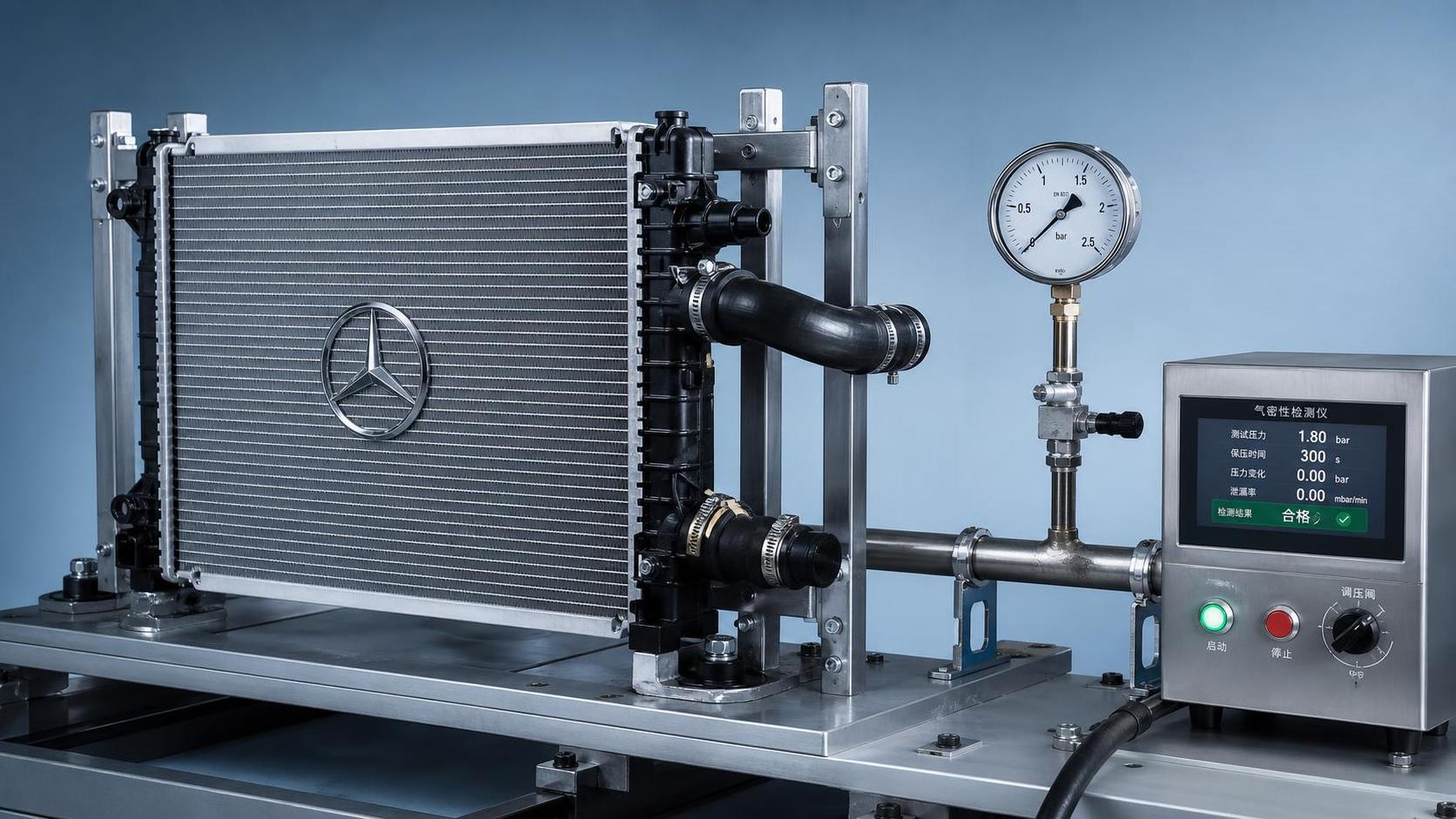
Which pressure-resistance tests actually matter when evaluating a Mercedes radiator?
For a technical evaluator, the useful question is not simply whether a Mercedes radiator was “tested,” but which test method was used, under what conditions, and what failure mode the test was meant to expose. Pressure resistance is tied to three things at once: the strength of the core and tanks, the sealing quality at joints and interfaces, and the radiator’s ability to survive pressure cycling without developing leaks later in service.
In practice, pressure evaluation usually combines more than one method. A single static test may show that the assembly can hold pressure for a short period, but it says much less about fatigue around tube-to-header joints, crimped areas, welds, or brazed seams. That is why serious assessment of a Mercedes radiator normally looks at burst resistance, leak-tightness, pressure cycling, and sometimes thermal-pressure interaction rather than treating one pass/fail result as enough.
Is a simple leak test enough to judge pressure resistance?
No. A leak test is necessary, but it is only the first screen.
Leak testing checks whether the Mercedes radiator is sealed at the moment of inspection. It can reveal obvious defects such as poor brazing, a damaged tank interface, a bad weld, or a pinhole in the core. What it cannot prove by itself is whether the radiator will continue to stay sealed after repeated pressure loading, vibration, or thermal expansion.
For evaluation work, a leak test answers a narrow question: Does this unit currently lose pressure or media under the specified test condition? It does not fully answer: Will this unit maintain integrity over time in a real cooling system?
That distinction matters when comparing suppliers or reviewing production quality. A part can pass an air-under-water or dry air-decay leak test and still fail early in service because the weak point only opens after cyclic loading.
What does a burst pressure test tell you?
A burst pressure test is the direct way to see the maximum pressure the radiator structure can withstand before a catastrophic failure occurs. The assembly is pressurized in a controlled manner until rupture, permanent structural failure, or loss of integrity appears.
This method is valuable because it exposes the weak link in the structure. Depending on the design, that may be:
- the tube-to-header connection,
- the tank material or tank joint,
- the crimped sealing area,
- a welded bracket zone that concentrates stress,
- or a local defect introduced during forming or brazing.
For a technical review, the number itself is only part of the story. The failure location matters just as much. If the radiator bursts at a predictable high-stress point consistent with the design limit, that tells you one thing. If failure appears randomly across units or at a joint that should have margin, that points to process instability.
When suppliers present burst data, ask for the test medium, temperature condition, pressurization method, and the exact failure description. Without those details, the result is hard to compare across different Mercedes radiator designs.
Why do pressure cycle tests often matter more than a one-time pressure test?
Because many radiator failures are fatigue failures, not immediate overload failures.
A Mercedes radiator in service does not see pressure once. It sees repeated rise-and-fall loading during warm-up, cooling, engine speed changes, and system operating fluctuations. Those repeated cycles work the joints, expand and contract the materials, and slowly grow small defects into leaks.
Pressure cycling is therefore one of the most informative durability checks for technical evaluators. It helps answer whether the radiator keeps its seal and structural stability after repeated stress, not just under a single event. This is especially relevant when assessing products used in heavy-duty applications or thermal systems with demanding duty cycles.
If you are reviewing test records, pay attention to whether the cycle test defines the pressure range, hold time, cycle count, and acceptance condition after completion. A statement like “passed cycle test” is too thin to support a serious sourcing or qualification decision.
What should be checked in the test setup before trusting the result?
A weak test setup can make a good radiator look bad, or a marginal one look acceptable. Before relying on any pressure-resistance result, check the test conditions behind it.
This is where many evaluations go off track. The report may look formal, but if the conditions are not aligned with the intended use, the result has limited value.
Should thermal loading be considered together with pressure resistance?
Yes, especially when you are judging long-term sealing reliability rather than short-term survival.
Radiators do not operate in a room-temperature laboratory state. They expand, contract, and experience material mismatch between different sections of the assembly. A Mercedes radiator may hold pressure well at ambient conditions but become more vulnerable when thermal stress affects joints, gaskets, or brazed regions.
That is why thermal cycling or combined thermal-pressure testing can be more revealing than a cold pressure check alone. For technical evaluators, this is not about making the test more complicated for its own sake. It is about making sure the test reflects the real failure path. If the target application includes heavy-duty or demanding heat rejection duty, pressure data without temperature context can leave a blind spot.
Where do Mercedes radiator pressure failures usually start?
In most radiator designs, failures do not begin in the middle of the strongest section. They begin at transitions, joints, and areas where manufacturing variation is hardest to control.
Typical risk points include the header area, tank connection, brazed tube interfaces, welded attachments, and any region where residual stress is introduced during forming or assembly. On units exposed to vibration or repeated thermal movement, bracket-related stress transfer can also matter. The result is often a small leak before it becomes a visible rupture.
This is why post-test inspection should not stop at “pass” or “fail.” Look for deformation, wetting marks, crack origin, seal displacement, or abnormal distortion around the joint geometry. The point of failure often tells you more about manufacturing control than the pressure number alone.
Which documents should a technical evaluator ask for?
If you need to compare Mercedes radiator pressure-resistance capability across suppliers, ask for records that let you reconstruct the test, not just a certificate-like summary.
- Test report with method description and sample identification.
- Defined pressure range, hold time, and completion criteria.
- Temperature condition during testing.
- Description of the test medium and fixture arrangement.
- Failure mode record or post-test inspection notes.
- Evidence that the tested sample represents actual production status.
Those six items usually separate meaningful validation from presentation material. If a supplier is involved in the research, production, and global sales of radiators and related thermal components, the expectation should be disciplined documentation, not just broad quality claims.
What are the most common mistakes when comparing pressure test results from different suppliers?
The biggest mistake is treating unlike tests as if they were directly comparable.
A few examples show why comparisons go wrong:
- One supplier reports burst pressure; another reports leak pressure at a hold condition.
- One test is run at ambient temperature; another includes elevated thermal stress.
- One result comes from prototype samples; another comes from stable production units.
- One report shows final pass status only; another includes failure location and deformation notes.
Another common error is ignoring application class. A radiator intended for heavy trucks, construction machinery, or new energy thermal modules may face very different pressure and thermal demands. Evaluation has to match the intended duty, not just the part label.
If a radiator passes pressure testing, is that enough for approval?
Usually no. Passing pressure-resistance testing is necessary, but it should sit inside a broader technical review.
A Mercedes radiator can be strong enough in a pressure chamber and still present risk if the dimensional consistency is unstable, the material control is weak, or the production process does not reliably reproduce the tested sample. For that reason, evaluators normally connect pressure data with design review, process control, leak inspection, and application fit.
A practical approval path is to ask three linked questions:
- Did the radiator survive the relevant pressure and cycle conditions?
- Did it fail nowhere critical and show stable sealing behavior afterward?
- Do the records show that production units are built the same way as the tested units?
If one of those answers is weak, the evaluation is still open.
What is the most reliable way to judge pressure-resistance credibility in practice?
Use the test result, the test condition, and the failure evidence together. That sounds basic, but it is the cleanest way to avoid bad decisions.
If you only look at a pass statement, you miss the setup. If you only look at a high pressure figure, you may miss fatigue weakness. If you only look at a clean sample, you may miss whether production can repeat it. A Mercedes radiator should be judged by whether the selected test method matches the service risk you are trying to control.
For technical evaluators, that is the practical rule: prefer evidence that shows not just that the radiator held pressure once, but that the structure, joints, and seals remained credible under conditions close to the job it is expected to do.