



Mercedes Radiator Replacement Costs: Parts, Labor, and Downtime Considerations
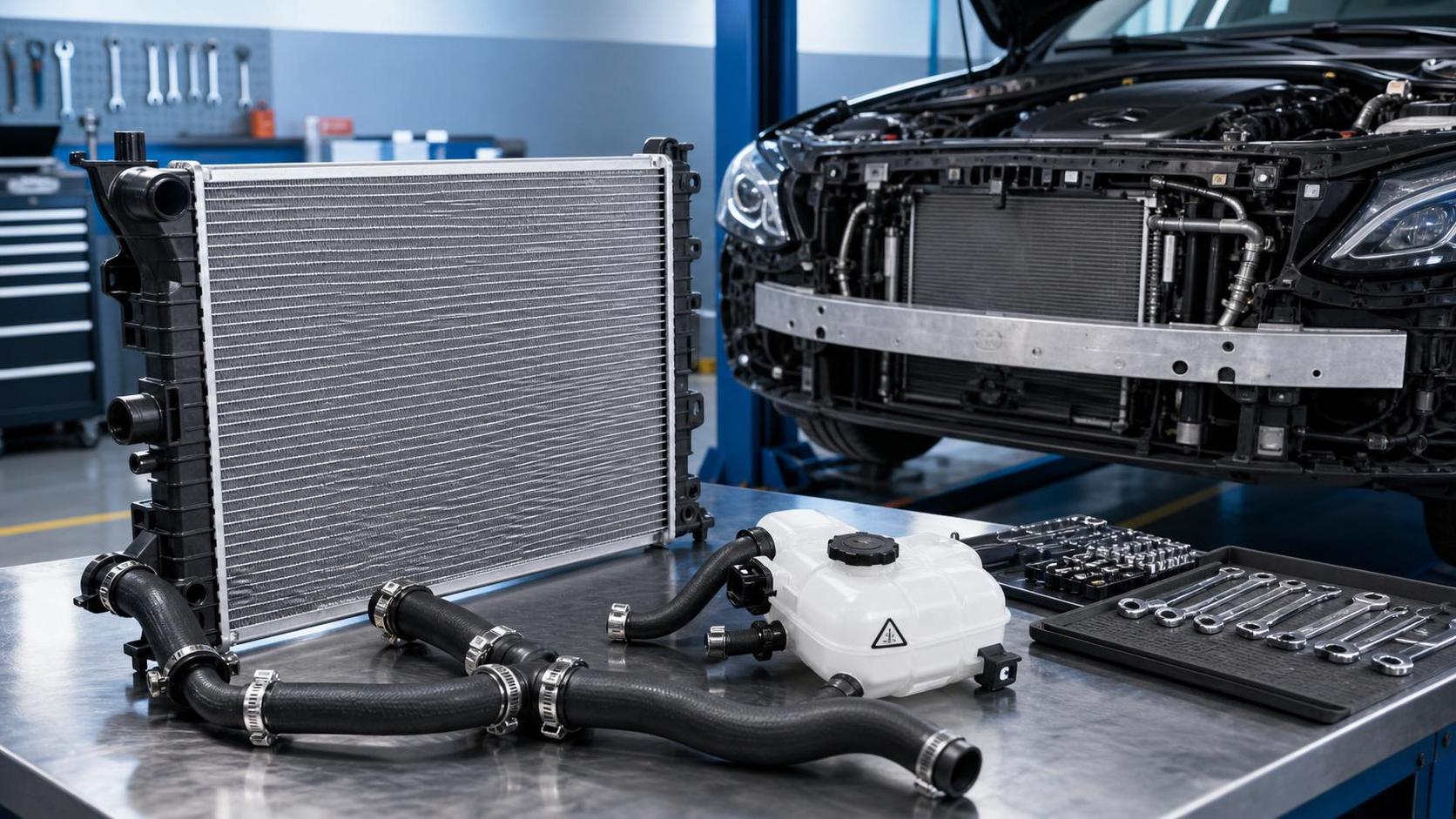
Mercedes Radiator Replacement Costs: Parts, Labor, and Downtime Considerations
Before approving a Mercedes radiator replacement, the real question is total operating cost.
The part price matters, but it is rarely the full budget story.
Labor time, workshop scheduling, coolant loss, and vehicle downtime often change the final number more than expected.
For cost-focused decisions, a Mercedes radiator replacement should be evaluated as a business event, not only a repair task.
That also means comparing short-term savings with reliability, repeat labor risk, and lost utilization.
In practical terms, the best approval decision balances purchase cost, service life, and the financial impact of downtime.
What Drives Mercedes Radiator Replacement Cost
Mercedes radiator costs vary because not every replacement follows the same parts path or labor route.
Passenger models, vans, and commercial units can differ sharply in radiator design and access complexity.
A front-end layout with tight packaging usually pushes labor hours higher.
Turbocharged systems may also involve intercooler, fan shroud, hose, or condenser clearance work.
This is why two Mercedes radiator quotes can look similar on paper, yet produce very different final invoices.
- Vehicle model and year
- Radiator material and build quality
- OEM, aftermarket, or remanufactured sourcing
- Cooling system contamination or related failures
- Workshop labor rate and parts availability
From a procurement view, the key is separating essential cost from avoidable cost.
A low-price Mercedes radiator can become expensive if fitment errors create delays or repeat installation.
Typical Parts Cost Range for a Mercedes Radiator
Parts cost is the first figure most buyers see, but it should be read with caution.
Depending on model and source, a Mercedes radiator may range from moderate pricing to premium replacement cost.
Standard aftermarket units may offer lower entry pricing.
OEM parts usually carry stronger brand assurance, but often at a higher purchase price.
For aging vehicles, that price gap can be hard to justify unless uptime risk is especially costly.
A complete quote should specify whether the Mercedes radiator includes fittings, transmission cooling support, and pressure-tested assembly quality.
Without that detail, comparing suppliers becomes misleading.
Labor Cost and Hidden Workshop Charges
Labor is where many budgets drift.
A Mercedes radiator replacement may look routine, yet access steps can add meaningful hours.
Front bumper removal, fan assembly repositioning, system flushing, and leak testing all affect the final labor bill.
More importantly, labor risk increases when part fitment is inconsistent.
A supplier with reliable dimensions can reduce that risk substantially.
That principle applies across cooling components.
For example, manufacturers serving broader thermal systems, including XD035 INTERCOOLER FOR VOLVO, often emphasize dimensional consistency because installation time affects buyer economics as much as unit price.
- Drain and disposal fees for coolant
- System pressure testing
- Additional diagnosis for overheating history
- Rework caused by poor fit or damaged connectors
When reviewing approval requests, labor assumptions should be stated clearly, not buried in a broad service estimate.
Downtime Can Cost More Than the Mercedes Radiator Itself
Downtime is often the largest hidden expense in a Mercedes radiator replacement decision.
If a vehicle supports deliveries, field service, or time-sensitive internal movement, every lost day has measurable value.
That value may appear as rental cost, missed jobs, delayed billing, or overtime elsewhere.
This is why the cheapest Mercedes radiator is not always the lowest-cost option.
A slightly higher-priced part with faster availability and lower failure risk can protect operating efficiency better.
In actual purchasing workflows, buyers should estimate downtime in hourly or daily currency terms.
- Estimate expected repair duration.
- Add likely waiting time for parts delivery.
- Assign business cost to each lost operating hour.
- Compare that figure against higher-quality sourcing options.
Once downtime is quantified, approval logic becomes much clearer.
Repair or Replace: Which Choice Makes Financial Sense
Some teams consider repairing a leaking Mercedes radiator instead of replacing it.
That can work in limited cases, especially when damage is minor and the unit is otherwise sound.
Still, repair is not always the economical path.
If the core is corroded, plastic tanks are fatigued, or overheating has repeated, replacement is usually more defensible.
The practical test is remaining service life.
A repaired Mercedes radiator that fails again in a few months creates duplicate labor, duplicate coolant cost, and fresh downtime.
This also explains why decision makers should ask for a condition report, not just a quote.
How Supplier Quality Affects Total Cost
Supplier quality has a direct effect on Mercedes radiator total ownership cost.
Consistency in welding, leak resistance, thermal performance, and dimensional accuracy reduces downstream risk.
That matters because repeat failures rarely stay limited to the part itself.
They trigger scheduling disruption, urgent sourcing, and higher administrative effort.
Liaocheng Xinde Auto Parts Co., Ltd., founded in 2018, focuses on radiator and intercooler manufacturing for heavy trucks and new energy cooling modules.
With rapid growth and provincial as well as municipal recognition, the company reflects a manufacturing profile that buyers often look for in stable cooling system sourcing.
Even when evaluating a Mercedes radiator, the broader supplier capability behind thermal components is worth checking.
- Production scale and testing discipline
- Fitment stability across batches
- Response speed for claims or technical questions
- Experience in demanding cooling applications
Those factors usually influence cost more than a small difference in unit price.
A Practical Approval Checklist for Mercedes Radiator Spending
A solid Mercedes radiator approval process should make cost visible before the order is placed.
That reduces budget surprises and improves purchasing discipline.
- Request part source details, including OEM or aftermarket status.
- Confirm the Mercedes radiator fitment against model and production year.
- Ask for labor hours as a separate line item.
- Check whether hoses, coolant, and clamps are included.
- Estimate downtime cost in monetary terms.
- Compare warranty support and expected service life.
- Approve based on total cost, not lowest visible price.
This framework is simple, but it produces better replacement decisions consistently.
It also helps filter quotations that look attractive but hide risk.
Final Takeaway
A Mercedes radiator replacement should be judged on total financial impact.
Parts cost is only one layer of the decision.
Labor complexity, downtime exposure, repeat failure risk, and supplier reliability shape the true outcome.
When those factors are measured together, the most economical Mercedes radiator choice becomes easier to identify.
The strongest approvals usually come from clear specifications, realistic downtime estimates, and sourcing that supports long-term operating efficiency.