



International Radiator Materials Compared: Aluminum vs Copper-Brass for Repairs
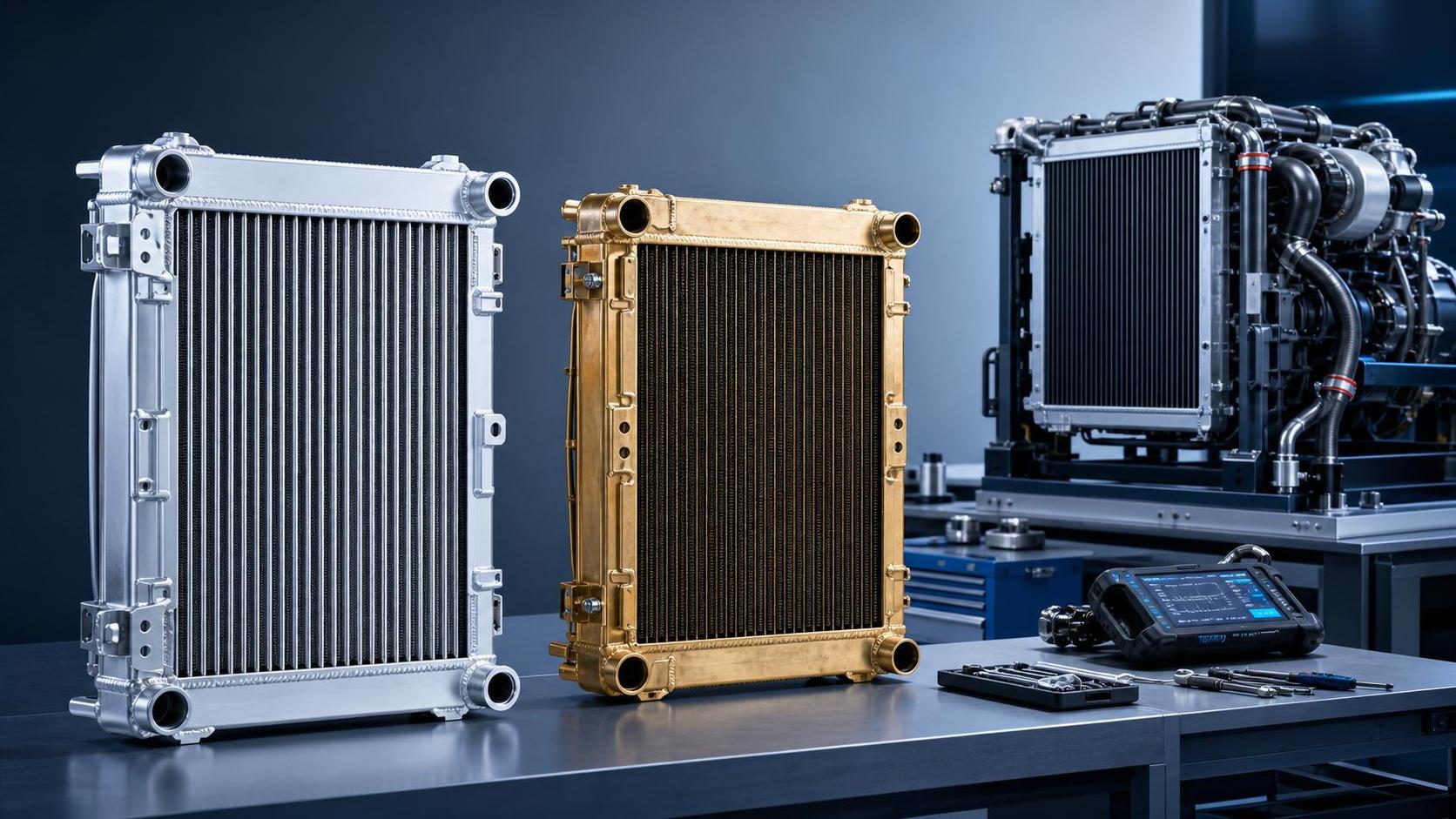
International Radiator Materials Compared: Aluminum vs Copper-Brass for Repairs
When repair teams assess an International Radiator, material choice usually becomes the first serious technical question.
It affects heat rejection, joint strength, corrosion behavior, repair methods, and total lifecycle cost.
That matters even more in heavy trucks, construction machinery, and new energy cooling modules.
In the International Radiator market, aluminum and copper-brass remain the two most discussed material systems for repair decisions.
Each has clear technical strengths, but neither is automatically the better answer in every service environment.
Liaocheng Xinde Auto Parts Co., Ltd., established in 2018, focuses on radiators, intercoolers, engineering machinery radiators, and new energy cooling modules.
Its manufacturing base has expanded quickly, supported by high-tech and integrity-related provincial and municipal recognitions.
Against that background, a practical comparison helps refine International Radiator repair strategy with fewer assumptions and better field outcomes.
Why Material Choice Matters in International Radiator Repairs
A radiator is not judged only by cooling output.
Repairability, vibration resistance, tube integrity, fin stability, and coolant compatibility all influence service success.
For an International Radiator, these factors often vary by route conditions, engine load, ambient temperature, and maintenance discipline.
A fleet operating on paved highways faces different failure patterns than a machine working in dust, mud, and constant vibration.
This is why material comparison should go beyond simple thermal conductivity tables.
- Heat transfer performance under real airflow restrictions
- Resistance to fatigue, stone impact, and pressure cycling
- Ease of soldering, brazing, patching, or replacing cores
- Weight effects on vehicle efficiency and packaging
- Long-term corrosion risk linked to coolant quality
Aluminum International Radiator Designs: Key Strengths and Limits
Aluminum now dominates many modern International Radiator applications.
The main reason is system efficiency, not just material cost.
Aluminum radiators are lightweight, easy to package, and well suited to high-volume manufacturing.
They also support thinner-wall designs, which helps maintain acceptable heat rejection with lower mass.
Main advantages
- Lower weight supports fuel economy and easier module integration
- Good thermal performance when fin and tube geometry is optimized
- Strong compatibility with modern brazed core production
- Broad availability in current truck and machinery replacement channels
Main repair concerns
Repairing an aluminum International Radiator can be less forgiving in the field.
Thin sections are sensitive to overheating during welding or localized repair.
Contamination, oxide layers, and prior corrosion can also reduce repair quality.
In practice, severe core damage often leads to replacement rather than repeated patch work.
Copper-Brass International Radiator Designs: Where They Still Excel
Copper-brass remains relevant in the International Radiator repair conversation for good reasons.
Even where new systems favor aluminum, copper-brass can still offer repair-side advantages.
Its traditional value comes from serviceability and predictable workshop processes.
Why it remains attractive
- Soldered joints are often easier to reopen and repair
- Tube or tank repairs can be more practical in workshop conditions
- Material behavior is familiar to many established radiator technicians
- High thermal conductivity of copper remains technically valuable
Where limitations appear
Copper-brass units are usually heavier than aluminum alternatives.
That weight can affect installation, fuel efficiency, and cooling package design.
Some older constructions also struggle to match modern airflow and space-efficiency targets.
So while a copper-brass International Radiator may repair well, it may not always fit current performance priorities.
Direct Comparison: Thermal Performance, Durability, and Repair Practicality
The better material depends on the full radiator design, not material alone.
Still, technical teams usually compare the same core decision points.
For a current International Radiator program, aluminum often wins on system integration and weight control.
For legacy service networks, copper-brass may still reduce downtime because repairs are more familiar and repeatable.
That tradeoff is especially visible when equipment runs far from major service centers.
How Operating Conditions Change the Best International Radiator Choice
Recent market shifts show that operating context matters more than generic preference.
A highway tractor and a construction machine do not stress the radiator in the same way.
- High vibration environments favor designs with strong joint reliability and stable mounting support.
- Dust-heavy sites raise fin blockage risk, reducing any theoretical thermal advantage.
- Poor coolant control increases corrosion risk in both materials, but damage mechanisms differ.
- Remote operations value repairability because replacement lead time may be long.
This also explains why one International Radiator specification may perform well in one region and disappoint in another.
Material selection should therefore sit inside a broader reliability assessment, not outside it.
A Practical Product Reference for Freightliner Repair Evaluation
In real procurement work, technical comparison usually ends with a specific part review.
One example is XD91203 RADIATOR FOR FREIGHTLINER .
Its referenced models include 0529621001, 0529621003, and 0529621007.
Typical applications cover 2008-2013 FREIGHTLINER CORONADO and 2011-2012 WESTERN STAR.
The listed size is 1020*1058*56, which is useful when confirming packaging and replacement compatibility.
For International Radiator benchmarking, examples like this help compare dimensions, application range, and service strategy across adjacent heavy-duty platforms.
A Clear Decision Framework for Repair Teams
If the International Radiator is part of a modern, weight-sensitive cooling module, aluminum is often the stronger choice.
If workshop repairability and repeated service intervention matter more, copper-brass may deserve closer review.
A disciplined evaluation usually includes these checks:
- Confirm actual failure mode before selecting material direction
- Review coolant chemistry and maintenance history
- Measure vibration load, debris exposure, and cleaning practices
- Compare repair cost against expected remaining service life
- Check whether replacement availability offsets repair complexity
The most reliable International Radiator decision usually comes from balancing thermal performance with service reality.
That means looking at material, repair method, environment, and supply continuity together.
Aluminum is usually the better fit for modern lightweight systems.
Copper-brass still holds value where serviceability and workshop recovery remain the dominant priorities.
For any International Radiator repair plan, the best result comes from matching the material to the failure pattern, duty cycle, and long-term maintenance model.