



How International Radiator Design Affects Cooling Efficiency Under Heavy Load
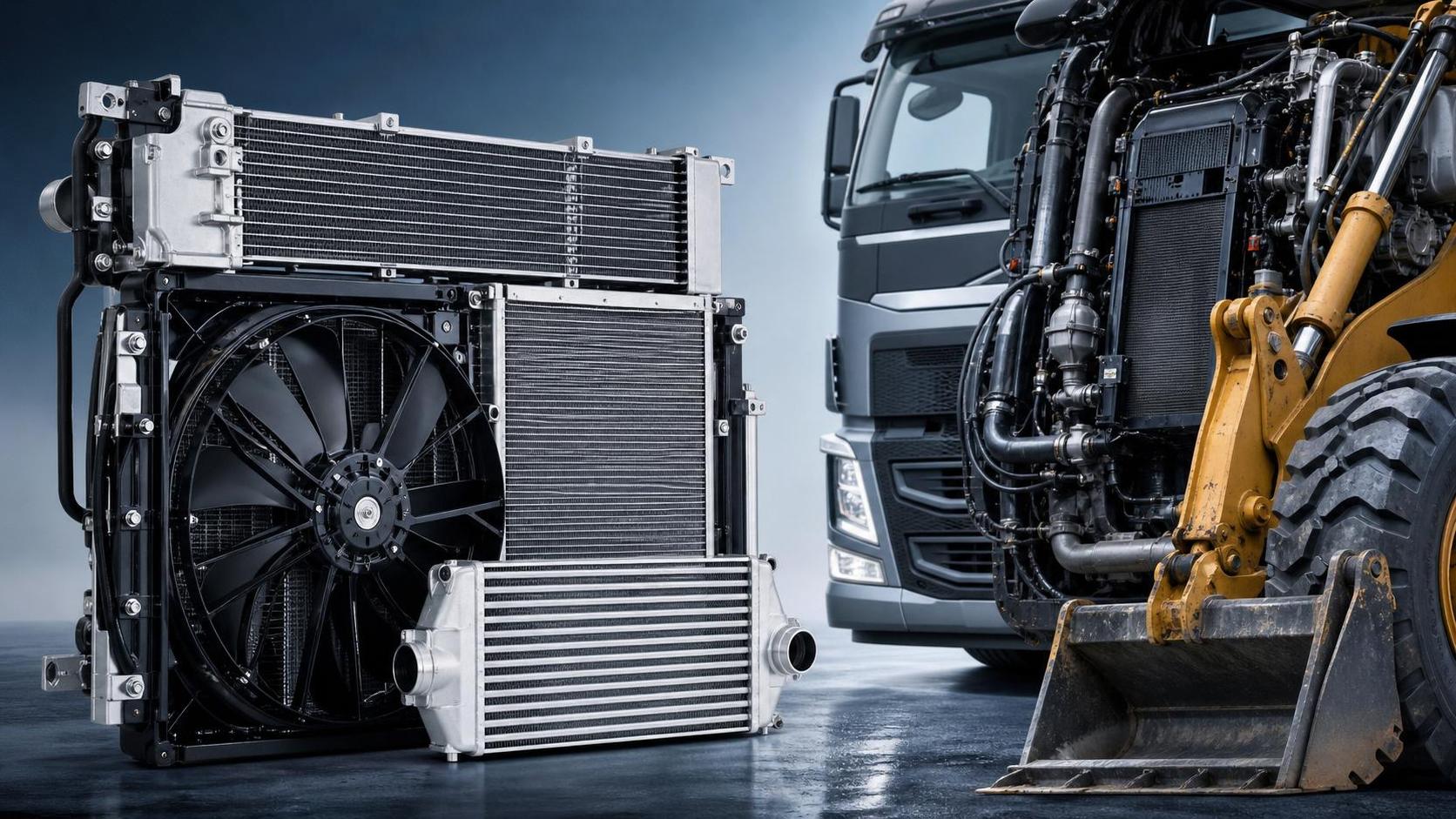
Heavy-load cooling is rarely limited by engine power alone. In practice, the way an International Radiator is designed often determines whether equipment keeps working steadily or loses efficiency under sustained thermal stress.
For operations involving heavy trucks, construction machinery, and new energy thermal systems, radiator design shapes uptime, fuel economy, component life, and maintenance planning. That is why design details deserve closer attention than simple fitment or price comparison.
Why radiator design matters under heavy load
An International Radiator works as a heat exchange system, not just a metal assembly with coolant passages. Under heavy load, heat generation rises quickly, while airflow, ambient temperature, and duty cycle often become less predictable.
If the radiator cannot release heat at the same pace it is produced, coolant temperature climbs. Once that happens, engine performance, lubricating stability, and surrounding component durability can all be affected.
This is especially relevant in long-haul transport, high-idle work, mountainous routes, jobsite machinery, and mixed urban duty. In these conditions, thermal overload usually builds gradually before it becomes visible.
A well-designed International Radiator reduces that risk by balancing heat rejection, structural strength, pressure stability, and airflow efficiency within a realistic operating envelope.
The design elements that influence cooling efficiency
Cooling efficiency depends on several linked design choices. Looking at one parameter alone can lead to the wrong conclusion, because thermal performance is the result of system interaction.
Core size and heat exchange surface
Larger cores generally provide more surface area for heat transfer. However, bigger is not automatically better if airflow distribution becomes uneven or if installation space restricts fan performance.
Core thickness also changes how air moves through the fins. A thicker core may increase capacity, but excessive resistance can reduce effective airflow in real operating conditions.
Tube and fin structure
Tube geometry affects coolant velocity, pressure drop, and heat transfer area. Fin density affects how much heat can be removed, but higher fin density may trap dust, mud, or oily residue more easily.
For an International Radiator used in demanding environments, the best design is usually the one that balances cooling performance with contamination resistance and serviceability.
Material selection and joining quality
Material choice affects weight, thermal conductivity, corrosion behavior, and long-term reliability. Just as important is the consistency of brazing, welding, sealing, and tank assembly.
Under heavy load, weak joints and unstable materials often appear first as small leaks, pressure loss, or reduced heat transfer. These failures usually start before full breakdown is noticed.
Airflow management around the radiator
A radiator can have strong core specifications and still cool poorly if airflow management is weak. Fan matching, shroud design, grille opening, and surrounding module layout all shape actual cooling results.
This is one reason an International Radiator should be evaluated as part of a thermal package, not only as a standalone spare part.
What the industry is paying attention to now
Thermal systems are facing tighter operating expectations. Engines run harder, packaging space is tighter, and working cycles are less forgiving than they were in simpler cooling layouts.
At the same time, uptime pressure has increased. A cooling issue no longer means only repair cost. It can also mean delayed delivery, interrupted site work, and additional stress across connected parts.
Manufacturers with focused development capability are therefore becoming more relevant. Liaocheng Xinde Auto Parts Co., Ltd., established in 2018, has expanded quickly through research, production, and global sales of radiators, intercoolers, and related modules.
Its background in heavy truck, construction machinery, and new energy radiator modules reflects a broader market trend: thermal components are now selected with more attention to application-specific performance and reliability verification.
Recognition such as High-tech Enterprise and consumer trust honors also matters in this context, because heavy-load cooling decisions rely on process discipline as much as nominal specifications.
Where an International Radiator creates business value
The value of an International Radiator is easiest to see in operating outcomes. Better thermal control supports more stable engine temperatures, fewer shutdown events, and more predictable maintenance intervals.
That translates into practical benefits across several areas:
- Lower risk of overheating during long climbs, heavy hauling, or continuous hydraulic work.
- Improved durability of hoses, seals, bearings, and adjacent thermal-sensitive components.
- Better consistency across seasonal temperature changes and mixed-duty operating schedules.
- Reduced unplanned service interventions caused by thermal imbalance or cooling margin loss.
In heavy equipment environments, these benefits usually matter more than a small difference in initial component cost.
How application matching changes the result
Not every International Radiator performs the same way across all platforms. Matching depends on load profile, engine output, ambient conditions, available airflow, and packaging constraints.
A transport fleet operating on highways needs stable cooling during long-duration load. Construction machinery may need stronger resistance to vibration, dust loading, and repeated thermal cycling.
Intercooler performance can also influence the broader cooling picture. Charge air temperature affects combustion efficiency and thermal load, so system decisions should not isolate one heat exchanger from the others.
For example, a component such as XD309 INTERCOOLER FOR MERCEDES-BENZ, with OEM A9605000002 and a core size of 925*752*64mm, shows how dimensional fit and thermal duty must be read together rather than separately.
Typical evaluation points by operating scenario
Practical ways to assess radiator suitability
A useful evaluation process starts with operating reality rather than catalog comparison. Rated dimensions are important, but thermal behavior under actual load matters more.
- Review the highest continuous load, not only average working conditions.
- Check airflow conditions around the radiator package, including fan and shroud efficiency.
- Compare pressure resistance, joint quality, and vibration tolerance with the expected duty cycle.
- Look at fouling risk if the operating environment includes dust, debris, or oily residue.
- Confirm that related components, including intercoolers, are matched to the same thermal objective.
Usually, the better decision comes from building a performance checklist around operating temperature range, service interval targets, route or site conditions, and module integration limits.
A clearer basis for the next decision
Choosing an International Radiator for heavy-load use is ultimately a question of fit between thermal demand and design capability. The most reliable option is not simply the largest unit or the lowest-cost replacement.
A better path is to compare core structure, airflow behavior, application duty, and manufacturing consistency in the same review. That approach makes cooling performance more predictable and long-term operation easier to manage.
When reviewing current or future platforms, it is worth mapping heat load, installation space, contamination risk, and component compatibility first. With that framework in place, selecting an International Radiator becomes a technical decision supported by clearer evidence.