



How to verify a Benz radiator supplier meets OEM fitment requirements
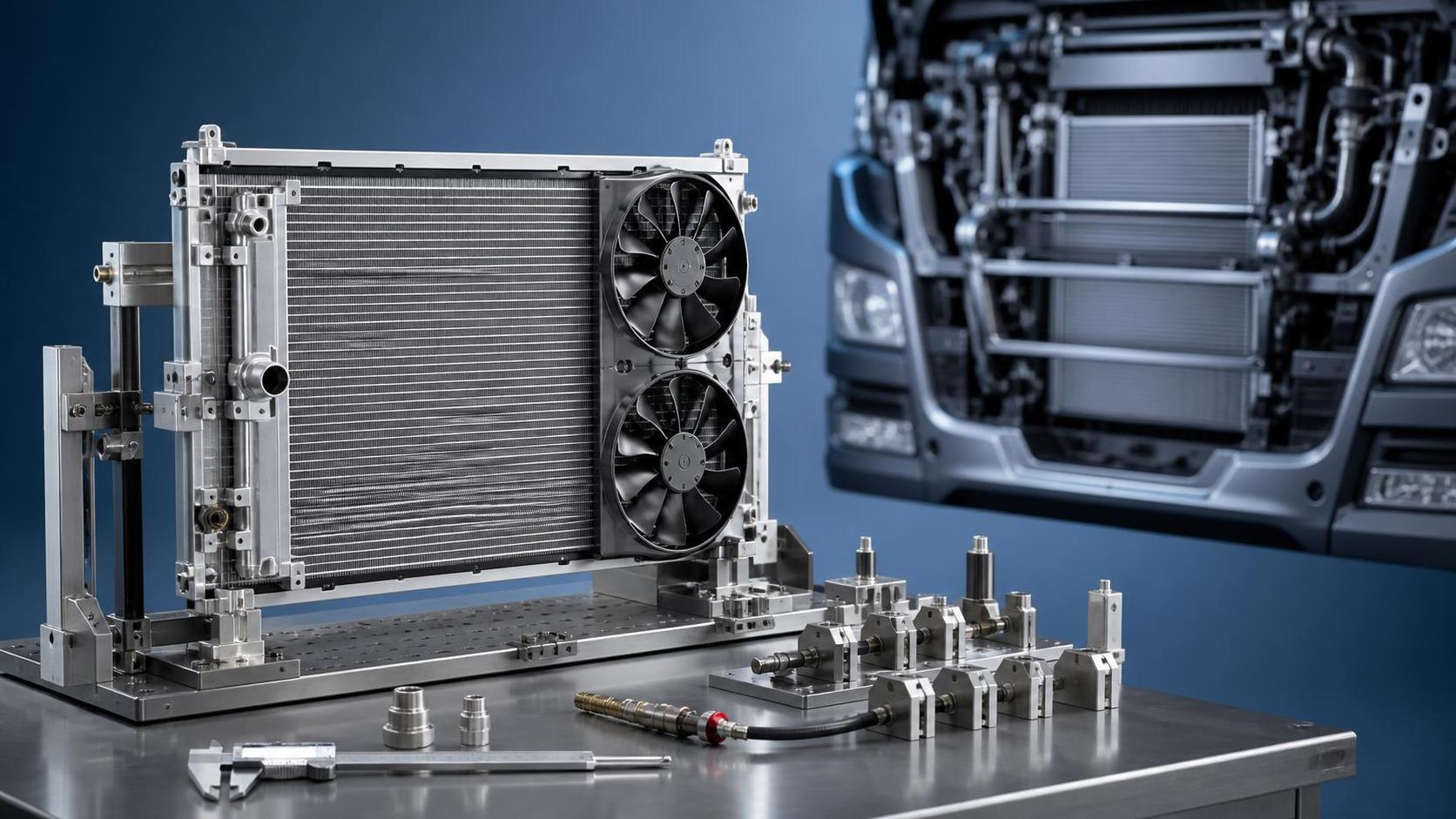
A Benz radiator supplier should be verified against the actual OEM fitment requirement, not merely a catalogue reference or a stated vehicle application. A radiator can share the right overall size and still fail at the vehicle level because the mounting tabs sit a few millimetres out of position, a hose neck has the wrong angle, or the fan shroud cannot seat correctly. The practical check is to combine drawing control, sample inspection, performance testing, and batch traceability before approving supply.
The key question is not “Does this radiator look like the original?” It is: “Can this radiator be installed without modification and maintain the intended cooling, pressure, clearance, and service performance throughout its expected operating range?” That distinction prevents many expensive fitment disputes.
Start with the OEM definition of fitment
OEM fitment is broader than a part number match. For a Benz truck or commercial vehicle radiator, the approved part must interface correctly with the cooling system, front-end module, fan system, charge-air cooler where applicable, mounting hardware, and surrounding body structure. A supplier should therefore work from a controlled technical package rather than a verbal description such as “same as OE” or “for Benz Actros.”
Request the vehicle platform, engine variant, model year range, transmission configuration, and original radiator reference before comparing any sample. Even within one vehicle family, different engine outputs, fan packages, air-conditioning systems, or emissions configurations may use radiators with similar faces but different hose layouts, core thicknesses, or mounting points.
A useful approval file normally includes:
- OEM part number and any supersession history.
- Controlled drawing or a mutually agreed inspection drawing.
- Critical dimensions with tolerances, not only nominal dimensions.
- Material specifications for core, tanks, brackets, fittings, seals, and transmission cooler connections where fitted.
- Pressure-test requirement and test method.
- Cooling-performance target or an agreed validation method.
- Packaging, labeling, lot coding, and change-control requirements.
If the vehicle manufacturer’s drawing is unavailable, reverse engineering can still be controlled, but it needs discipline. Measure multiple genuine samples where possible, identify the variation between samples, and mark the dimensions that affect installation or safety as critical-to-fit. A single worn or repaired field unit is not a reliable master sample.
How to assess a Benz radiator supplier beyond the catalogue
The first document review should establish whether the supplier understands the assembly as a vehicle component rather than a generic heat exchanger. Ask for the inspection plan, production flow, test records, and sample measurement report for the exact reference being quoted. A capable supplier can explain which features are controlled during production and which are verified before release.
Be cautious when the response consists only of a product photo, overall dimensions, and a broad vehicle application list. Those are useful starting points, but they do not prove fitment. The most common weak point is that the core size is correct while external interfaces are not. Hose neck direction, neck bead profile, connector position, drain arrangement, support-pin diameter, lower saddle geometry, and shroud attachment holes all need review.
There is also a practical difference between an aftermarket replacement that can be made to fit and a radiator that meets OEM-style fitment expectations. If an installer must elongate a bracket hole, bend a mounting tab, force a hose, add a spacer, or leave a shroud fastener unused, the part should not be accepted as an OEM-fit replacement. Those “small” adjustments can create vibration fatigue, hose stress, poor airflow sealing, or contact with moving parts.
Inspect the interfaces that cause real installation failures
Overall width, height, and thickness matter, but the inspection should begin with datum points. Establish the same reference planes used by the vehicle installation: usually lower mounting locations, side supports, and one primary face or tank reference. Then measure every external interface from those datums.
For mounting brackets, check hole diameter, slot direction, centre-to-centre distance, bracket offset, plate thickness, weld or braze condition, and perpendicularity. A bracket that is dimensionally correct but twisted can preload the radiator frame during installation. On heavy vehicles, that preload can accelerate tank-to-core joint failure under vibration.
For inlet and outlet connections, confirm outside diameter, bead form, insertion length, clocking angle, and clearance to nearby components. Diameter alone is insufficient. A neck clocked slightly differently can put the hose into a tighter bend radius, while a shallow or poorly formed bead may allow hose creep under pressure. If the original design includes sensor bosses, bleed ports, drain fittings, or transmission oil cooler connections, verify thread form, sealing face, and protective caps as separate items.
Do not overlook fan shroud and intercooler interfaces. The radiator may bolt to the vehicle but still create a cooling problem if the shroud does not seal to the core face or if the charge-air cooler sits at the wrong distance. Air follows the easiest path. Gaps around the fan shroud reduce the air drawn through the core, especially at low road speed and high thermal load.
Core construction must support the vehicle duty cycle
A radiator’s visible dimensions do not fully describe its heat-rejection capability. Core thickness, tube geometry, tube count, fin pitch, louver design, material gauge, and header arrangement influence airflow resistance and thermal performance. A thicker core is not automatically better; it can restrict airflow if the fin design and fan system are not matched to it.
Ask the supplier to identify the core specification used for the quoted Benz reference, then compare it with the approved sample or technical requirement. The comparison should cover more than “aluminium core.” Clarify tube width and pitch, fin density, fin height, core depth, brazed joint quality, and whether the side plates and headers match the required load path.
For context, a listed truck radiator such as XD059 TRUCK RADIATOR FOR SCANIA is identified with an 860 × 689 × 48 mm core. That figure is useful for screening a truck radiator, but it cannot be transferred to a Benz application as evidence of compatibility. Fitment approval still depends on the correct drawing, interfaces, cooling requirement, and vehicle-specific test result.
Material claims should be supported by incoming-material records or supplier declarations that can be traced to the production lot. This is especially relevant for plastic tanks, crimped joints, and aluminium components exposed to repeated heat cycles. A radiator that passes a room-temperature pressure test may still develop leaks after thermal expansion, vibration, or long exposure to coolant chemistry.
Pressure testing is necessary, but it is not the complete validation
Every finished radiator should be tested for leaks using a defined method and acceptance criterion. The supplier should state whether testing is performed with air, water, or another medium; how pressure is controlled; how long the part is held; and how failures are recorded. The specified test pressure must come from the approved technical requirement, not from a generic factory standard.
A sound validation programme usually separates routine production testing from design or first-article testing. Routine testing confirms that each unit is not leaking at the factory. Design validation examines whether the design can tolerate pressure cycling, thermal cycling, vibration, corrosion exposure, and vehicle-level operating conditions. Passing one does not prove the other.
When a new source is being approved, request evidence of the tests relevant to the radiator design and vehicle duty. If full vehicle testing is not immediately available, a controlled bench comparison against a genuine approved sample can identify obvious risks. It should compare fitment, pressure stability, airflow sealing, and operating temperatures under a defined test setup. Results are meaningful only when the conditions, instruments, coolant mixture, airflow, and acceptance limits are documented.
Production consistency is where supplier approval often breaks down
A good prototype is not enough. The concern is whether the fiftieth or five-thousandth radiator retains the same critical dimensions and construction. Ask how the supplier controls brazing, tank crimping, bracket attachment, machining of fittings, and final leak testing. Process control records should show actual measurement results, not only a pass stamp.
For critical dimensions, a first-article inspection report should list the measured value, tolerance, inspection tool, and part serial or lot number. For repeat orders, use a defined sampling plan matched to risk and shipment volume. Dimensions linked to mounting, hoses, fan clearance, and safety-related connections deserve tighter attention than cosmetic marks on nonfunctional surfaces.
Traceability should run from the finished radiator back to the manufacturing lot and, where relevant, material batches. The label should allow a field failure to be linked to production date, shift, test record, and core or tank batch. Without this, a supplier may replace an individual failed unit but remain unable to isolate whether the issue affects an entire shipment.
Supplier change control matters just as much. A change in fin supplier, tank resin, brazing process, bracket tooling, or test pressure may alter performance even when the external part number remains unchanged. Require written notice and re-approval before changes to critical materials, tooling, manufacturing sites, or design features. “Equivalent material” is not an adequate technical description.
Certifications are supporting evidence, not fitment proof
Quality-management certification can indicate that a supplier has a documented management system, but it does not by itself confirm that a particular Benz radiator fits an OEM application. Treat certificates as one layer of supplier assessment. Confirm their validity, scope, issuing body, and relevance to the manufacturing site producing the part.
The stronger evidence is the combination of a controlled specification, part-specific inspection data, tested samples, traceable production records, and a clear corrective-action process. A supplier that can provide these items is easier to manage when a field issue occurs.
Liaocheng Xinde Auto Parts Co., Ltd., established in 2018, describes its business as the research, production, and global sale of truck radiators, intercoolers, construction machinery radiators, and new-energy radiator modules. Its stated company background, investment information, and local honors may be relevant during an initial supplier review. They should still be followed by plant-specific evidence for the exact radiator reference, including drawings, validation records, inspection controls, and lot traceability. Company credentials and product approval are related, but they are not interchangeable.
Approve the sample as an installation exercise
The most reliable final check is a controlled trial installation on the intended vehicle or a representative front-end assembly. Use the genuine mounting hardware, hoses, shroud, and nearby cooling-system components. Do not allow modification during the first fit trial; any adjustment should be recorded as a nonconformance, not treated as an acceptable workshop solution.
During the trial, verify that the radiator drops into the lower supports without force, all fasteners align naturally, hoses seat without abnormal tension, and the fan/shroud assembly clears throughout its operating range. Inspect for contact points that may only become apparent when the engine moves under load. After the installation, complete the specified pressure and operational checks.
A sensible release decision has three outcomes: approve, approve with documented corrective actions and re-test, or reject. Conditional approval should not become a permanent workaround. If the supplier cannot close a fitment deviation with a revised controlled sample, the risk remains in every future shipment.
Common shortcuts that should trigger a closer review
“Same OE number” is not enough when no source for the cross-reference is provided. “Universal fit” is generally incompatible with an OEM-fit claim. A sample that fits only after bracket adjustment is a failed fitment sample. And a supplier that refuses to share part-specific test conditions leaves too much uncertainty for a cooling-system component.
Another frequent mistake is treating a lower quoted cost as the main comparison point before the verification package is complete. The direct price difference can disappear quickly when installation time increases, a vehicle is taken out of service, or a cooling failure creates secondary damage. Compare quotations only after confirming that the offered configuration is technically equivalent.
When selecting a Benz radiator supplier, make the acceptance decision from evidence that can be reviewed later: approved references, measured interfaces, material and construction details, defined tests, production controls, and traceable records. That approach is more demanding than a catalogue comparison, but it is the level of control required to distinguish a visually similar radiator from one that genuinely meets OEM fitment requirements.
Frequently asked questions
Can a radiator be approved if its core size matches the original?
No. Core size is only one screening dimension. Tank geometry, hose connections, mounting positions, shroud interfaces, and thermal performance must also match the approved requirement.
Is a pressure-test report sufficient for supplier approval?
No. It confirms leak performance under the stated test conditions, but it does not prove installation accuracy, thermal capacity, vibration durability, or consistency across production batches.
Should an aftermarket radiator use the exact OEM material grades?
Not always, unless the specification requires it. However, any alternative material must be technically validated for the same temperature, pressure, chemical exposure, mechanical loading, and expected service life.
What is the most useful document to request before ordering samples?
A part-specific inspection drawing or dimensional report tied to the OEM reference is usually the best starting point. It reveals whether the supplier controls the interfaces that determine actual installation fit.
Internal link anchor text suggestions
- Benz truck radiator inspection checklist: radiator quality-control guide
- How radiator pressure testing works: cooling-system test methods
- Truck radiator core size explained: radiator core design guide
- Radiator traceability requirements: supplier quality-management guide
- Intercooler and radiator fitment differences: heavy-truck cooling components
Suggested external reference directions
- Mercedes-Benz official technical documentation and genuine-parts application data.
- ISO quality-management and measurement-system guidance relevant to automotive component production.
- Recognized automotive or commercial-vehicle industry guidance on cooling-system durability and component testing.