



How to Read Mercedes Radiator Specifications Before Ordering a Replacement
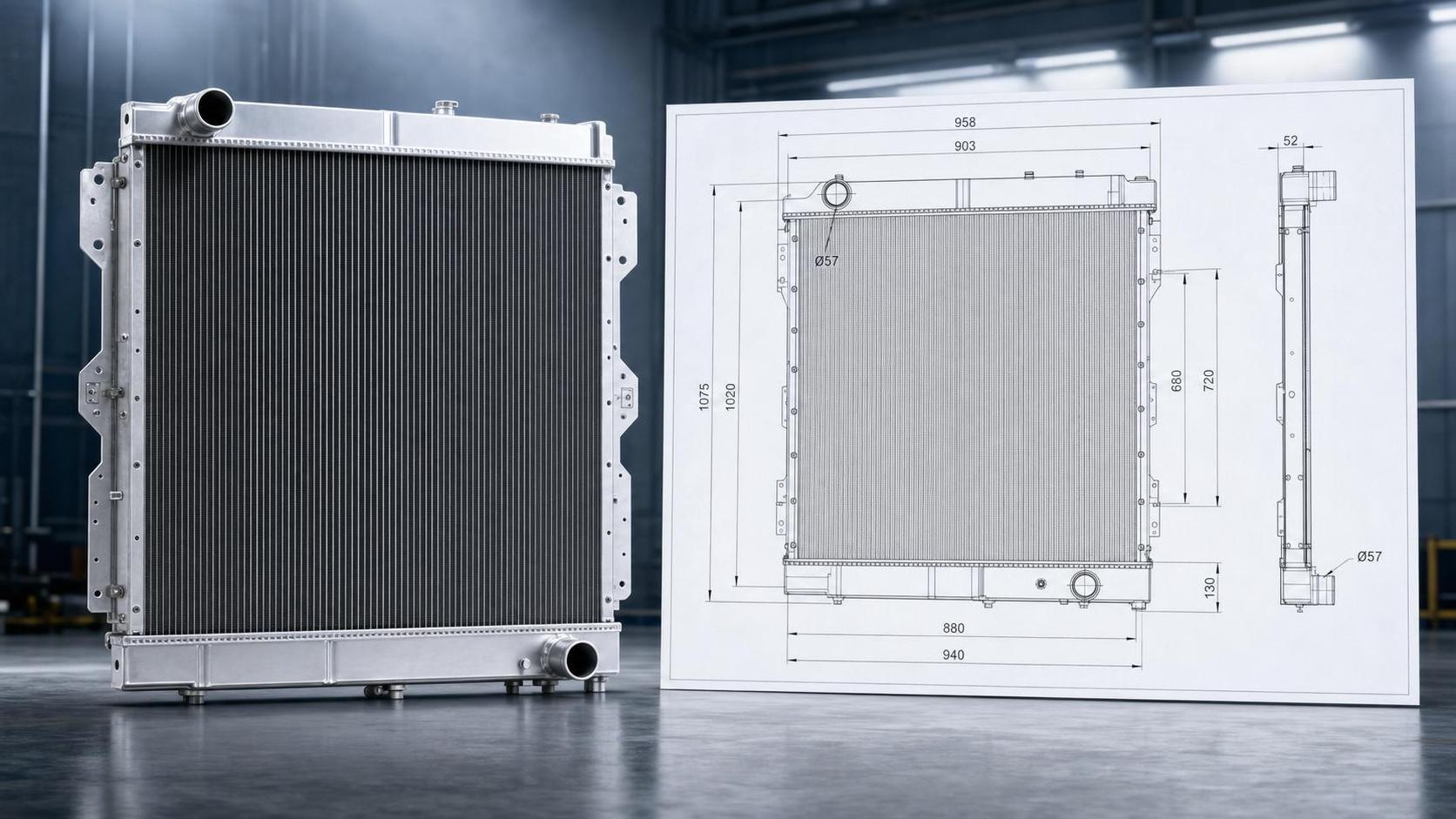
How to Read Mercedes Radiator Specifications Before Ordering a Replacement
Ordering the right Mercedes radiator starts with understanding the specifications behind the part number.
Details like core size, port layout, material, and OE reference affect fit, cooling performance, and purchasing efficiency.
A wrong choice can delay repairs, increase warranty risk, and create avoidable logistics costs.
This guide explains how to read Mercedes radiator specifications clearly and compare replacement options with confidence.
Why Mercedes Radiator Specifications Matter
A Mercedes radiator is not identified by one number alone.
Several dimensions and functional details work together to define the correct replacement.
In commercial and heavy-duty applications, small differences often lead to installation failure.
That includes hose mismatch, bracket offset, fan clearance issues, or lower cooling efficiency under load.
Reading the specification sheet carefully helps reduce reordering cycles and supplier disputes.
It also makes supplier comparison more objective, especially when quotations look similar on paper.
Start with the OE Number and Vehicle Match
The first checkpoint for any Mercedes radiator is the OE reference.
This number connects the radiator to a specific vehicle platform, engine type, and cooling configuration.
Do not rely only on model name, because the same truck series may use different radiator assemblies.
A proper match usually requires checking:
- OE number and superseded numbers
- Vehicle model and production year
- Engine code and emission stage
- Transmission type if oil cooling is integrated
- Market version, because regional cooling packages may differ
If a supplier cannot confirm these basics, the Mercedes radiator quotation is incomplete.
In practical sourcing, OE mapping is the starting point, not the final proof.
Read Core Size Before Anything Else
Core size is one of the most important Mercedes radiator specifications.
It usually includes core length, core height, and core thickness.
These dimensions affect heat dissipation area and available airflow across the cooling pack.
Do not confuse overall tank-to-tank size with core size.
A radiator may fit the frame opening but still have a smaller cooling core than required.
When comparing two replacement offers, verify whether both use the same measuring standard.
This is especially important when one drawing shows fin area and another shows total assembly size.
For a heavy-duty Mercedes radiator, a thickness difference of several millimeters can change performance under high load.
Check Inlet, Outlet, and Mounting Layout
Port position is where many ordering mistakes happen.
The upper inlet and lower outlet must match the original hose routing exactly.
Even if the core dimensions are right, wrong port angles can block installation.
A Mercedes radiator drawing should confirm:
- Inlet and outlet diameter
- Left or right position orientation
- Neck angle and hose direction
- Sensor ports, drain plugs, and accessory fittings
- Mounting brackets, pins, and bolt locations
Ask for a technical drawing, not only product photos.
Photos can hide depth, offset, and angle differences that matter during assembly.
Understand Material and Structure
Material choice affects durability, repairability, and cost.
Most replacement Mercedes radiator products use aluminum cores with plastic tanks or full aluminum construction.
Plastic-aluminum units are common and cost-efficient for many fleet applications.
Full aluminum radiators are often preferred for stronger vibration resistance and heavy-duty working conditions.
Also review tube and fin structure.
A different fin density can change airflow resistance and thermal performance.
This matters when the vehicle works in hot climates, long-distance transport, or dusty sites.
Liaocheng Xinde Auto Parts Co., Ltd., established in 2018, focuses on radiators, intercoolers, and heavy-duty cooling components.
Its manufacturing background in truck and new energy radiator modules shows how structural details influence real operating reliability.
Look for Integrated Functions
Not every Mercedes radiator is only a coolant heat exchanger.
Some versions include an integrated transmission oil cooler or extra connection points.
If these features are missing, the replacement may install physically but fail functionally.
Review the specification sheet for:
- Built-in oil cooler presence
- Thread size and fitting type
- Sensor mounting holes
- Expansion or overflow related connections
- Pressure cap compatibility where applicable
This is one reason a lower-priced Mercedes radiator can become expensive after delivery.
Compare Drawings, Samples, and Supplier Data
A good procurement process uses more than one verification layer.
First, compare the supplier drawing with the old Mercedes radiator sample.
Next, confirm part references against catalog data and vehicle records.
Finally, ask for production details when the application is sensitive.
Useful checks include:
- Overall dimensions and core dimensions
- Port diameter and orientation
- Mounting point distance and bracket shape
- Material specification and welding or crimping method
- Pressure test standard and leak test record
These checks reduce the chance of approving a Mercedes radiator based on incomplete sales descriptions.
Use Cross-Reference Carefully
Cross-reference numbers are helpful, but they are not absolute proof of interchangeability.
Catalog databases sometimes group similar products that still have structural differences.
That is why a Mercedes radiator cross number should always be paired with dimensional verification.
A practical example from the broader radiator market is XD92108 radiator for international .
It is linked with references such as OEM 238704, 3S012484, 3S013471, and 2601807C91.
The lesson is simple.
Even when cross numbers look complete, the final decision still depends on structure, dimensions, and application match.
Questions Worth Asking Before You Place the Order
Before confirming a Mercedes radiator order, ask clear technical questions.
- Is the quoted radiator matched by OE number and exact vehicle application?
- Are core size and overall size both confirmed?
- Do inlet and outlet positions match the original sample?
- Is there an integrated oil cooler or sensor port requirement?
- What material and pressure test standard are used?
- Can the supplier provide drawings, test photos, or a sample inspection report?
These questions help separate a real technical match from a generic catalog match.
Final Check Before Ordering a Mercedes Radiator
Reading Mercedes radiator specifications well is mostly about discipline and detail.
Start with OE compatibility, then verify core size, port layout, mounting points, materials, and integrated functions.
Do not approve a replacement based only on appearance or a brief product title.
A well-checked Mercedes radiator order reduces downtime, avoids return costs, and improves supplier consistency over time.
When every specification is confirmed before payment, the replacement process becomes faster, cleaner, and far more reliable.