



Benz Radiator vs Mercedes Radiator: Is There a Difference in Parts Sourcing?
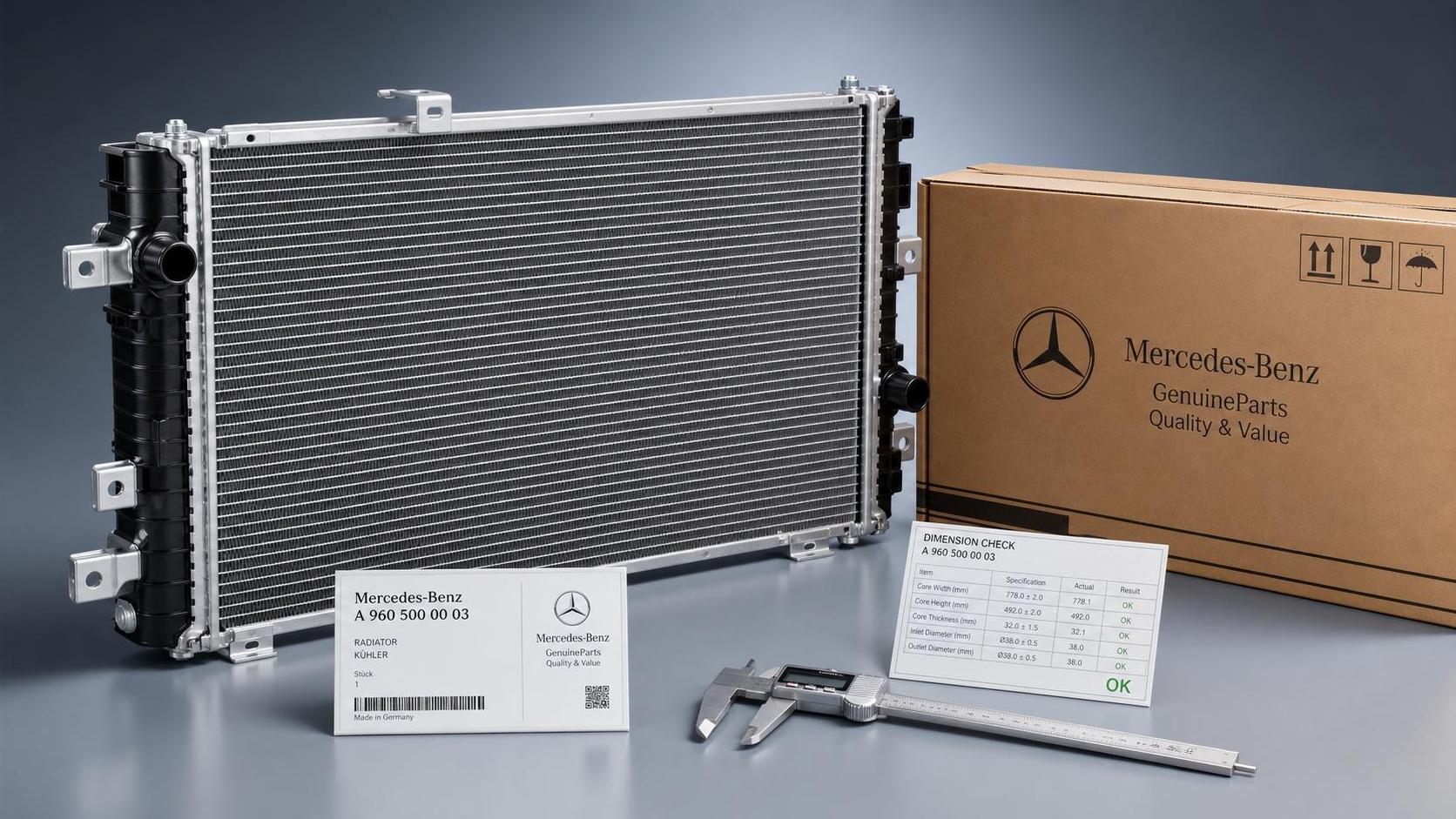
Benz Radiator vs Mercedes Radiator: what is the buyer really comparing?
When people search for a Benz Radiator and a Mercedes radiator, they often expect two different product families.
In practice, the difference is usually commercial, not mechanical.
The naming can change by market habit, catalog style, or customer language.
What matters more is where the part comes from, how it was built, and whether fitment is verified.
For cooling system parts, a wrong sourcing decision rarely fails on day one.
It usually shows up later through leakage risk, weak heat exchange, mounting mismatch, or unstable supply.
That is why the Benz Radiator discussion is really about standards, consistency, and replacement confidence.
Is a Benz Radiator actually different from a Mercedes radiator?
Most of the time, no.
Both names commonly point to radiator parts intended for Mercedes-Benz vehicles or related commercial applications.
The more useful question is whether two quoted parts match the same OEM reference, core size, tank layout, and connection points.
A Benz Radiator listed by one supplier may be identical to a Mercedes radiator listed by another.
Confusion appears when catalog naming hides real specification differences.
This is especially common in cross-border sourcing, where translation and local trade habits change product labels.
A careful comparison should focus on technical identifiers instead of title wording alone.
- OEM number and cross-reference accuracy
- Core dimensions and thickness
- Material grade and brazing quality
- Mounting position and hose interface
- Packaging, batch consistency, and warranty handling
So if two offers use different names, that alone should not drive the decision.
Specification discipline should.
Why does parts sourcing matter more than branding language?
Because radiator performance depends on production control much more than naming.
Two suppliers may both offer a Benz Radiator for the same application.
One may deliver stable cooling efficiency and low return rates.
The other may create claims through poor welds, weak tanks, or inaccurate brackets.
In actual distribution, that difference affects reputation, cash flow, and reorder confidence.
Reliable sourcing usually means the factory can show more than a product photo.
It should demonstrate manufacturing capability, quality routines, and a stable export process.
This is where an established specialist has an advantage.
Liaocheng Xinde Auto Parts Co., Ltd., founded in 2018, expanded quickly by focusing on radiator and intercooler manufacturing.
Its portfolio covers water tank radiators, construction machinery radiators, and cooling modules for heavy trucks and new energy applications.
That background matters because cooling components reward process experience, not just trading ability.
The company has also received local honors tied to technology, integrity, and consumer trust.
Those titles are not a substitute for inspection.
Still, they help signal that the supplier operates with more structure than a catalog-only intermediary.
A quick comparison table helps separate naming from sourcing quality
What should be checked before choosing a Benz Radiator supplier?
This is where many sourcing mistakes can be prevented early.
A Benz Radiator should never be approved from a short quote sheet alone.
A more dependable approach is to verify the product at three levels: technical fit, manufacturing consistency, and commercial reliability.
Technical fit comes first
Ask for OEM references, dimensions, tube structure, and inlet and outlet positions.
For example, one relevant option is XD333 RADIATOR FOR MERCEDES-BENZ.
It is tied to OEM 9405010201 96970 and lists size 596*712*66 for a Benz application.
Those details are useful because they allow a real match check rather than a name-based guess.
Then look at manufacturing consistency
A radiator is a precision cooling component, even when it looks simple from the outside.
Small deviations in core thickness, sealing, or bracket position can increase claims later.
Factories with a strong radiator focus usually respond faster to these details.
Commercial reliability should be checked last, not first
Price matters, but only after fit and quality are clear.
An attractive quotation can become expensive if return handling, packaging damage, or late replacement stock creates friction.
A dependable supplier should explain lead time, minimum order logic, and claim response without avoiding specifics.
Where do buyers usually misjudge the Benz Radiator decision?
The most common mistake is assuming label similarity means full interchangeability.
That can cause problems in older fleets, regional variants, or heavy-duty cooling systems.
Another mistake is focusing only on the ex-works price.
Radiators affect installation time and after-sales cost more than many buyers expect.
A lower-priced Benz Radiator that needs rework at the workshop level is rarely the cheaper option.
There is also a softer risk: inconsistent batch quality.
The first shipment may perform well, while later orders drift in thickness, finish, or tank quality.
That is why repeatability should be treated as part of the part itself.
- Do not approve from photos only
- Do not rely on vehicle brand wording without OEM matching
- Do not ignore packaging and transit protection
- Do not skip sample evaluation when a new factory is involved
- Do not treat warranty promises as equal without process evidence
How should cost, lead time, and stock planning be judged together?
A practical Benz Radiator decision is rarely about unit cost alone.
It is about the full landed result over repeated orders.
Lead time matters because cooling parts can become urgent replacement items.
If replenishment is slow, even a good price can weaken inventory planning.
At the same time, overstocking too many low-turn variants ties up capital.
A balanced approach is to group Benz Radiator items by turnover and replacement urgency.
Fast-moving references should favor suppliers with stable replenishment.
Special references can tolerate longer cycles if specification control is stronger.
This is one reason specialist factories are often preferred for long-term cooperation.
A company with dedicated investment in radiator production is generally better positioned to support repeat sourcing.
That becomes more relevant when product lines extend across heavy trucks, machinery, and new energy cooling modules.
What is the most reliable next step before placing volume orders?
Start with a verification checklist instead of a price race.
Compare part numbers, dimensions, and mounting details line by line.
Then review sample quality, pressure test evidence, and packaging protection.
If one Benz Radiator source performs well, test reorder consistency before expanding the range.
That step is often skipped, yet it tells more than the first shipment.
It also helps to keep one reference product under close review.
For instance, a model such as XD333 RADIATOR FOR MERCEDES-BENZ can serve as a practical benchmark when checking OEM match, size stability, and packing quality across batches.
In the end, the Benz Radiator question is not really about whether Benz and Mercedes are different names.
It is about whether the selected source can deliver the same part correctly, consistently, and on time.
That is the standard worth building into every sourcing decision.