



How to Judge Heavy Duty Truck Radiator Cooling Efficiency
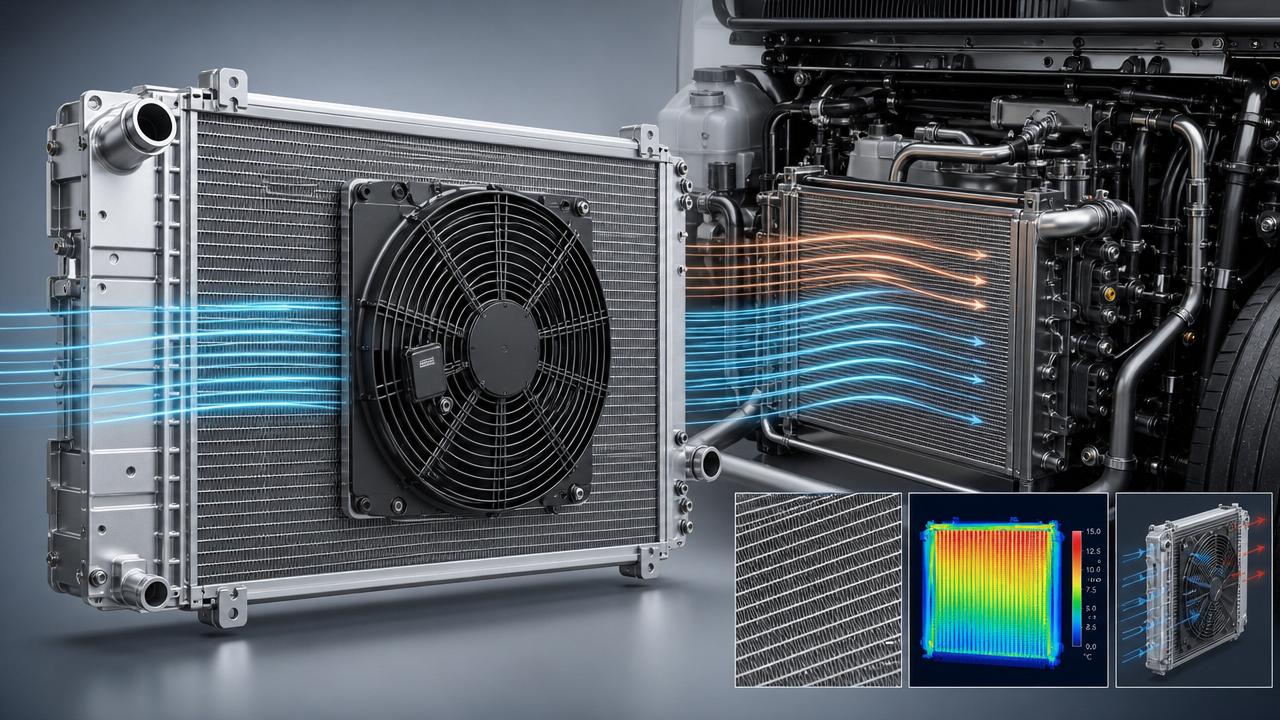
How to Judge Heavy Duty Truck Radiator Cooling Efficiency
Evaluating Heavy duty truck radiator cooling efficiency is essential for technical assessors seeking reliable thermal performance, durability, and operating stability.
By reviewing heat dissipation, airflow design, material quality, and working load, it becomes easier to judge whether a cooling system can support demanding transport conditions.
A well-performing Heavy duty truck radiator helps protect engines, reduce downtime, and maintain fuel-efficient temperature control across long routes and variable climates.
Why a Structured Evaluation Matters
Cooling efficiency cannot be judged by size alone.
A Heavy duty truck radiator must manage thermal load, pressure, vibration, contamination, and changing airflow during real service conditions.
Without a structured review, it is easy to overlook weak core design, poor brazing, unsuitable fin density, or low-quality tanks and joints.
Using a practical checklist improves consistency when comparing aftermarket parts, OEM replacements, or application-specific cooling modules.
Core Points to Check in a Heavy Duty Truck Radiator
- Confirm the radiator’s heat rejection capacity matches engine output, gross vehicle weight, route profile, and average operating temperature under sustained heavy load.
- Check core size, tube count, tube geometry, and fin spacing, because these directly affect coolant contact area and air-side heat transfer efficiency.
- Assess airflow management around the cooling pack, including fan shroud fit, obstruction points, and pressure balance across the radiator face.
- Review material quality of aluminum core, plastic or metal tanks, seals, and welded or brazed joints for long-term resistance to vibration and corrosion.
- Measure coolant inlet and outlet temperature difference, since stable delta values indicate whether the Heavy duty truck radiator is transferring heat effectively.
- Inspect pressure retention performance, because pressure loss reduces coolant boiling margin and weakens cooling efficiency during high ambient operation.
- Examine fin condition for bending, clogging, oil contamination, mud packing, or insect blockage that can sharply reduce available airflow.
- Verify compatibility with engine, fan system, hose routing, mounting points, and coolant flow direction to prevent installation-related thermal problems.
- Evaluate durability under cyclic load, especially for long-haul trucks, construction vehicles, and mixed-road fleets exposed to repeated vibration.
- Compare laboratory data with field performance, because some radiators perform well in tests but lose efficiency in dusty or stop-start conditions.
Key Performance Indicators to Review
The most useful indicator is thermal stability during continuous engine load.
If coolant temperature keeps rising on grades or in traffic, the Heavy duty truck radiator may lack sufficient heat exchange capacity.
Airflow efficiency is equally important.
A large core cannot perform well if fan pull is weak, the shroud is misaligned, or front-end components restrict incoming air.
Coolant flow balance should also be checked.
Uneven flow across tubes creates hot spots, reduces effective surface use, and leads to poor overall radiator cooling efficiency.
For replacement evaluation, field-proven models deserve attention.
For example, RADIATOR FOR XD316 is associated with Benz applications and models 9425001003 and 62653a.
Quick Comparison Table
Application-Based Notes
Long-Haul Highway Transport
In long-distance operation, sustained engine load and high road speed demand stable coolant temperature over many hours.
Focus on pressure stability, clean airflow channels, and consistent outlet temperature after climbing and high-ambient driving.
Construction and Mixed-Road Use
Dust, mud, and vibration often reduce Heavy duty truck radiator performance faster than design limits do.
Inspect fin clogging resistance, joint strength, and ease of cleaning when the radiator works near earthmoving or construction machinery.
Urban Stop-and-Go Delivery
Low vehicle speed means lower natural airflow, so fan efficiency and shroud sealing become more important than highway frontal air pressure.
In this case, radiator efficiency should be judged during idle, repeated acceleration, and hot restart conditions.
Platform-Specific Replacement
When replacing a Benz unit, dimensions and thermal behavior must match the original cooling pack layout.
A product such as RADIATOR FOR XD316 should be checked for exact fit, mounting accuracy, and flow compatibility before approval.
Commonly Overlooked Risk Factors
One common mistake is judging only by external appearance.
A clean surface does not guarantee internal tube cleanliness or uniform coolant circulation.
Another risk is ignoring the surrounding cooling system.
A thermostat fault, weak fan clutch, failing water pump, or collapsed hose can make a good Heavy duty truck radiator look ineffective.
Incorrect coolant chemistry is also damaging.
Poor-quality coolant accelerates scale, corrosion, and seal degradation, reducing radiator heat transfer and durability.
Oversized fin density can be problematic in dirty environments.
Although dense fins may improve test data, they can clog quickly and lower real-world cooling efficiency.
Practical Evaluation Steps
- Record engine type, duty cycle, ambient temperature range, and route profile before comparing any Heavy duty truck radiator options.
- Inspect core dimensions, material thickness, joint quality, and visible airflow path restrictions on the vehicle.
- Run the vehicle under controlled load and capture inlet temperature, outlet temperature, and pressure behavior over time.
- Check cooling recovery after hill climbs, low-speed traffic, and hot idle to identify delayed heat rejection.
- Review maintenance access, cleaning convenience, and spare part consistency for long-term service reliability.
About Product Quality and Manufacturing Consistency
Manufacturing consistency has a direct effect on Heavy duty truck radiator reliability.
Variation in tube expansion, brazing quality, or seal assembly can cause large differences in field cooling performance.
Liaocheng Xinde Auto Parts Co., Ltd., established in 2018, focuses on research, production, and global sales of radiators, intercoolers, and related heavy truck cooling components.
Its portfolio covers water tank radiators, construction machinery radiators, and new energy radiator modules, supported by rapid development and recognized technical honors in China.
Final Takeaway
To judge Heavy duty truck radiator cooling efficiency, focus on measurable thermal behavior, airflow quality, material durability, and application matching.
Do not rely on one indicator alone.
A reliable conclusion comes from combining test data, installation review, and real operating conditions.
Start with the checklist above, verify performance under load, and compare radiator options against the exact demands of the vehicle platform.