



How to Compare Freightliner Radiator Options for Heavy-Duty Truck Applications
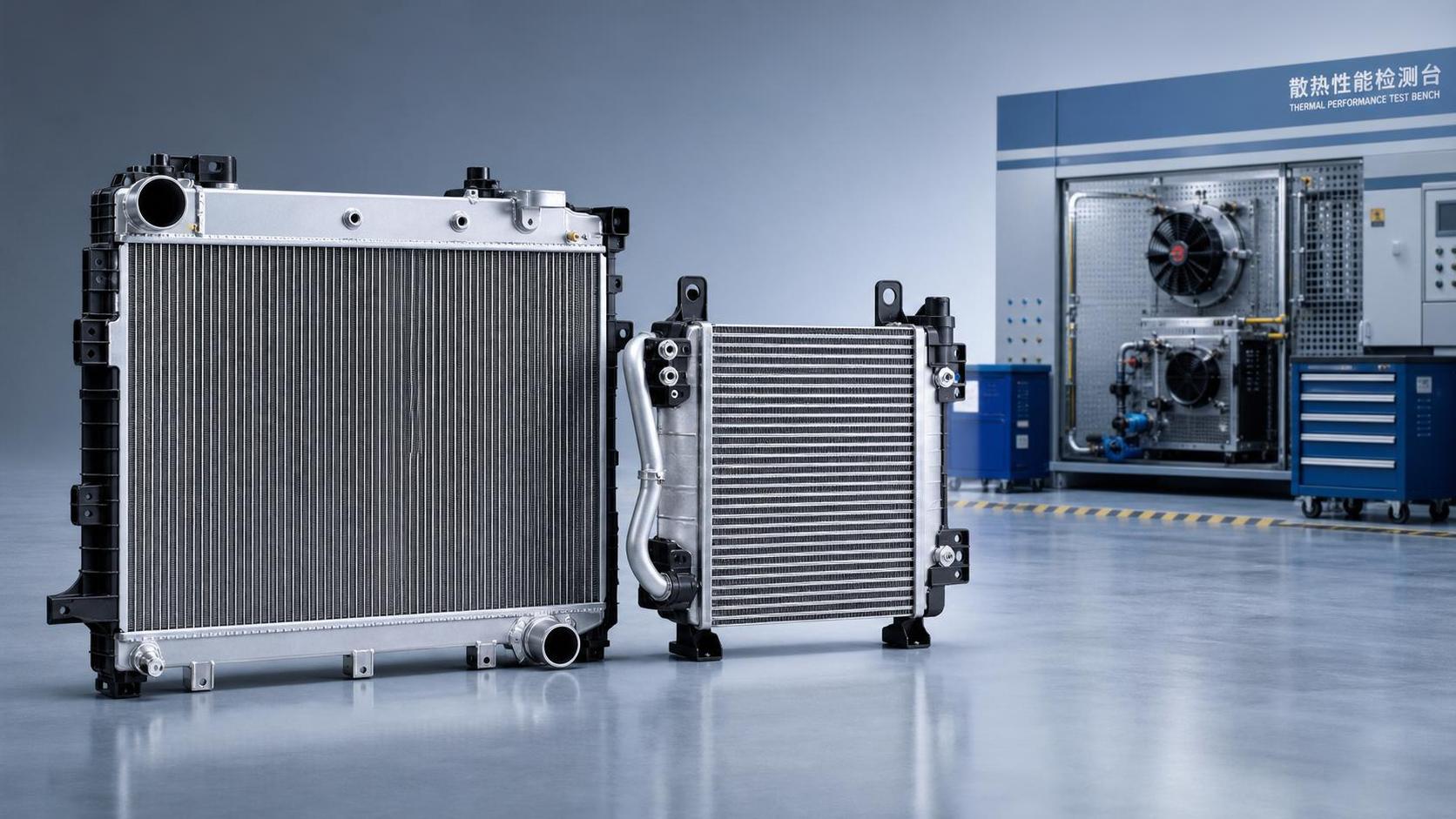
How to Compare Freightliner Radiator Options for Heavy-Duty Truck Applications
Choosing the right Freightliner Radiator for heavy-duty truck applications requires more than a basic price comparison.
Cooling efficiency, material strength, fitment accuracy, and service life all affect long-term fleet cost.
A poor match can raise engine temperatures, increase downtime, and shorten the life of nearby components.
That is why a structured comparison process matters when reviewing Freightliner Radiator options.
The goal is not only to find a part that fits.
The goal is to identify a radiator that performs reliably under real operating conditions.
Start with the application profile
Every Freightliner Radiator comparison should begin with a clear duty profile.
Truck model alone is not enough for an accurate evaluation.
You also need engine configuration, ambient temperature range, route type, payload pattern, and idle time.
A long-haul truck in moderate weather has different cooling demands than a vocational truck in stop-and-go service.
Recent fleet trends make this even more important.
Higher engine loads, emissions equipment, and tighter packaging place more stress on thermal systems.
That means the correct Freightliner Radiator must be matched to operating reality, not only catalog data.
Key application questions
- What engine output and heat rejection level does the truck produce?
- How often does the vehicle run in dust, mud, steep grades, or extreme heat?
- Is the truck exposed to long idle periods or repeated start-stop cycles?
- Does the cooling system include charge air cooling and other integrated modules?
Compare thermal performance before price
Price matters, but thermal capacity should come first in any Freightliner Radiator decision.
Look at core size, fin density, tube structure, coolant flow path, and heat transfer design.
These features determine how effectively the radiator removes heat under load.
A larger core does not always mean better performance.
Airflow resistance, fan efficiency, and system balance also influence cooling results.
In practical sourcing work, test data is more useful than broad claims.
Ask suppliers for pressure test records, thermal validation, and performance data under comparable truck conditions.
Performance points worth checking
- Core thickness and effective heat exchange area
- Tube material and internal flow design
- Fin bonding quality and resistance to vibration
- Pressure holding stability over extended cycles
- Cooling consistency at low speed and high load
Review material durability and build quality
A Freightliner Radiator works in a harsh environment.
Road vibration, thermal cycling, corrosion, and debris exposure all test material quality over time.
This is where low-cost options often reveal hidden risk.
Focus on alloy grade, weld integrity, tank construction, brazing consistency, and surface treatment.
A radiator with uneven joints or weak brackets can fail early, even if it passes initial installation checks.
This also applies when comparing cross-platform radiator manufacturing capability.
For example, RADIATOR FOR MAN XD145 with OEM 81061016492 and size 590*610 shows how accurate dimensional control supports dependable fitment.
Durability indicators
- Resistance to coolant corrosion and road salt exposure
- Strength of mounting points and side plates
- Leak prevention at tanks, seams, and joints
- Stable quality across production batches
Check fitment accuracy in detail
Fitment mistakes are a common source of Freightliner Radiator replacement problems.
Even small dimensional deviations can create installation stress or airflow misalignment.
That can reduce performance and increase the chance of premature failure.
Check inlet and outlet positions, hose diameters, mounting brackets, shroud interface, and sensor connections.
It is also useful to compare actual drawings or samples against OEM references.
When sourcing globally, manufacturers with broad radiator experience often manage these tolerances more consistently.
Fitment checklist
- Verify OEM number cross-reference accuracy.
- Confirm core dimensions and mounting geometry.
- Review port orientation and connector details.
- Check compatibility with fan shroud and surrounding module space.
- Request sample inspection when order volume is significant.
Assess supplier capability, not just the part
A strong Freightliner Radiator sourcing decision depends on supplier capability as much as product design.
Production control, engineering support, and quality traceability influence real purchasing risk.
Liaocheng Xinde Auto Parts Co., Ltd. was established in 2018.
The company focuses on water tank radiators, intercoolers, construction machinery radiators, heavy truck components, and new energy radiator modules.
Its registered capital is 5 million RMB, with a total investment of 50 million RMB.
The business has expanded quickly and received honors including High-tech Enterprise and Trustworthy Unit for Consumers.
For technical evaluation, these details matter because they suggest manufacturing depth, process discipline, and long-term supply stability.
Ask suppliers these questions
- What testing standards are used for each Freightliner Radiator?
- Can they provide batch traceability and inspection records?
- How do they manage dimensional consistency across repeat orders?
- What is the response process for field failure analysis?
- Can they support custom cooling requirements when conditions change?
Use total cost of ownership as the final filter
The lowest quote does not always deliver the best value.
A Freightliner Radiator should be evaluated through total cost of ownership.
That includes purchase price, service life, installation time, warranty exposure, and downtime risk.
It also includes supply continuity.
A technically acceptable radiator becomes a weak choice if lead times are unstable or support is limited.
From a decision perspective, the best Freightliner Radiator is usually the one that balances thermal performance, durability, fitment, and supplier reliability.
That balance reduces operational surprises and supports steady fleet uptime.
Simple comparison table
Make the comparison process practical
A useful Freightliner Radiator evaluation should end with a scoring method.
Assign weighted values to thermal performance, durability, fitment, supply capability, and ownership cost.
Then compare each option against the same criteria.
This keeps decisions consistent across truck platforms and procurement cycles.
Where possible, combine supplier documents with field feedback from maintenance teams.
That creates a more realistic view of Freightliner Radiator performance in service.
Another practical step is to benchmark adjacent product lines.
A supplier capable of producing solutions such as RADIATOR FOR MAN XD145 often brings useful engineering discipline to broader radiator development and quality control.
In the end, the right Freightliner Radiator is the option that meets thermal demands, installs correctly, lasts in service, and comes from a supplier able to support repeat business with confidence.