



How a Radiator Core Factory Handles Consistency at Scale
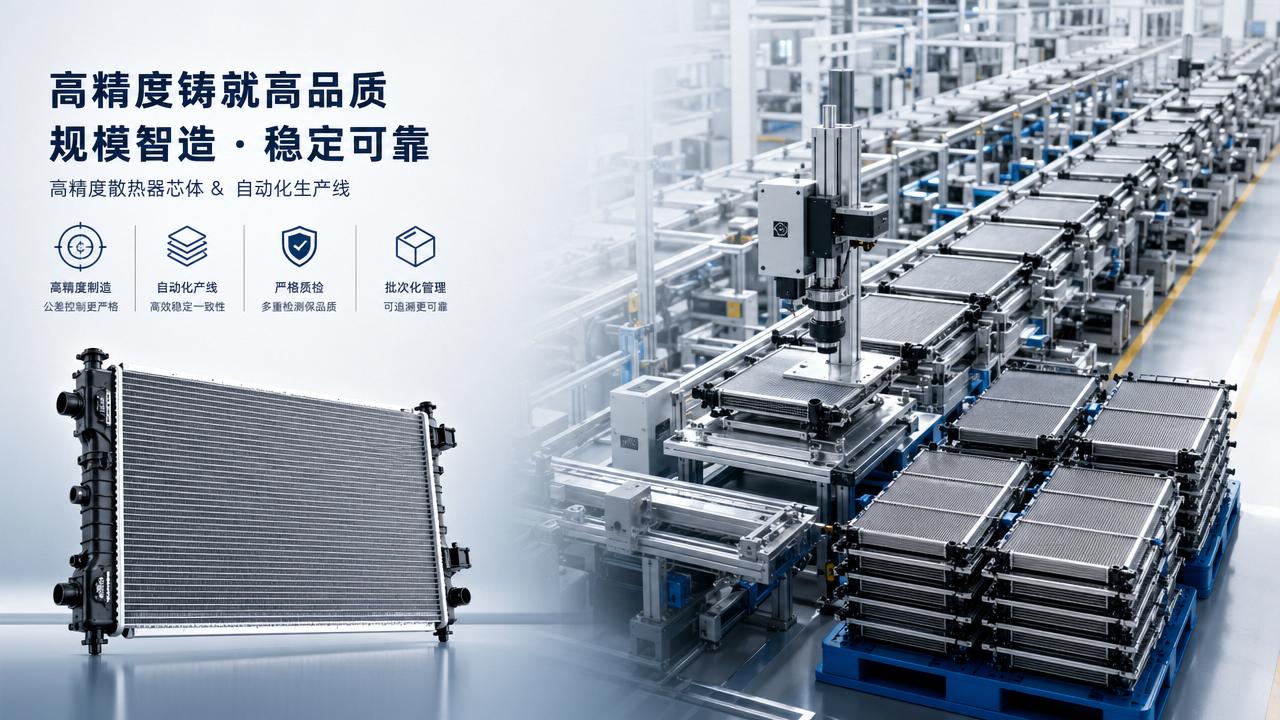
For business evaluators, consistency is one of the clearest signals of manufacturing strength. A reliable radiator core factory must deliver stable quality, repeatable performance, and scalable production without compromising lead times or compliance. This article explores how disciplined processes, technical expertise, and continuous improvement help manufacturers like Liaocheng Xinde Auto Parts Co., Ltd. maintain consistency at scale in a highly competitive auto parts market.
Why consistency matters differently across real business scenarios
When a buyer, sourcing manager, or investment reviewer assesses a radiator core factory, the key question is rarely whether the supplier can produce a sample. The more important issue is whether the same quality can be maintained across different order sizes, product families, delivery windows, and end-use conditions. In the auto parts industry, inconsistency creates hidden costs: returns, assembly delays, thermal performance failures, and reputational damage in downstream markets.
This is especially relevant in parts manufacturing because the application environment is not uniform. Passenger vehicles, heavy trucks, construction machinery, and new energy thermal modules all require different process controls. A radiator core factory serving multiple customer groups must therefore standardize what should be standardized while still preserving flexibility where technical variation is unavoidable.
Liaocheng Xinde Auto Parts Co., Ltd., established in 2018, has expanded rapidly in China’s competitive market for water tank radiators, intercoolers, construction machinery radiators, heavy truck components, and new energy radiator modules. Its growth, supported by honors such as High-tech Enterprise and Trustworthy Unit for Consumers, suggests an operational model designed not just for output volume, but for repeatable manufacturing results.
Typical evaluation situations where consistency becomes decisive
- Supplier qualification for long-term procurement contracts
- Capacity and risk review before entering a new export market
- Assessment of a factory’s suitability for OEM-like or OE replacement programs
- Verification of whether a growing manufacturer can scale without quality drift
What evaluators should look for first
Before comparing pricing, evaluators should confirm whether the radiator core factory has repeatable process logic. That includes material control, tooling discipline, in-process inspection, final validation, and traceability. Consistency at scale is not a single feature; it is a system that survives pressure from volume growth, product variation, and delivery demands.
Three common application scenarios and how consistency is judged in each one
A business evaluator should not use one checklist for all sourcing situations. The same radiator core factory may perform very well in one application and require deeper review in another, simply because the use conditions and supply expectations differ. Breaking the evaluation into practical scenarios helps separate real capability from generic marketing claims.
Below are three common situations in which consistency becomes a purchasing and qualification issue. Each scenario changes what “stable performance” means, what risks matter most, and what process evidence should be requested.
For a company like Liaocheng Xinde, which covers heavy-duty cooling products and new energy related applications, scenario-based evaluation is particularly useful because its product range spans multiple operating environments and commercial priorities.
Scenario 1: High-volume aftermarket supply for passenger and commercial vehicles
In the aftermarket, buyers often need broad SKU coverage, stable dimensions, packaging accuracy, and repeat ordering reliability. Here, a radiator core factory is judged less by one premium prototype and more by whether every shipment matches the approved version. Small deviations in core thickness, tube alignment, or brazing quality can create fitment complaints at the distributor or installer level.
This is the environment where process standardization matters most. Orders may be frequent, varied, and time-sensitive. Evaluators should ask how the factory controls tooling changes, production scheduling, and batch identification when many models are produced in parallel. Stable output under mixed-model manufacturing is a strong sign of process maturity.
A practical example is Radiator for Benz, which covers applications such as W124 E-Class, W206 C-Class, and W242 Electric Drive series for Mercedes-Benz passenger cars and commercial vehicles. For products like this, consistency means meeting or exceeding OEM specifications repeatedly, while preserving cooling efficiency and thermal management performance across batches.
Scenario 2: Heavy truck and construction machinery applications under demanding duty cycles
For heavy trucks and construction machinery, thermal loads are higher and operating conditions are less forgiving. Dust, vibration, long hours, and variable ambient temperatures all increase the importance of structural durability. In this scenario, consistency is not only dimensional; it is also mechanical and thermal. Core integrity, weld stability, pressure resistance, and long-cycle cooling performance become central review points.
A radiator core factory serving this segment must show more than general production scale. Evaluators should confirm whether the factory has application-specific validation, not just visual inspection. For example, stable fin bonding, pressure testing routines, and durability-oriented workmanship standards indicate a supplier that understands real-world operating stress rather than only factory-floor appearance.
This is where business risk is often underestimated. A supplier may offer competitive pricing, but if consistency breaks under field conditions, the cost of downtime and replacement is far greater than the original unit price difference. For evaluators, this scenario requires careful review of process capability, not only commercial terms.
Scenario 3: New energy thermal management and project-based sourcing
New energy applications introduce another layer of complexity. Thermal management in electric and hybrid systems often requires tighter coordination between design, heat exchange efficiency, module integration, and quality control documentation. In such programs, a radiator core factory must align manufacturing consistency with technical collaboration.
Project-based buyers usually care about process transparency, engineering response speed, and change management. If a drawing revision is introduced, can the factory implement it without causing inconsistency in adjacent SKUs? If a pilot order succeeds, can volume production maintain the same thermal and structural characteristics? These are critical scale-up questions.
For rapidly growing manufacturers, this scenario often reveals their true level of operational discipline. The ability to support advanced radiator modules while preserving schedule and repeatability is one of the strongest indicators that scale is being managed professionally.
Scenario comparison for evaluators
How a radiator core factory builds consistency into scalable operations
A dependable radiator core factory does not rely on final inspection alone. It creates consistency upstream, during production, and after shipment. This is what allows growth without quality instability. For evaluators, the most useful question is not “Do you inspect quality?” but “Where in the process is quality locked in?”
Factories that scale successfully usually share several operational habits: disciplined raw material management, standardized work instructions, line-level checks, and documented traceability. These systems help maintain repeatability even when product families expand or customer demand fluctuates.
In Liaocheng Xinde’s case, rapid expansion in radiators, intercoolers, construction machinery radiators, and new energy modules implies that consistency must be managed across both product complexity and output growth. That kind of growth is sustainable only when process control develops as fast as capacity.
Process controls that matter most at scale
- Incoming material verification to reduce variability before production starts
- Standardized tooling and fixture management for repeatable dimensions
- In-process checkpoints for alignment, bonding, and assembly quality
- Pressure and performance testing tied to batch records
- Corrective action routines that prevent recurring defects
Why documentation is part of consistency
Many buyers focus on physical quality but overlook data discipline. Yet documentation often determines whether a radiator core factory can support serious business relationships. Batch traceability, specification records, test results, and change logs allow issues to be isolated quickly. For business evaluators, this reduces operational risk and improves confidence in supplier accountability.
How to match factory capability to your own business situation
Not every buyer needs the same supplier profile. A distributor with broad aftermarket coverage, a machinery parts importer, and a project-based thermal management buyer should all evaluate a radiator core factory differently. The goal is not to find a universally “best” factory, but to find the one whose consistency model fits your application and growth plan.
For example, if your main concern is fitment stability across recurring orders, prioritize dimensional control and SKU management. If your concern is harsh-duty reliability, request evidence of structural and pressure consistency. If your business depends on engineering collaboration, assess technical responsiveness and change execution.
The same logic applies when reviewing product lines with mixed application coverage. A CE-certified unit with a 1-year warranty, OE NO. 2025005203 / 202 500 52 03, universal specification, and compact size such as 20X15X10 cm may look straightforward on paper, but evaluators should still ask how those standards are maintained across every shipment, not just one approved sample.
Quick matching guide by buyer type
Common evaluation mistakes
- Assuming sample approval guarantees mass-production stability
- Comparing suppliers only on unit price instead of total operating risk
- Ignoring whether growth has outpaced management systems
- Failing to align technical expectations with actual end-use conditions
What consistency at scale says about long-term supplier value
For business evaluators, a strong radiator core factory is not defined by output volume alone. It is defined by whether scaling up makes the operation stronger, not more fragile. When process control, technical capability, and scenario-specific quality standards work together, consistency becomes visible in delivery reliability, lower claim rates, and better downstream confidence.
This is why manufacturers with clear specialization and disciplined growth are worth close attention. Liaocheng Xinde Auto Parts Co., Ltd. has positioned itself in a technically demanding segment that includes heavy trucks, construction machinery, water tank radiators, intercoolers, and new energy radiator modules. For evaluators, the relevant question is how those capabilities translate into dependable business execution across your own application scenario.
If you are reviewing a radiator core factory for sourcing, qualification, or partnership purposes, begin with your usage scenario, then test the supplier’s process logic against it. Ask how quality is stabilized, how variation is controlled, and how production remains repeatable as order complexity grows. That approach will give you a much clearer view of whether the supplier is merely productive or truly reliable at scale.