



How a New Energy Vehicle Radiator supports battery temperature stability
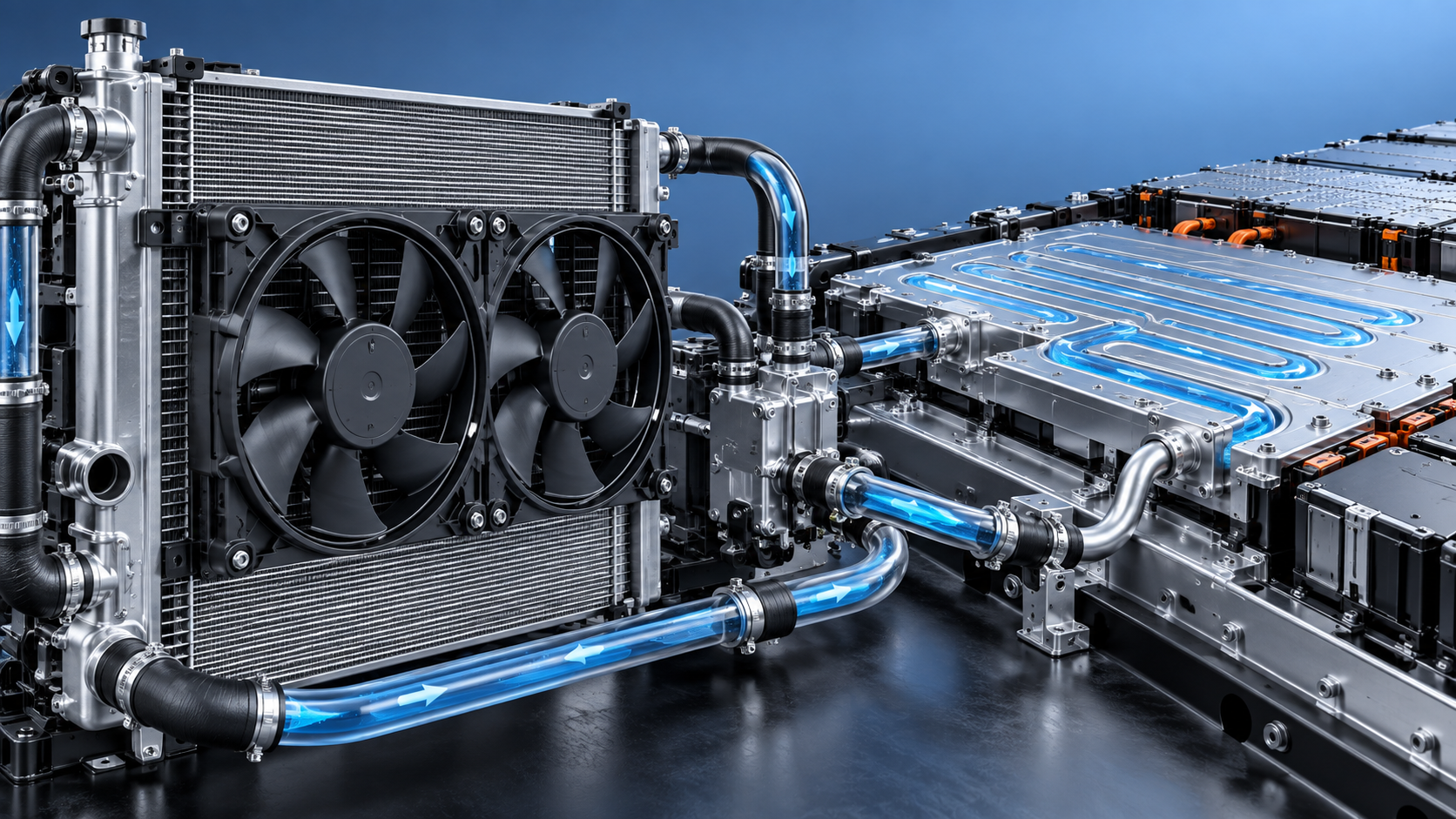
Battery temperature stability depends on a complete thermal path, not on a radiator viewed as an isolated heat exchanger. A New Energy Vehicle Radiator supports that path by releasing heat from the coolant after it has absorbed energy from the battery pack, power electronics, motor, or associated cooling plate. When its heat-rejection capacity matches the vehicle's duty cycle and the rest of the circuit is properly controlled, battery cells are more likely to remain within their intended operating window during charging, high-load driving, climbing, towing, or hot-weather operation.
The radiator therefore matters to battery performance, but it does not determine battery temperature by itself. Coolant flow, pump capacity, valve logic, cooling-plate contact, chiller performance, fan control, ambient temperature, pack insulation, and battery-management calibration all influence the result. For technical evaluators, the useful question is not simply whether a radiator is fitted. It is whether the complete thermal-management architecture can remove heat at the rate the battery system produces it, while also avoiding excessive cooling or large temperature differences across the pack.
Where the radiator sits in the battery thermal path
Most liquid-cooled battery systems use a closed coolant loop. Coolant circulates through channels, cold plates, or structural passages adjacent to battery modules. It picks up heat generated by cell resistance, charging losses, and local electrical loading. The warmed coolant then travels through hoses, valves, pumps, and often a heat exchanger before reaching the vehicle radiator. Air moving through the radiator core transfers that heat to the environment.
In a straightforward cooling mode, the radiator is the final heat-rejection component. It lowers coolant temperature before the fluid returns to the battery. In more complex systems, the battery loop may be connected through a chiller to the refrigerant circuit, or through a coolant-to-coolant heat exchanger to a separate low-temperature loop. The radiator may serve the battery directly, support the power-electronics loop, or provide one of several available heat-rejection routes.
This distinction changes how radiator performance should be assessed. A radiator in a direct battery loop must be evaluated against battery coolant temperatures and pack heat load. A radiator supporting a chiller-based system affects the wider thermal balance, but may not be the component that controls battery temperature during every operating condition. A vehicle can also have separate high-temperature and low-temperature circuits: the motor and inverter may tolerate a different coolant range from the battery, so combining all loads in one undersized or poorly managed circuit can create compromises.
Stable temperature means more than preventing overheating
Overheating is the most visible battery thermal concern, but temperature stability has two dimensions: keeping the average pack temperature within a workable range and limiting variation between cells or modules. A radiator contributes mainly to the first task by controlling the temperature of coolant entering the pack. It can also influence the second indirectly. If coolant enters too warm, or if flow through the loop becomes restricted, modules farther along the circuit may receive less cooling capacity than modules near the inlet.
Cell temperature differences can complicate charging and discharge behavior. Batteries are managed as a system, yet individual cells do not age or respond identically when thermal conditions diverge. A pack with uneven heat distribution may require more conservative control because the warmest region reaches its limit before the rest of the pack does. The thermal system then has to protect that local condition even when average pack temperature appears acceptable.
Radiator selection alone cannot correct a cooling plate with uneven internal passages or a pack layout that concentrates heat in one area. It can, however, reduce the temperature of the coolant available to the pack and preserve thermal margin under sustained load. That margin is particularly important where repeated acceleration, long gradients, high ambient temperature, fast charging, low vehicle speed, or heavy auxiliary electrical demand reduce the system's ability to shed heat.
Heat load changes faster than many radiator assumptions
A common mistake is to size the heat exchanger around a single steady operating point, such as cruising speed in moderate ambient conditions. That can produce a radiator that performs adequately in a catalog calculation but loses margin in the situations that matter most to the user. At highway speed, ram air assists heat rejection. In low-speed urban operation, traffic queues, depot work, construction-site duty, or slow climbs, fan performance and shroud design become much more important. During charging, there may be no vehicle motion at all, so airflow is almost entirely dependent on the fan system.
Ambient air temperature also affects the available temperature difference between coolant and air. As that difference narrows, the radiator must transfer the same heat with less natural driving force. Dirt buildup on the core, blocked grille openings, damaged fins, recirculation of hot underhood air, or fan degradation can further reduce performance. These conditions do not always produce an immediate fault. They may first appear as reduced charging capability, increased fan operation, restricted power, or a narrower operating window during repeated high-load use.
What determines whether a radiator can support the battery circuit
Radiator evaluation should start with system requirements, then move to physical configuration. Core size is relevant, but it is only one part of the answer. A larger frontal area or thicker core may increase heat-transfer potential, yet gains depend on fin geometry, tube design, coolant flow distribution, air-side pressure drop, fan capability, and the available installation space. A core that is too restrictive on the air side can reduce airflow if the selected fan cannot overcome the resistance.
The following checks are more useful than relying on overall dimensions alone:
- Thermal duty: Define the expected heat load from the battery loop and any other circuits sharing the radiator. Include demanding conditions rather than only nominal cruising operation.
- Coolant temperature range: Confirm the intended radiator inlet and outlet temperatures, because heat rejection changes with the temperature difference between coolant and ambient air.
- Airflow at low speed: Assess fan capacity, shroud coverage, control strategy, and the risk that heated exhaust air recirculates through the core.
- Coolant-side pressure drop: Excessive restriction can reduce pump flow and weaken temperature uniformity across the battery cooling circuit.
- Air-side pressure drop: Dense fins or stacked heat exchangers may improve surface area while demanding more from the fan package.
- Package interaction: Condensers, charge-air coolers, transmission coolers, and protective screens can alter airflow before it reaches the radiator.
- Durability: Vibration, thermal cycling, corrosion exposure, hose loading, and mounting design affect whether thermal performance remains stable over service life.
For a battery thermal loop, pressure and flow requirements deserve the same attention as heat-rejection figures. If a replacement radiator has compatible mounting points but materially different internal restriction, the existing pump and valve calibration may no longer provide the required coolant flow. Conversely, a low-restriction core is not automatically better if it compromises heat transfer, introduces poor flow distribution, or does not match the vehicle's control strategy.
Reading core dimensions in context
Dimension comparisons are frequently useful in parts sourcing, but they can create false confidence when treated as the main technical criterion. Core width, height, and thickness indicate packaging and approximate surface area; they do not fully describe the tube pitch, fin density, fin louver geometry, header design, material thickness, or effective airflow through the installed heat-exchanger stack.
A related lesson appears when reviewing charge-air coolers. For example, an XD3023 INTERCOOLER FOR HINO is specified for a particular HINO application with OEM reference 17940-E0491 and a 570*655*62mm core. Those dimensions help identify fitment and package constraints, but an intercooler is designed for compressed intake air rather than a battery coolant loop. It should not be treated as interchangeable with a New Energy Vehicle Radiator simply because both use an aluminum fin-and-tube core. Their fluid media, temperature targets, pressure conditions, connection layouts, and control roles differ.
The same principle applies within vehicle radiator families. Two coolant radiators with similar external dimensions may behave differently once installed. The correct comparison includes tank configuration, port positions, mounting interfaces, core construction, specified coolant medium, pressure capability, airflow environment, and the circuit for which the unit was designed. For battery systems, compatibility with coolant chemistry and electrical isolation requirements may also be part of the engineering review.
Why radiator performance changes during charging and low-speed operation
Driving can provide substantial airflow through the front-end cooling stack, but charging often removes that advantage. Fast charging can generate enough battery heat to require active cooling while the vehicle is stationary. In that situation, the radiator's effective performance depends heavily on fan operation and on whether hot discharge air is drawn back toward the front of the vehicle. A design that appears strong at road speed can have limited reserve at zero vehicle speed.
For this reason, the radiator should be reviewed together with the fan, shroud, grille, condenser placement, and vehicle bodywork. A fan that covers only part of the core may leave regions with weak airflow. Large gaps between fan shroud and core allow air to bypass the fin surface. Debris screens can protect the stack but may increase resistance if their mesh is too restrictive or poorly maintained. In compact vehicle packages, proximity between the fan outlet and other surfaces can create recirculation zones that raise inlet-air temperature.
Battery protection logic can compensate for limited cooling by reducing charge current or power demand. That response protects the system, but it changes the user experience and may be misdiagnosed as a battery issue. Before attributing reduced charging or power availability to cell condition, the thermal path should be examined: coolant temperature entering and leaving the pack, radiator inlet and outlet temperature, fan command and actual operation, coolant flow, ambient conditions, and obstruction across the cooling stack.
Common assumptions that lead to weak selection decisions
“A bigger radiator always fixes thermal instability.” A larger core may help, but only if the vehicle can move enough air through it and the coolant circuit can deliver heat to it. If the limitation is a weak pump, poor cold-plate contact, a restricted valve, inadequate chiller capacity, or hot-air recirculation, adding core volume may produce little improvement.
“Battery cooling is only required in hot climates.” Hot weather increases heat-rejection difficulty, but battery temperature management also has to address cold conditions. A radiator is mainly a heat-rejection device. In low ambient temperatures, the control system may bypass it, reduce fan operation, use a valve strategy, or rely on heaters and heat-pump functions to bring the battery into a suitable range. A system optimized only for maximum cooling can increase warm-up time or create avoidable energy use.
“Matching the OEM outline is enough.” Physical fit is necessary but does not confirm thermal or hydraulic equivalence. Replacement assessment should include port diameter and location, hose routing, mounting stiffness, pressure rating, material compatibility, core construction, and circuit-specific performance requirements. This is especially important where one vehicle platform uses multiple battery capacities, motor outputs, or climate packages under similar front-end packaging.
“A radiator fault will always trigger an immediate warning.” Gradual loss of air-side performance may be absorbed by increased fan duty or more conservative battery control before a clear fault occurs. Inspecting fin condition, contamination, coolant level, hose condition, fan response, and temperature trends can identify degradation earlier than waiting for a severe overheating event.
A practical review sequence for researchers and parts teams
For a new vehicle program, a replacement part review, or an investigation into unstable battery temperatures, begin by mapping the cooling architecture. Identify whether the battery has a direct radiator loop, shares a low-temperature loop with the inverter, uses a chiller, or can switch between several thermal paths. Then establish which operating condition produces the concern: high-speed load, slow driving, stationary charging, high ambient temperature, repeated acceleration, or a combination.
Next, separate thermal capacity from control behavior. If coolant entering the pack remains too warm under demand, the system may lack heat-rejection capacity, airflow, or refrigerant-side support. If coolant temperature oscillates sharply, valve logic, pump control, sensor placement, or fan staging may be involved. If average coolant temperature is acceptable but certain modules are consistently warmer, the issue may lie within the pack flow distribution rather than the front-end radiator.
A radiator should ultimately be judged by how well it supports the thermal system under the vehicle's intended operating envelope. The useful specification is not merely a core measurement or a generic claim of improved cooling. It is a matched combination of heat-rejection capacity, airflow performance, coolant flow characteristics, package compatibility, and control integration. When those elements are aligned, the radiator helps keep battery temperatures more stable, protects operating margin in demanding conditions, and gives the battery-management system a more predictable thermal environment to work with.