



How Condenser Design Choices Affect System Reliability
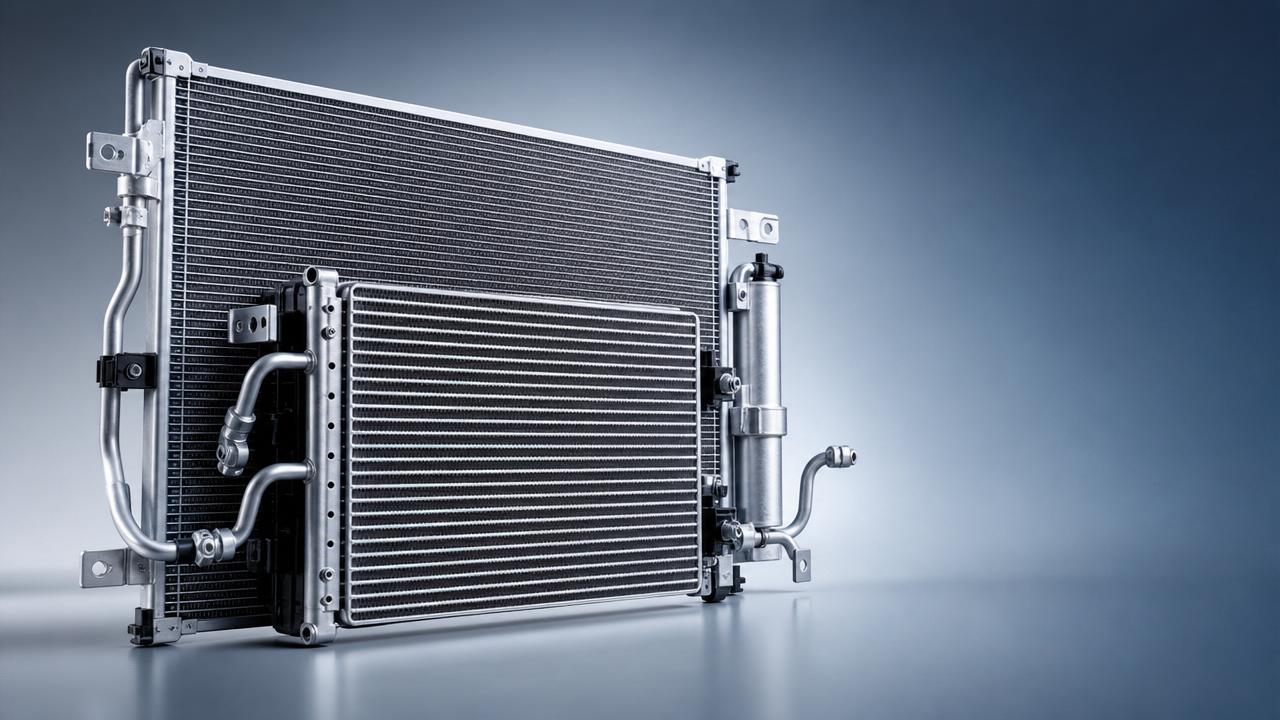
Condenser design has a direct impact on system reliability, especially in demanding automotive and heavy-duty applications. For technical evaluation, the most important choices are not cosmetic. They define thermal balance, fatigue life, leak resistance, service stability, and efficiency under real load.
In heavy trucks, construction machinery, and new energy cooling modules, a Condenser must survive vibration, pressure cycling, road contamination, and temperature swings. When design margins are weak, small flaws can become costly system failures. When engineering is right, the Condenser supports predictable performance for years.
This shift matters across the parts industry. Liaocheng Xinde Auto Parts Co., Ltd., founded in 2018, has grown around advanced radiator, intercooler, and cooling module development. Its experience reflects a wider market reality: reliability now depends on integrated thermal design, not only on nominal cooling capacity.
Why Condenser reliability is becoming a sharper engineering priority
System packaging is getting tighter, while thermal loads are increasing. Engines, hybrid systems, and electric platforms all create more demanding heat management conditions. That means each Condenser must remove heat efficiently without creating excessive pressure drop or structural weakness.
Field expectations are changing too. Fleets and equipment operators want longer service intervals, fewer leaks, and stable performance across harsh climates. A Condenser is no longer judged only by initial cooling output. It is judged by consistency over time.
At the same time, refrigerant systems are becoming more sensitive to contamination, airflow imbalance, and assembly quality. This raises the importance of design details such as alloy choice, brazing quality, fin geometry, and header strength.
The strongest trend signals come from durability failures, not lab ratings
Many Condenser issues appear after installation rather than during bench testing. Reliability risk often grows from combined stress. Thermal expansion, vibration, moisture, salt exposure, and pressure pulsation act together, not separately.
That is why high nominal heat rejection is not enough. A technically strong Condenser must maintain performance when airflow drops, ambient temperature rises, and the unit faces repeated start-stop cycles.
- Leak points often begin at joints, headers, or poorly controlled brazed areas.
- Thermal fatigue appears sooner when tube walls and fin structures are mismatched.
- Corrosion accelerates when material compatibility and coating strategy are weak.
- Blockage risk increases when internal flow paths are too restrictive.
What is driving the new Condenser design direction
The current design direction is shaped by operating pressure, lighter structures, stricter efficiency targets, and higher reliability expectations. These drivers affect product development decisions throughout the parts sector.
Material and structure choices decide whether a Condenser survives real service
Aluminum alloy selection affects corrosion and fatigue life
Most modern Condenser designs rely on aluminum for weight and thermal conductivity advantages. However, not all alloys perform equally under road salt, humidity, and vibration. Proper alloy pairing between tubes, fins, and headers helps prevent galvanic imbalance and premature degradation.
Tube design changes both efficiency and durability
Multi-channel flat tubes improve heat transfer by increasing surface area and refrigerant distribution control. Yet channel count, wall thickness, and internal geometry must match operating pressure. An over-optimized tube may cool well at first but fail earlier under pulsation.
Fin density must balance heat rejection and contamination resistance
Higher fin density can improve Condenser performance in controlled conditions. In dusty or muddy environments, it may reduce airflow over time. Reliability improves when fin pitch is selected for the actual service environment, not just for peak laboratory numbers.
Header and joint integrity remain critical
Headers, side plates, and brazed joints absorb major stress during thermal cycling. Poor stress distribution around these areas is a common source of leakage. A durable Condenser uses geometry that spreads load and supports stable braze formation.
How these design choices affect different business links
For product development, better Condenser design reduces the gap between prototype performance and field performance. Validation becomes more meaningful when simulation, material data, and fatigue testing align with application reality.
For production, tighter design tolerances mean process discipline matters more. Brazing atmosphere control, core assembly accuracy, and leak testing must support the intended reliability level. Good design cannot compensate for unstable manufacturing execution.
For aftermarket and service outcomes, a reliable Condenser lowers repeat failures, protects connected components, and improves thermal system consistency. This is especially important in heavy-duty vehicles, where downtime costs often exceed the part value itself.
- Engineering gains more value from application-specific validation.
- Production must control brazing and dimensional consistency.
- Service performance depends on anti-corrosion and anti-fatigue design.
- Brand credibility rises when failure rates stay low in harsh conditions.
What to examine first when comparing a Condenser design
A useful review starts with the relationship between heat transfer and durability. A Condenser should not be selected only by size or nominal output. The right question is whether its design can hold thermal efficiency without sacrificing structural life.
- Check alloy system and anti-corrosion strategy.
- Review tube structure, wall thickness, and channel design.
- Evaluate fin spacing for the real contamination environment.
- Confirm joint design and brazing quality requirements.
- Compare pressure cycling and vibration validation data.
- Assess airflow compatibility within the full cooling package.
In many cases, cooling package knowledge from adjacent products also matters. For example, radiator and Condenser integration principles often overlap in airflow management and structural packaging. A reference point can be RADIATOR MERCEDES-BENZ XD315, built for AT&MT applications with OEM 9425001103 and size 952*808*48.
The next reliability gains will come from system-level thermal thinking
The future of Condenser performance will not depend on one isolated parameter. Better reliability will come from coordinated design across airflow path, refrigerant routing, vibration support, coating strategy, and manufacturing repeatability.
This matters more in heavy trucks and new energy applications. Thermal modules now operate under more variable loads and stricter efficiency expectations. A Condenser that performs well only in narrow conditions will not deliver stable system behavior.
Where attention should go next
The most reliable Condenser is usually the one designed around actual use conditions, not ideal assumptions. Material strength, airflow access, contamination tolerance, and joining quality all need equal attention.
For cooling system development, the practical next step is to compare existing Condenser designs against field failure patterns. Look for recurring causes such as fin clogging, braze weakness, corrosion spots, or pressure fatigue. Those findings often reveal the most valuable design upgrades.
In a market that rewards durability and thermal efficiency, Condenser design choices are no longer secondary details. They are direct reliability decisions. Strong engineering now means choosing structures and materials that keep performance stable long after initial installation.