



Heavy duty truck radiator issues that raise repair costs
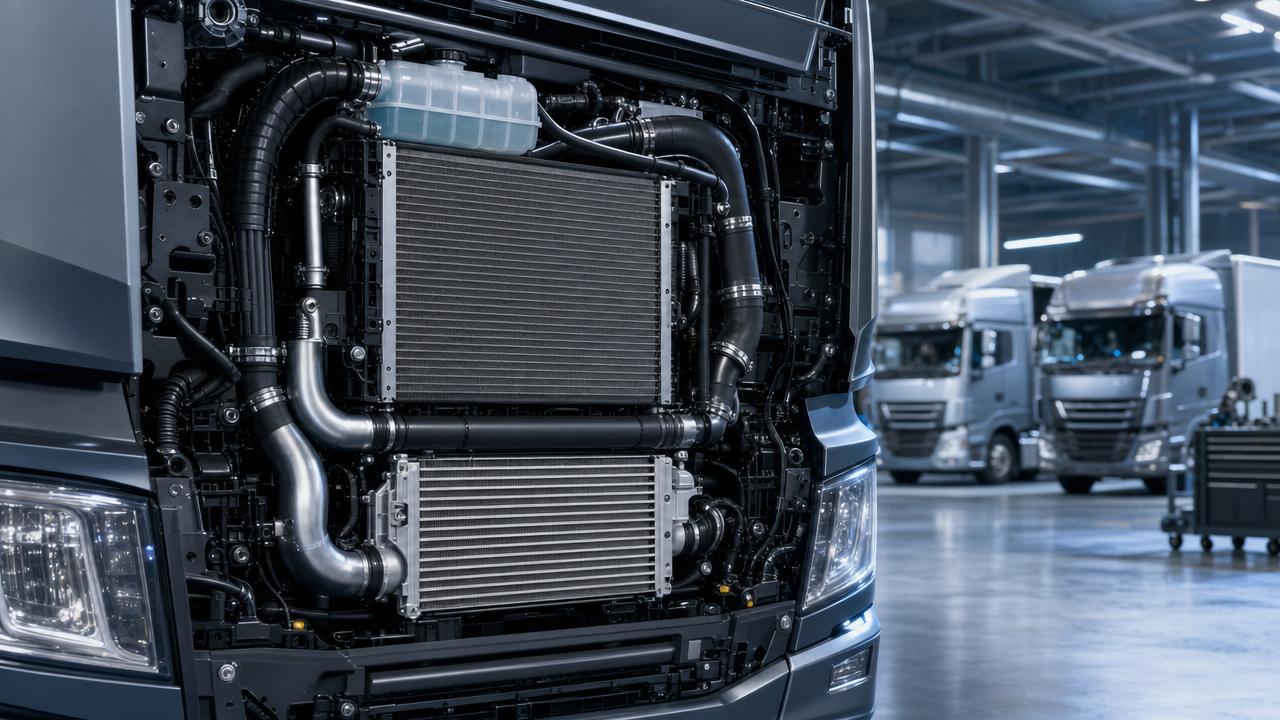
Heavy duty truck radiator issues and why costs escalate
When a Heavy duty truck radiator begins to fail, repair costs rarely stay limited to one part.
Heat imbalance affects engine efficiency, cooling pressure, hose life, turbo performance, and vehicle uptime.
In the parts industry, one radiator problem often triggers several connected maintenance events.
That is why early diagnosis matters more than delayed replacement.
A reliable Heavy duty truck radiator supports stable coolant flow, controlled operating temperature, and lower total repair exposure.
For heavy truck fleets, the true cost includes labor, downtime, roadside service, engine wear, and missed delivery schedules.
Liaocheng Xinde Auto Parts Co., Ltd. focuses on water tank radiators, intercoolers, construction machinery radiators, and new energy radiator modules.
Established in 2018, the company has expanded rapidly and earned several provincial and municipal honors in China.
This market growth reflects a broader demand for durable cooling components with dependable lifecycle value.
Basic overview of Heavy duty truck radiator failure patterns
A Heavy duty truck radiator transfers heat from coolant to ambient air through tubes, fins, and tanks.
Its performance depends on airflow, clean coolant passages, sealing integrity, and vibration resistance.
Most failures develop gradually before visible overheating appears.
Common early signs include coolant loss, rising temperature under load, external fin damage, and pressure instability.
In heavy truck applications, cooling systems work under long duty cycles and harsh road conditions.
That operating environment makes the Heavy duty truck radiator a high-impact component in maintenance planning.
Core failure mechanisms
- Internal blockage from scale, rust, or contaminated coolant
- Tube or tank leakage caused by fatigue, corrosion, or poor sealing
- Fin deformation that reduces airflow and heat dissipation
- Pressure cap or connection failure that disturbs coolant circulation
- Mounting stress and vibration damage during long-haul operation
Industry signals behind rising radiator-related expenses
Repair inflation is not driven by parts price alone.
Modern heavy trucks run hotter, carry stricter emissions systems, and depend on tighter thermal management.
As a result, a weak Heavy duty truck radiator can create broader mechanical and financial consequences.
These pressures make radiator selection and maintenance standards more important than before.
The cost drivers hidden behind common Heavy duty truck radiator issues
1. Coolant leaks that appear minor but expand fast
Small leaks often start around seams, tanks, tube joints, or hose connections.
At first, refill frequency seems manageable.
Later, coolant loss increases engine temperature swings and weakens lubrication stability.
This chain can damage head gaskets, sensors, and nearby rubber components.
2. Internal blockage that reduces heat transfer
Scale and debris narrow coolant passages inside the Heavy duty truck radiator.
The engine may still run, but cooling reserve drops during climbs, heavy loads, or hot weather.
Blocked flow also increases water pump strain and raises the risk of uneven engine temperatures.
3. Fin damage and airflow restriction
Bent fins, mud buildup, and road debris lower airflow across the core.
Even when coolant quality is acceptable, poor airflow cuts heat rejection efficiency.
That causes repeated overheating complaints and unnecessary replacement of other cooling parts.
4. Structural fatigue from vibration
Long-distance haulage creates constant vibration and chassis movement.
If the radiator core, brackets, or mounting points are weak, cracks form over time.
Repeated repair attempts rarely solve a fatigue problem permanently.
Business value of choosing the right radiator component
The right Heavy duty truck radiator lowers more than emergency replacement frequency.
It improves service predictability, protects engine assets, and supports budget control over the full operating cycle.
In parts sourcing, durability and fitment accuracy often matter more than the lowest initial unit cost.
One relevant example is XD92106 RADIATOR FOR INTERNATIONAL .
This model matches OEM 238639, 2593295C92, and 2593295C91, with a size of 725*628*65 for INTERNATIONAL applications.
Accurate dimensional compatibility helps reduce installation problems and repeat labor.
What creates lifecycle value
- Stable thermal performance under heavy load
- Consistent weld, tank, and core durability
- Reliable sealing and pressure retention
- Fitment that reduces installation adjustment time
- Supply continuity for planned replacement schedules
Typical operating scenarios where radiator issues become expensive
Each scenario can shorten the service life of a Heavy duty truck radiator if maintenance is reactive instead of preventive.
Practical steps to reduce repair costs and extend radiator life
Inspection priorities
- Check coolant level trends rather than one-time readings
- Inspect tanks, seams, and hose joints for staining or residue
- Review fin condition and remove external blockage carefully
- Monitor operating temperature under load, not only at idle
- Verify mounting integrity to limit vibration stress
Replacement planning considerations
When replacement becomes necessary, avoid selecting by price alone.
Review material quality, pressure durability, application matching, and supplier consistency.
A correctly specified Heavy duty truck radiator prevents repeated workshop visits and protects connected components.
Products such as XD92106 RADIATOR FOR INTERNATIONAL show how OEM reference alignment supports reliable fitment decisions.
Next-step focus for better cooling system control
Heavy duty truck radiator problems are rarely isolated events.
They influence engine protection, service schedules, labor efficiency, and total maintenance cost.
A strong parts strategy starts with recognizing early warning signs and choosing components built for real-duty conditions.
For more stable operating results, compare fitment data, verify OEM references, and standardize inspection intervals across the cooling system.
That approach helps keep each Heavy duty truck radiator working longer, while reducing unexpected repair escalation over time.