



Excavator Radiator Performance Gaps Between OEM and Aftermarket
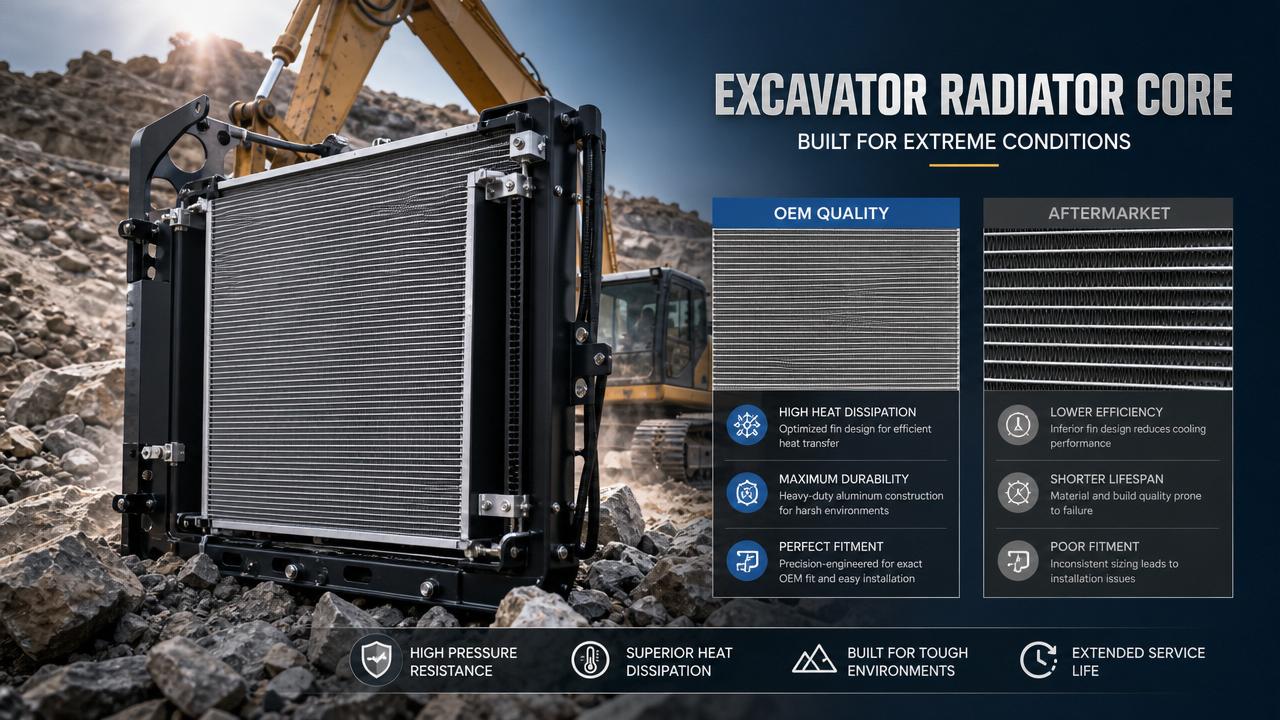
Why Excavator radiator choices matter in real operating scenes
When comparing OEM and aftermarket options, Excavator radiator performance affects uptime, fuel efficiency, repair frequency, and total lifecycle cost.
The gap is rarely visible in catalog photos. It appears under dust, vibration, heavy load, and long working hours.
For parts evaluation, the right question is not only price. The real question is fit, thermal stability, material consistency, and delivery reliability.
In demanding jobsite conditions, a weak Excavator radiator can trigger overheating, power derating, coolant loss, and unplanned shutdowns.
That is why OEM versus aftermarket should be judged by operating scene, risk exposure, and expected service interval.
Scene-based evaluation starts with workload, climate, and maintenance reality
Not every machine needs the same cooling margin. Excavators in mines, quarries, ports, and urban projects face different thermal stress.
A replacement Excavator radiator that performs well in light-duty work may fail earlier in high-dust or high-ambient conditions.
OEM units usually prioritize exact fitment, validated airflow balance, and tested corrosion resistance.
Aftermarket units vary widely. Some match OEM standards closely, while others reduce tube density, wall thickness, or fin integrity.
A sound decision requires matching the cooling component to the actual service environment, not only to the machine model number.
Typical application scenes reveal where OEM and aftermarket gaps become visible
High-dust quarry and mining scenes
These scenes demand stable airflow and strong fin durability. Dust quickly blocks weak fin structures and reduces heat exchange.
An Excavator radiator with inconsistent fin spacing may clog faster, raising coolant temperature during long cycles.
OEM products often show better brazing consistency. Better aftermarket suppliers can also reach this level with controlled manufacturing.
Hot climate and continuous-load construction scenes
In hot regions, cooling margin becomes critical. Even a small drop in radiator efficiency can push operating temperature beyond safe limits.
Here, the Excavator radiator core design matters more than listed dimensions alone. Tube layout, fin pitch, and coolant flow resistance shape performance.
Aftermarket options with lower-grade aluminum may transfer heat less consistently after repeated thermal cycling.
Urban rental fleets and mixed-brand service scenes
These scenes often balance cost control with acceptable reliability. Downtime still matters, but flexibility and availability matter too.
A qualified aftermarket Excavator radiator can offer practical value if dimensional tolerance, mounting points, and pressure testing are reliable.
This is also where supplier responsiveness becomes part of performance, because delayed replacement extends equipment idle time.
The biggest performance gaps usually come from four technical points
1. Material quality and structural durability
OEM designs typically follow stable material specifications. Better alloys support stronger corrosion resistance and improved burst strength.
In some aftermarket units, thinner tanks or lower-grade cores reduce cost but shorten service life under vibration.
2. Fitment accuracy and installation risk
An Excavator radiator must align with brackets, shrouds, hoses, and fan clearance. Minor deviation can cause stress cracks or airflow loss.
OEM parts usually minimize rework. Some aftermarket parts require hose adjustment or bracket correction, adding hidden labor cost.
3. Heat dissipation stability over time
New parts may look similar at installation. Performance differences often appear after months of load, vibration, and contamination.
A dependable Excavator radiator keeps heat transfer stable, rather than only meeting initial cooling targets.
4. Supplier consistency and traceability
The aftermarket is not one quality level. It ranges from low-cost trading stock to highly controlled manufacturing programs.
Traceable production, pressure testing, and batch control reduce procurement risk more effectively than price comparison alone.
Scene-by-scene demand differences should guide Excavator radiator selection
How to judge aftermarket value without underestimating risk
A lower purchase price does not always mean lower operating cost. Evaluation should combine technical and commercial checkpoints.
- Confirm core dimensions, mounting points, hose neck angles, and fan shroud compatibility.
- Ask for pressure test records, leak rate standards, and material information.
- Review cooling performance under comparable duty cycles, not only visual appearance.
- Check batch consistency, packaging protection, and after-sales response time.
- Estimate downtime cost if the Excavator radiator fails before the service interval target.
Cross-category cooling experience can also indicate manufacturing capability.
For example, companies producing truck and machinery cooling systems often control welding, core assembly, and durability testing more effectively.
A related example is RADIATOR FOR SCANIA , model 1776026, sized 860*928*40.
While intended for another platform, such products show whether a supplier can manage size accuracy and heavy-duty heat exchanger production.
Common misjudgments that lead to Excavator radiator problems later
One common mistake is comparing only outer dimensions. Matching length and height does not guarantee equal cooling performance.
Another mistake is assuming all aftermarket suppliers offer the same standard. Quality dispersion in this market is significant.
Some also ignore transport packaging. Fin deformation during shipping can reduce airflow before the Excavator radiator is even installed.
It is also risky to overlook local coolant quality, maintenance habits, and pressure cap condition. These factors influence radiator lifespan directly.
A final misjudgment is treating emergency replacement and planned sourcing the same way. Urgent supply needs different inventory support.
A practical selection path for better uptime and lower total cost
Start with the operating scene. Define dust level, ambient temperature, daily load hours, and acceptable downtime threshold.
Then compare OEM and aftermarket Excavator radiator options using measurable checkpoints instead of general claims.
- Classify machines by severity of use.
- Set minimum technical requirements for core structure and fitment tolerance.
- Request testing evidence and delivery assurance.
- Trial high-volume models first and track thermal performance over time.
- Build a qualified supplier list for repeat purchasing.
Liaocheng Xinde Auto Parts Co., Ltd. focuses on radiators, intercoolers, construction machinery radiators, and related heavy-duty cooling components.
Established in 2018, the company has expanded rapidly and earned multiple provincial and municipal recognitions in China.
For anyone reviewing Excavator radiator sourcing, the most effective next step is to compare drawings, test data, and scene-specific requirements together.
That approach turns radiator selection from a price decision into a controlled reliability decision.