



Custom Radiator Core Options Worth Reviewing Before Project Freeze
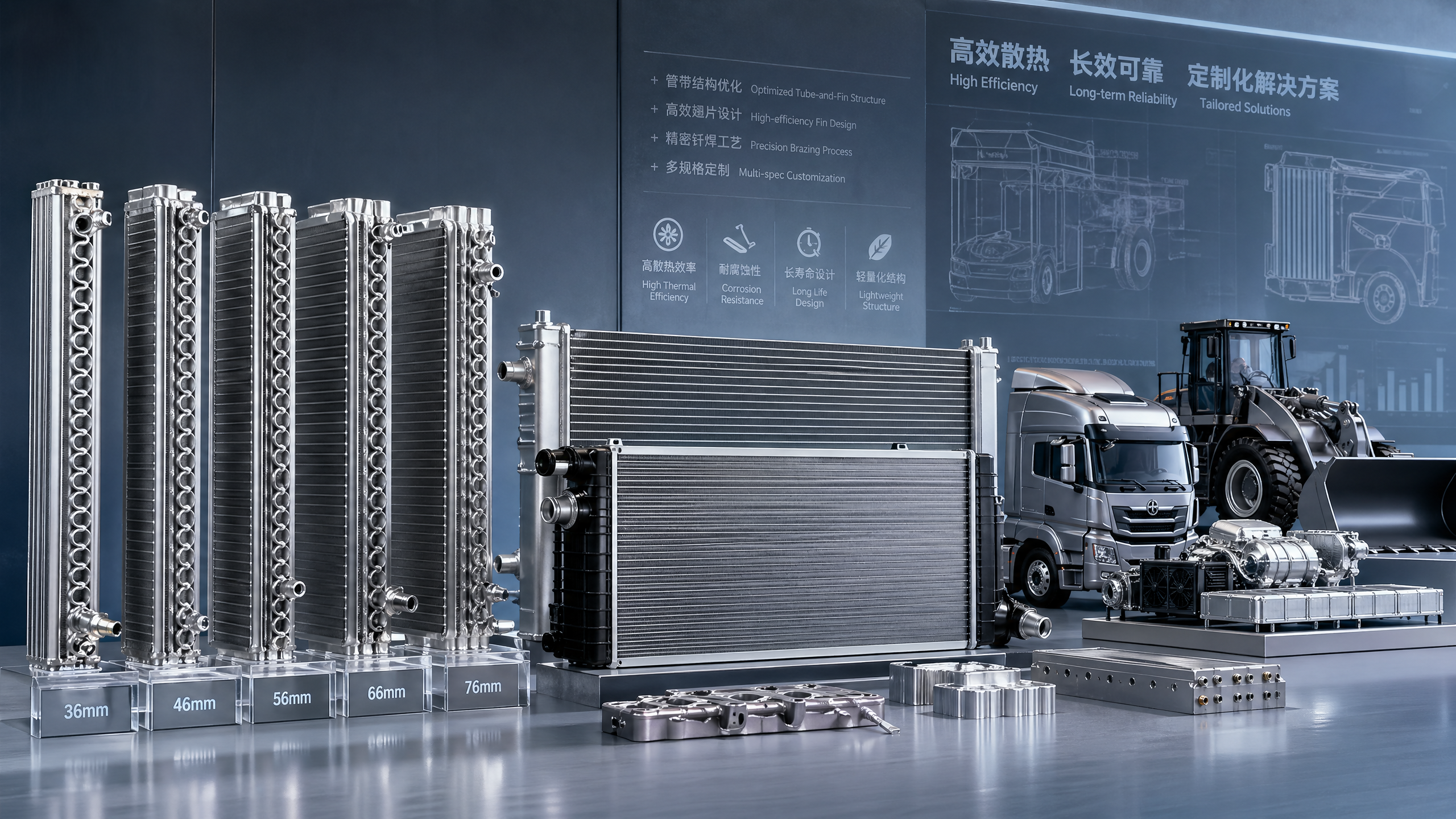
Before locking specifications and procurement timelines, project managers should take a closer look at radiator core options that can affect cooling efficiency, durability, packaging, and lifecycle cost. For heavy trucks, construction machinery, and new energy applications, the right radiator core is not just a component choice but a project risk decision. Reviewing the key variables early helps prevent redesigns, delays, and performance issues after project freeze.
Why Radiator Core Decisions Are Moving Upstream in Project Planning
A clear industry shift is underway: radiator core selection is no longer treated as a late-stage purchasing detail. In many vehicle and equipment programs, especially heavy-duty platforms, cooling module choices now enter discussion 3 to 6 months earlier than they did in more traditional development cycles. That change is driven by tighter package space, higher thermal loads, faster launch targets, and stronger pressure to avoid costly engineering change orders after design freeze.
For project managers, this trend matters because radiator core performance affects multiple systems at once. A core design decision can influence airflow resistance, fan duty cycle, coolant temperature margin, mounting architecture, vibration durability, and even supplier lead time. If the wrong radiator core is approved too quickly, the issue may not surface until prototype testing or field use, when correction costs rise sharply and timing flexibility is already limited.
The change is especially visible in three segments: heavy trucks operating under sustained load, construction machinery exposed to dust and vibration, and new energy applications where battery, motor, and power electronics cooling create more integrated thermal requirements. In these segments, a 5% to 10% difference in effective heat rejection margin can be the difference between a stable platform and repeated thermal troubleshooting during validation.
Signals project teams are seeing before freeze
The market signals are practical rather than theoretical. Programs are asking for more cooling in smaller frontal area. Procurement teams are seeing wider variation in aluminum tube and fin configurations. Engineering teams are being asked to support both standard and custom radiator core layouts across regional platforms. At the same time, operating duty cycles are becoming less forgiving, with longer idle periods, more stop-start operation, and more mixed ambient environments from -30°C winter start-up to 45°C summer load peaks.
These signals suggest that radiator core review should happen before tooling commitment, before final airflow assumptions are locked, and ideally before the validation plan is closed. A project that waits until purchasing review may already be too late to make low-cost changes.
Liaocheng Xinde Auto Parts Co., Ltd., established in 2018 with registered capital of 5 million RMB and total investment of 50 million RMB, has built its business around research, production, and global sales of water tank radiators, intercoolers, construction machinery radiators, and related components for heavy trucks and new energy radiator modules. For project teams, that type of manufacturing focus is relevant because it reflects where cooling demand is growing fastest and where customization pressure is strongest.
Early review priorities
- Confirm whether the radiator core must prioritize peak heat rejection, contamination resistance, or package depth.
- Check if the cooling module will share airflow with charge air, hydraulic, condenser, or battery cooling functions.
- Review whether the target duty cycle includes long-duration low-speed operation, because this changes the preferred core balance.
- Align engineering and sourcing on prototype timing, because custom radiator core samples may require 2 to 6 weeks depending on complexity.
What Is Changing in Radiator Core Requirements Across Applications
Radiator core requirements are evolving in ways that directly affect specification strategy. The old assumption that a larger core simply provides safer cooling is giving way to more precise optimization. Today, project teams are comparing fin density, tube geometry, brazed structure quality, coolant-side pressure drop, and air-side fouling behavior much earlier. The reason is simple: thermal targets are climbing, but available installation space often stays the same or even shrinks by 5% to 15% in platform updates.
Another notable shift is the increased use of application-specific core tuning. Heavy truck radiator core layouts often emphasize sustained thermal stability and roadside service practicality. Construction machinery may place higher value on dust tolerance and anti-vibration robustness. New energy systems increasingly require modular integration, where the radiator core is evaluated not only on raw cooling output but also on system response, weight, and compatibility with compact thermal loops.
This means there is no single “best” radiator core. There is only a best-fit choice for a defined duty profile, target life, contamination level, and package envelope. Reviewing options before project freeze allows managers to make that distinction with less schedule risk.
Typical change patterns by segment
The table below summarizes how radiator core priorities are shifting by application. It is not a universal rule set, but it helps project leaders identify where evaluation criteria are becoming more demanding.
The practical takeaway is that specification templates used five years ago may no longer be enough. A radiator core that performs well in a clean-road passenger environment may not translate to a dust-heavy machine compartment. Likewise, a conservative oversized core may protect thermal margin but create fan energy penalties or packaging conflicts elsewhere in the platform.
In some passenger vehicle applications, a compact brazed aluminum solution such as Radiator for Lynk can illustrate how packaging and thermal performance are increasingly balanced together. With aluminum construction, model 2069525700, dimensions of 83X14X58 cm, and application in an automotive cooling system for Link 06 / binyue, this type of radiator direction reflects the broader market preference for efficient thermal modules rather than simple size-based design decisions.
What project managers should ask engineering teams now
- What thermal load range was assumed: nominal, peak, or worst-case continuous operation?
- How much contamination allowance is built into the radiator core design for 6 to 12 months of field exposure?
- What pressure-drop limit can the cooling system accept before fan power or pump burden becomes a problem?
- Does the current design support cost-effective local sourcing or only one narrow production route?
The Main Drivers Behind Today’s Radiator Core Choices
Several forces are shaping radiator core decisions at the same time. The first is thermal density. Engines, power electronics, and integrated systems are generating more heat per unit space, even when overall machine dimensions do not increase. The second is platform efficiency. OEMs and equipment builders want lighter, more compact assemblies without giving up durability. The third is schedule pressure. Product development cycles in some programs are compressed to 9 to 18 months, leaving less room for late redesign.
Material and manufacturing preferences are also influencing the trend. Brazed aluminum designs remain widely favored because they support lower weight, scalable production, and effective thermal transfer. But core configuration still requires careful tuning. A design that improves heat transfer by increasing fin density may also become more sensitive to clogging or cleaning difficulty. That trade-off matters more today because field conditions are less predictable and uptime expectations are higher.
Another driver is global sourcing reality. Buyers are not only selecting a radiator core for performance; they are evaluating whether the supplier can support design iteration, sample validation, stable production, and communication across regions. When a cooling component sits on the critical path, a delay of even 2 to 3 weeks in technical clarification can affect prototype build or PPAP-style approval planning.
Driver-to-impact mapping
The following table helps translate industry drivers into decisions that project leaders can act on before project freeze.
For many teams, the strongest shift is from component-level thinking to system-level thinking. A radiator core should no longer be judged only by a catalog dimension or a single thermal point. It should be reviewed as part of the operating environment, service behavior, and project timing chain.
Common evaluation dimensions becoming more important
- Core thickness versus airflow penalty in tightly packed compartments.
- Tube-to-fin design balance for thermal performance over 1,000+ operating hours.
- Brazing consistency in applications with repeated thermal cycling.
- Repairability and service accessibility in field maintenance conditions.
How These Changes Affect Project Risk, Cost, and Supply Decisions
The impact of radiator core decisions extends well beyond engineering. For project managers, one of the biggest risks is hidden rework. If the selected core underperforms during validation, the fix may require fan recalibration, shroud changes, mounting modifications, or even front-end package updates. Those changes can affect tooling, test timing, and supplier coordination all at once. In practical terms, a design issue identified after freeze often costs far more than one found during concept review.
Cost is also changing in character. Buyers increasingly look past piece price and ask about total lifecycle implications. A lower-cost radiator core may carry higher fouling sensitivity, shorter effective service intervals, or more complex validation demands. Conversely, a better-optimized core may reduce fan workload, improve thermal stability, and lower warranty exposure over a 12-month or multi-season operating period. The important shift is that value is now measured across procurement, validation, operation, and replacement cycles.
Supply decisions are becoming more strategic as well. Teams want manufacturing partners that can support custom development, application matching, and communication on tolerance, brazing structure, and schedule feasibility. This is particularly important when a radiator core must be adapted to regional climate, local engine calibration, or machine-specific contamination levels.
Project-stage risk points to review
A stage-based review helps identify where radiator core mistakes most often become expensive. The list below can be used in internal gate meetings or supplier communication.
Risk checkpoints before and after freeze
- Concept stage: verify heat load assumptions, ambient range, and package envelope with at least one alternate radiator core direction.
- Design stage: confirm airflow path, mounting loads, and coolant-side pressure targets before final drawing release.
- Sample stage: align prototype quantity, sample build timing, and test sequence; 2 to 6 weeks is a common planning window for custom parts.
- Validation stage: test not only at nominal condition but also in dust-loaded, vibration, and temperature cycling scenarios where applicable.
- SOP preparation: verify production repeatability, packing method, and replacement part traceability.
In some automotive cooling projects, a solution such as Radiator for Lynk shows why these details matter. A brazing radiator in aluminum with a 12-month warranty profile and thermal stability focus may fit demanding driving conditions, but the real decision value comes from checking whether those attributes match the exact project environment, packaging limits, and service expectations rather than assuming cross-application equivalence.
What Project Managers Should Review Before Final Specification Freeze
The most useful response to current market change is not to delay every decision, but to review the right variables in the right order. A good radiator core review framework should combine technical fit, commercial readiness, and schedule realism. This is where project managers can add strong value: by making sure cross-functional assumptions are tested before the design becomes difficult to change.
A practical review should begin with duty-cycle clarity. Is the platform expected to work at sustained load for 4 to 8 hours per shift? Will it operate in a high-dust environment? Is low-speed airflow a dominant condition? Will the same platform serve multiple regional markets with different ambient expectations? Each of these answers changes what “good” looks like in a radiator core.
The next step is supplier-side feasibility. Can the manufacturer support custom dimensions, technical discussion, and sample turnaround without creating launch risk? Can they discuss material choice, brazed structure, application fit, and production transition in clear terms? Early clarity here often prevents the most frustrating late-stage delays.
A focused pre-freeze checklist
Use the checklist below to structure internal and supplier reviews for radiator core selection.
This kind of checklist is useful because it forces alignment between engineering, purchasing, and program leadership. A radiator core may appear technically acceptable, but if sample support, production timing, or contamination resistance remain unclear, the project still carries avoidable risk.
Signals that a design needs another review round
- Thermal simulations rely on ideal airflow assumptions with little allowance for blockage or fouling.
- The radiator core was selected from a similar project without matching duty-cycle differences.
- Prototype timing leaves no room for a second sample loop before design freeze.
- Service access or cleaning practice has not been reviewed for real operating environments.
How to Prepare for the Next Round of Cooling System Decisions
The direction of travel is clear: radiator core decisions are becoming more application-specific, more cross-functional, and more important to launch reliability. For project managers, the right response is to treat cooling hardware as a decision area that deserves early review, not late procurement cleanup. Programs that do this well usually reduce redesign pressure, improve supplier coordination, and enter validation with more realistic thermal confidence.
This is particularly relevant for companies working in heavy trucks, construction machinery, and new energy radiator modules, where the cooling environment is more complex and downtime costs are higher. Manufacturers with dedicated experience in water tank radiators, intercoolers, and related thermal components can often support more practical conversations about customization, durability, and production feasibility than a generic sourcing route.
At this stage, the best next move is to confirm your radiator core assumptions before freeze rather than defend them after testing. Even a short technical review covering dimensions, material route, duty cycle, lead time, and validation conditions can save weeks later in the program.
Why choose us
Liaocheng Xinde Auto Parts Co., Ltd. focuses on the research, production, and global sales of radiators, intercoolers, construction machinery radiators, and related cooling components for heavy trucks and new energy applications. Since 2018, the company has developed rapidly in China’s market and has received provincial and municipal honors such as High-tech Enterprise, Civilized and Honest Enterprise, and Trustworthy Unit for Consumers. For project teams, what matters most is our practical orientation toward thermal component manufacturing and application-focused support.
If you are reviewing radiator core options before project freeze, you can contact us to discuss parameter confirmation, product selection, custom solution direction, sample support, delivery cycle expectations, quotation communication, and application matching for heavy-duty or new energy cooling systems. A focused early discussion can help clarify whether your current radiator core path is ready for freeze or still needs one more round of evaluation.