



Condenser vs Radiator: Similar Appearance, Different Jobs in Thermal Management
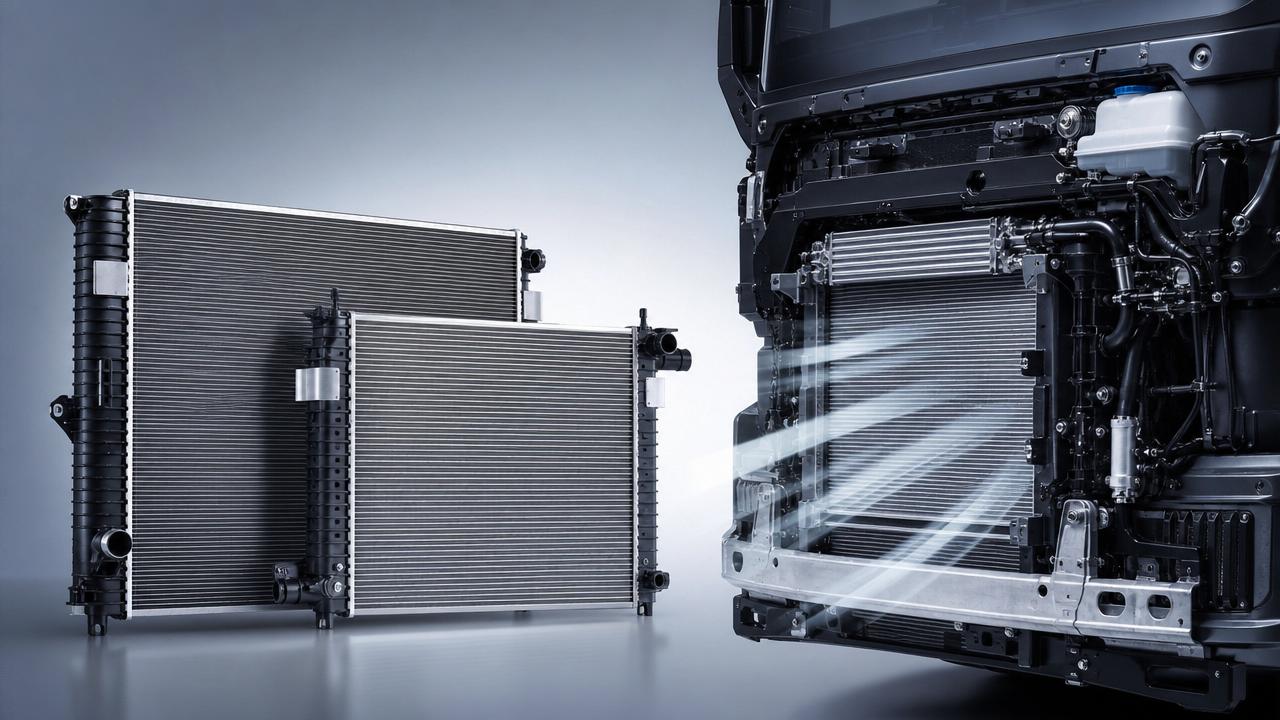
A condenser and a radiator often share a similar face: tubes, fins, tanks, and a strong dependence on airflow. Yet in thermal management, they solve different problems. That difference matters when comparing parts for passenger vehicles, heavy trucks, construction equipment, and new energy systems, because a wrong assumption at the component level can reduce cooling efficiency, raise system pressure, and shorten service life.
The topic is especially relevant in the auto parts sector, where compact packaging and rising thermal loads push every heat exchanger to work harder. In real applications, understanding how a Condenser differs from a radiator helps clarify system layout, maintenance priorities, and replacement choices rather than relying on appearance alone.
Why these two parts are often confused
At a glance, both parts look like metal cores designed to release heat into passing air. Both are mounted near the front of the vehicle in many layouts. Both use fins to enlarge surface area. That visual similarity explains the confusion.
The real distinction appears when the working fluid is considered. A Condenser handles refrigerant in an air conditioning or heat pump loop. A radiator handles engine coolant or another liquid cooling medium in a thermal circuit.
One component changes the state of the fluid as part of refrigeration. The other mainly lowers coolant temperature so heat can be carried away from the engine, battery, or power system.
The core job of a Condenser
A Condenser receives high-pressure, high-temperature refrigerant vapor from the compressor. Its task is to reject heat to ambient air until that vapor condenses into a high-pressure liquid. This phase change is central to the cooling cycle.
Because of that role, Condenser design focuses on refrigerant flow distribution, pressure resistance, leak prevention, and stable heat rejection under changing outdoor temperatures. Performance is closely tied to fin cleanliness, fan efficiency, and condenser face velocity.
If the Condenser cannot remove heat fast enough, head pressure rises. The system then works harder, cabin cooling declines, and fuel or energy consumption may increase. In severe cases, compressor stress also grows.
What a radiator is designed to do
A radiator transfers heat from hot coolant to air. In internal combustion vehicles, that coolant carries energy away from the engine block and cylinder head. In some heavy-duty or electrified systems, the radiator may also support auxiliary thermal loops.
Unlike a Condenser, the radiator usually works with liquid that stays in the same state during normal operation. The emphasis is on sustained heat removal, pressure stability, corrosion resistance, and reliable flow through the core.
Radiator performance affects warm-up control, operating temperature, emissions stability, and long-haul durability. In trucks and machinery, the margin for error can be small because loads stay high for long periods.
A practical comparison in thermal management
The simplest way to compare them is to look at system purpose, fluid condition, and operating risk. Each factor changes how the part should be selected, tested, and serviced.
This comparison shows why the phrase “they look the same” is technically incomplete. Their geometry may overlap, but their operating logic does not.
Why this difference matters more today
Thermal loads are increasing across the industry. Engines run under stricter efficiency targets. New energy platforms integrate more heat exchangers. Packaging space keeps shrinking. Under these conditions, the performance gap between a well-matched and a poorly matched component becomes more visible.
For that reason, the Condenser is no longer treated as an isolated A/C part in many programs. It interacts with fan strategy, radiator airflow, intercooler placement, and front-end module design. Air-side resistance and heat stacking can affect multiple systems at once.
This is also where manufacturing experience becomes important. Liaocheng Xinde Auto Parts Co., Ltd., established in 2018, has focused on the research, production, and global sales of water tank radiators, intercoolers, construction machinery radiators, and related modules for heavy trucks and new energy applications.
Its rapid growth and recognition as a High-tech Enterprise and Trustworthy Unit for Consumers reflect a market trend: buyers now pay closer attention to thermal system specialization, not just part interchangeability.
Where each component is commonly used
Passenger vehicles
In a conventional car, the Condenser supports cabin cooling and, in some systems, heat pump efficiency. The radiator protects engine temperature stability during traffic, highway cruising, and hot-weather climbing.
Heavy trucks
Thermal duty is heavier and operating cycles are longer. A Condenser must tolerate demanding ambient conditions, while the radiator must manage sustained load, dust exposure, and vibration without large performance loss.
Construction machinery
Restricted airflow and dirty job sites make maintenance critical. Blocked fins can harm both Condenser efficiency and radiator output, but symptoms differ. One may show poor cooling comfort, while the other leads to rising coolant temperature.
New energy platforms
The Condenser may work within a heat pump architecture, while radiator-type modules may support battery, motor, or power electronics loops. Here, system integration becomes more complex than in legacy layouts.
What to check when comparing options
A useful comparison goes beyond part shape or mounting points. Several technical details reveal whether a component is suitable for the real operating environment.
- Confirm the working medium first. A Condenser must match refrigerant type, pressure range, and sealing requirements.
- Check heat load, not just external size. Similar dimensions do not guarantee equal thermal performance.
- Review airflow interaction across the front-end stack, especially when Condenser, radiator, and intercooler share space.
- Consider corrosion exposure, fin density, and cleaning conditions in dusty or coastal environments.
- Verify durability under vibration, pressure cycling, and long operating hours.
In service markets, reference applications can also help. For example, a model-specific solution such as Radiator for Nissan may provide a clearer benchmark when assessing fitment, structure, and expected cooling behavior within a known vehicle platform.
Common mistakes in real-world evaluation
One frequent mistake is using appearance as the main identification method. A Condenser core may resemble a radiator core, but connection design, internal passage arrangement, and pressure expectations are different.
Another mistake is separating thermal parts from the full system. A stronger radiator cannot compensate for a restricted Condenser if airflow through the stack is already compromised. The reverse is also true.
It is also easy to underestimate operating context. A road vehicle, a heavy truck, and construction machinery may require very different design priorities even when the heat exchanger footprint looks close.
A clearer way to make the next decision
When evaluating a Condenser versus a radiator, start with system function, then move to fluid type, thermal load, airflow path, and durability conditions. That sequence usually prevents the most common selection errors.
If the application involves front-end packaging, heavy-duty cycles, or new energy modules, compare components as part of a thermal network rather than as separate catalog items. That approach gives a better basis for matching service life, cooling stability, and maintenance demands.
A Condenser and a radiator may share a similar outline, but their jobs are not interchangeable. A careful review of operating conditions, component data, and platform-specific references is the most practical next step before narrowing any shortlist.